







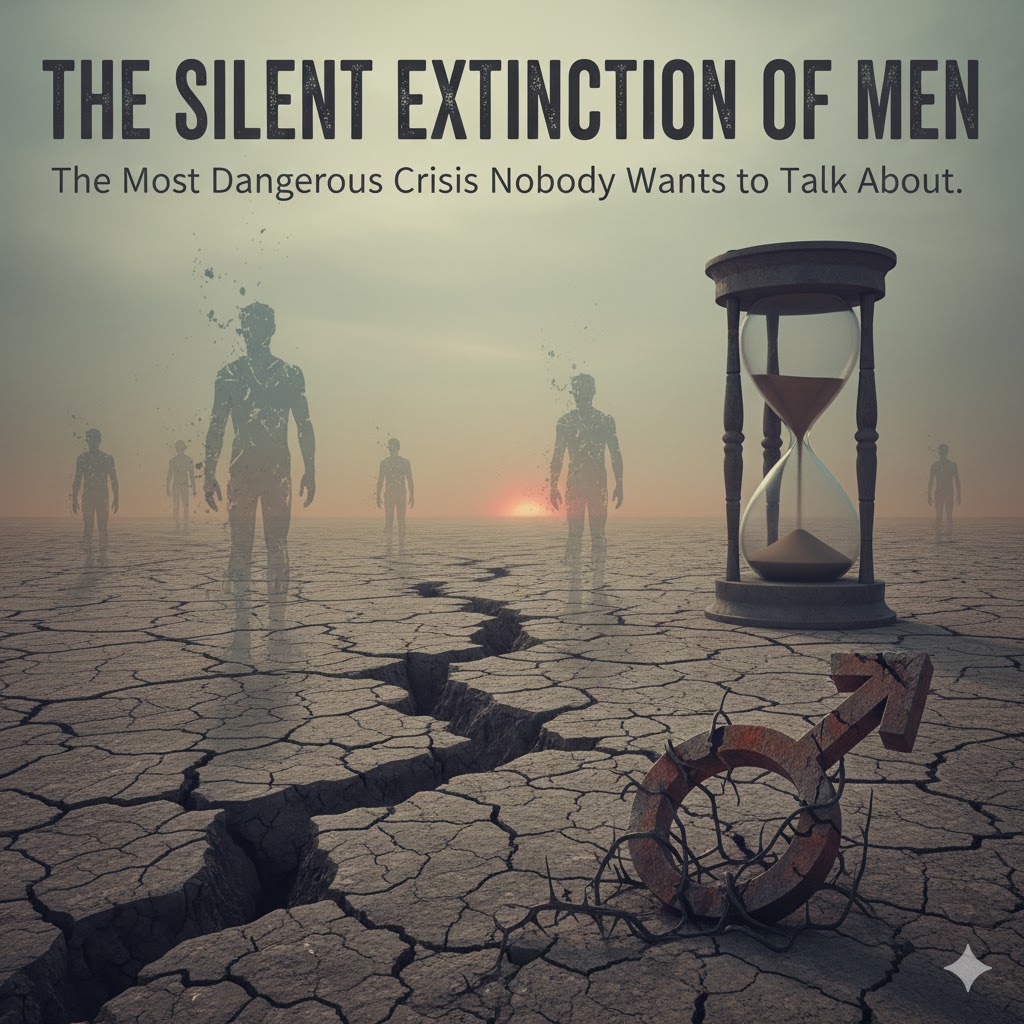
1. Introduction — The Crisis Hidden in Plain Sight
Around the world, a quiet demographic and social revolution is unfolding — one that is reshaping societies, economies, and the future of human civilization. It is not caused by war, famine, or disease. It is not visible in headlines or political speeches. Yet its consequences are already measurable and alarming:
- Men are dying younger than women in every single country on earth.
- Men are withdrawing from relationships, education, work, and community life.
- Marriage and fatherhood participation by men are collapsing.
- Male suicide rates are rising globally.
- Birth rates are falling — especially male births in some regions.
- Millions of young men no longer see a future for themselves.
This is not a metaphorical extinction.
This is a numerical, social, psychological, and civilizational disappearance of men.
What makes this crisis extraordinary is not just its severity —
but the fact that almost no government, institution, or academic body is willing to openly discuss it.
Why?
Because speaking about male decline triggers political discomfort:
- Some fear it sounds anti-woman.
- Some fear it challenges gender-equality narratives.
- Some believe men cannot be victims.
- Some assume “men have always survived — they will survive again.”
- And many simply don’t recognize how fast the situation is deteriorating.
But silence does not change reality.
The extinction of men — socially, economically, psychologically, and biologically — is one of the greatest threats to the stability of future societies. Every major societal function is affected:
- workforce
- family formation
- security
- innovation
- governance
- cultural continuity
- demographic survival
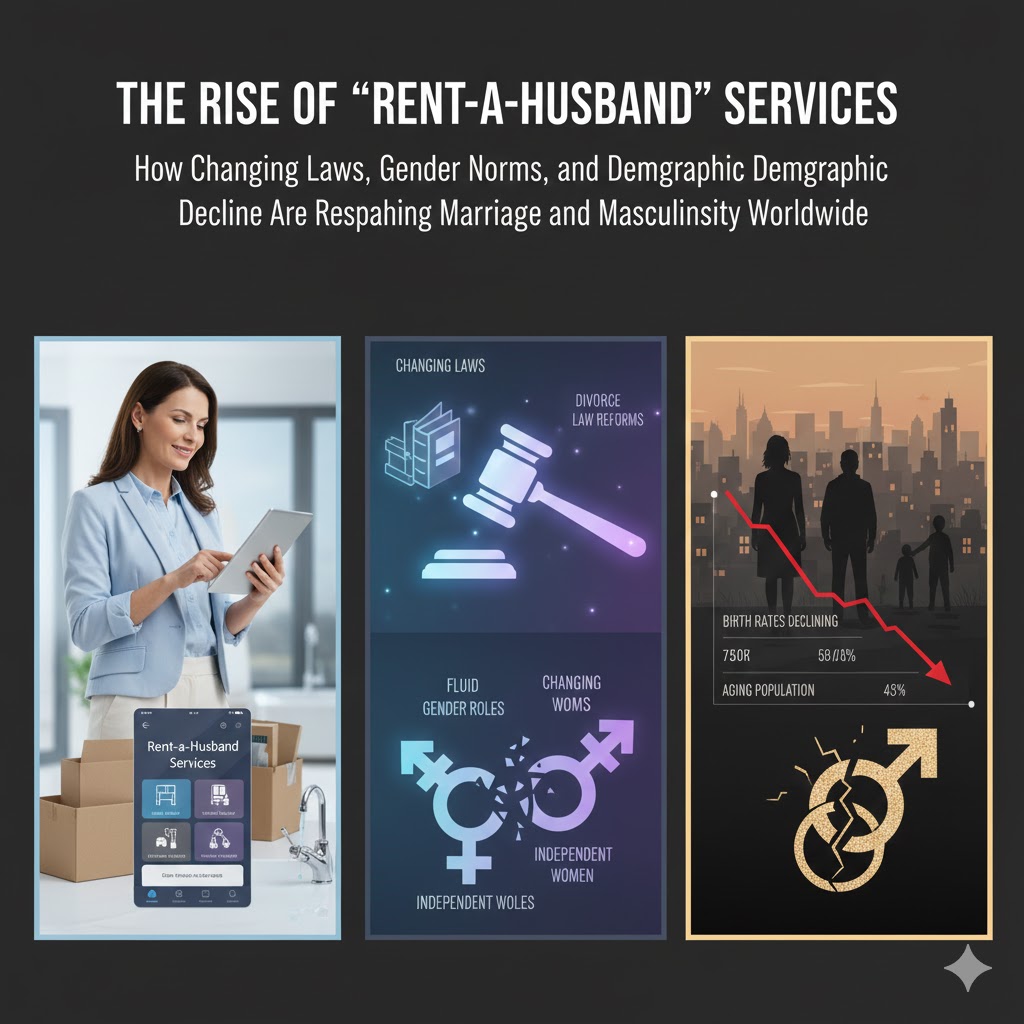
A society with disappearing men faces fertility collapse, aging populations, weakened social cohesion, higher crime, and deep loneliness across genders. Women also suffer because the absence of stable, healthy men makes long-term partnership harder, increases single-motherhood burdens, and drives industries of substituting male roles (handyman, rent-a-husband, rent-a-partner, emotional labor surrogates).
Our goal in this deep investigation is not to blame any gender but to understand the forces that are erasing men from the center of civilization — and what humanity must do to prevent irreversible decline.
This is not a “men’s rights” topic.
This is a civilizational survival topic.
With that foundation, we move to chapter two:
2. Global Male Mortality: Why Men Die Earlier Everywhere
Before social or psychological factors, the crisis begins with biology and mortality. In every country on earth:
- Men live 5 to 10 years less than women.
- Men die earlier from heart disease, accidents, workplace risk, violence, addiction, and suicide.
- Male life expectancy improvements have slowed or reversed in developed countries.
- Opioid deaths, alcohol deaths, and stress-related conditions disproportionately affect men.
Why do men die younger? Key causes:
1. Biological vulnerability
Men have higher risk of cardiovascular events and weaker immunological advantages.
2. High-risk occupations
Men overwhelmingly work in dangerous jobs:
- construction
- mining
- transport
- military
- policing
- industrial labor
Women live longer partly because they face fewer workplace risks.
3. Socialization into risk-taking
Men are culturally rewarded for:
- physical risk
- emotional suppression
- “toughness”
- not seeking help
This leads to delayed medical treatment and chronic stress.
4. Mental health and suicide
In many countries, men are 3–5 times more likely to die by suicide.
This is a catastrophic and silent epidemic.
The combination of shorter life spans, high mortality, and high suicide risk means:
Millions fewer men physically exist in society compared to women in comparable age groups.
This imbalance becomes even more severe in countries with:
- war
- migration
- economic instability
- addiction epidemics
- collapsing industrial jobs

3. Social Withdrawal of Men — The New Male Disappearance
The extinction of men is not only biological.
A more dramatic and less visible crisis is occurring at the social level: men are withdrawing from society itself.
In country after country, across cultures and economic systems, a pattern is visible:
- Men are leaving schools.
- Men are leaving the workforce.
- Men are leaving relationships.
- Men are leaving marriage.
- Men are leaving communities.
- Men are leaving fatherhood.
- And some are leaving reality altogether.
This is not laziness or moral failure — it is a structural collapse of male purpose and identity in modern society.
Let us break down the forces driving this withdrawal.
3.1 The Hikikomori Model Goes Global: Men Retreating Into Rooms
The world first noticed extreme male withdrawal in Japan under the name Hikikomori — young men isolating themselves completely, sometimes for years.
But this pattern is no longer a Japanese phenomenon:
- South Korea
- United States
- United Kingdom
- China
- Canada
- Southern Europe
- Eastern Europe
All report rising numbers of men who have given up on social life.
Why do they withdraw?
1. Economic humiliation
Societies still measure male worth by:
- income
- job status
- ability to provide
When men cannot meet these expectations, they withdraw out of shame.
2. Failure in the mating market
Men who cannot “compete” economically or socially often stop trying.
Dating becomes:
- expensive
- competitive
- psychologically painful
Many men decide the emotional cost is not worth it.
3. Digital alternatives
The digital world replaces real interaction:
- gaming
- online communities
- adult content
- virtual relationships
- AI companionship
These environments offer low-risk stimulation without fear of rejection.
4. Social anxiety and fear of judgment
Modern culture heavily scrutinizes male behavior — often with harsh consequences.
Fear of rejection, accusations, or social missteps causes some men to retreat.
5. Loss of community structures
Traditional male bonding networks have collapsed:
- guilds
- workplaces
- religious groups
- extended families
- neighborhood communities
Men are now more isolated than ever.
3.2 The Declining Male Presence in Public Life
Look at any public institution — educational, cultural, professional — and one trend is obvious:
Men participate less.
In education:
Men are disappearing from classrooms. Women earn:
- ~60% of university degrees in the UK & US
- The majority of master’s degrees
- The majority of professional degrees in many fields
Boys are falling behind as early as primary school.
In relationships:
Men are less likely to:
- date
- marry
- form long-term bonds
- become fathers
Many men express that the risks of relationships outweigh the rewards.
In workforce participation:
In the US, male labor force participation is at a 75-year low.
Millions of working-age men are:
- unemployed
- not seeking work
- living with parents
- dependent on government support
This is unprecedented in peacetime.
3.3 Why Women Notice This Crisis Before Men Do
Women observe this withdrawal directly:
- fewer men ready for partnership
- fewer men emotionally available
- fewer men stable enough for marriage
- fewer men confident enough to pursue relationships
- fewer men willing to take the risk of partner-based legal consequences
This leads to:
- rising loneliness for both genders
- rent-a-husband services
- rent-a-boyfriend companionship agencies
- handyman gig roles replacing husband labor
- emotional labor markets replacing male presence
- women choosing single motherhood or no motherhood
The cycle feeds itself.
3.4 The Internal Collapse of Male Purpose
Perhaps the deepest issue is existential:
Men can survive without society,
but societies cannot survive without men.
Yet modern culture increasingly treats men as:
- optional
- burdens
- threats
- replaceable
- unwanted
- irrelevant
This messaging — repeated over decades — has consequences.
A man who believes he is not valued begins to:
- disengage
- retreat
- stop trying
- detach from ambition
- detach from community
- detach from life
This is not a momentary trend; it is a fundamental shift in human civilization.
3.5 The Two Types of Disappearing Men
There are two distinct categories of withdrawn men:
1. The Invisible Poor Man
- lacking income
- lacking purpose
- living in isolation
- no relationships
- no children
- no social mobility
These men suffer quietly, unseen and unsupported.
2. The Autonomous Lone Wolf Man
- financially comfortable
- disillusioned with modern relationships
- prefers freedom and control
- avoids legal risk
- avoids emotional dependency
- replaces female companionship with casual or digital alternatives
These men voluntarily disengage.
The combination of both groups accelerates the demographic and social disappearance of men.
3.6 Consequences of Male Withdrawal for Society
The disappearance of men has cascading effects:
1. Declining marriages
Partnership becomes rare and transactional.
2. Falling fertility
Without male participation, birth rates collapse.
3. Expanding loneliness
Women face a shortage of emotionally stable partners.
Men face isolation, meaninglessness, and depression.
4. Economic stagnation
Societies lose male labor, innovation, and productivity.
5. Rise of “replacement industries”
- rent-a-husband
- rent-a-friend
- emotional companionship
- male handyman services
- male escorts (non-sexual and social)
These industries fill vacuum left by missing men.
6. Collapse of fatherhood
Millions of children grow up without fathers, repeating the cycle of instability.
3.7 This Is Not Men’s Fault — It Is a System Design Failure
Modern society was built for:
- industrial labor
- clear gender roles
- strong communities
- stable marriages
- predictable economies
None of these conditions exist anymore.
Men have lost:
- their roles
- their purpose
- their incentives
- their social status
- their expected futures
And no new model has replaced the old one.
The system is failing men — not the other way around.




4. Economic Displacement — Why Modern Economies No Longer Need Men the Way They Used To
One of the deepest and least discussed forces behind the “silent extinction of men” is economic displacement.
For thousands of years, society was structured around male physical labor, male risk-taking, male defense, and male breadwinning.
Men’s identities were tied to:
- providing
- protecting
- building
- fighting
- working with strength
- taking responsibility
But in the 21st century, the global economy has shifted in a way that systematically removes men from their traditional economic purpose.
The result?
Millions of men feel economically useless — and once a man loses economic usefulness, he begins to disappear socially, psychologically, and demographically.
Let’s break down how this happened.
4.1 The Death of Industrial Labor — The End of the Traditional Male Job
For centuries, economies depended on male-heavy industries:
- manufacturing
- mining
- construction
- shipbuilding
- steelwork
- railroads
- agriculture
- energy extraction
These fields required:
- strength
- endurance
- physical risk tolerance
- mechanical skill
- group labor
- discipline
They also created male bonding environments, stable wages, and clear identity.
But between 1980 and 2020, in country after country:
- factories closed
- automation replaced repetitive labor
- globalization moved production overseas
- unions dissolved
- wages stagnated
- male employment collapsed in industrial towns
Entire male-dominated economic ecosystems vanished almost overnight.
What replaced them?
4.2 The Rise of Services and Knowledge Economy (Which Favors Women)
The modern economy rewards:
- communication
- emotional intelligence
- organization
- customer interaction
- multitasking
- detail orientation
- compliance
- social awareness
- digital coordination
These are skills where women consistently outperform men, both biologically and educationally.
Service sectors (which dominate modern economies) include:
- healthcare
- education
- administration
- retail
- HR
- hospitality
- finance
- customer support
- social work
- corporate compliance
These are often female-majority sectors, which absorb women more readily than men.
Men who lose industrial jobs struggle to transition to these roles because:
- the work is emotionally demanding
- roles require soft skills
- wages are lower
- jobs feel “unmasculine”
- credentials and degrees are required
Thus, millions of men are left economically stranded.
4.3 Automation: Technology Replaces the Physical Strength of Men
Automation doesn’t replace all workers equally.
It primarily replaces men because men historically held physical jobs:
- robots replace factory workers
- machines replace miners
- trucks will soon replace drivers
- drones replace soldiers
- AI replaces technical support and logistics
- automated warehouses replace loaders
- self-checkout replaces retail clerks
Every wave of automation disproportionately removes male-dominated work.
4.4 The New Economy Rewards Flexibility, Not Loyalty
Male success in the past was built on:
- stability
- long-term employment
- loyalty
- predictable career paths
But the modern gig economy rewards:
- freelancing
- contracting
- short-term assignments
- task-based labor
Men who once built lifelong careers now bounce between unstable jobs.
When economic identity is unstable, psychological identity collapses too.
4.5 Education: Men Are Falling Behind, Women Are Surging Ahead
In nearly every developed country:
- Women earn more degrees than men
- Women outperform men academically from age 5 onward
- Women dominate graduate education
- Men drop out of school more often
- Boys receive more behavioral punishments
- Men engage less in academic and cognitive skills development
The modern economy is built on credentials and knowledge, and women are winning.
This educational gap translates into:
- women out-earning men until mid-30s
- men marrying later (if at all)
- fewer men qualifying as “financially attractive partners”
- rising female frustration
- rising male detachment
Without educational competitiveness, men become economically obsolete.
4.6 Feminization of Workplaces
Modern workplaces prioritize:
- emotional sensitivity
- communication
- equality ideology
- HR compliance
- collaborative environments
This can feel alien to many men who grew up with:
- stoic norms
- competitive socialization
- hierarchical structures
- physical skill identity
The workplace is no longer built around traditional masculinity.
Men feel out of place, and women feel more at home.
4.7 Economic Displacement → Social Withdrawal → Demographic Collapse
These forces combine into a vicious cycle:
Step 1: Men lose traditional economic roles
Factories close, automation increases, degrees become necessary.
Step 2: Men lose social status
Income no longer supports courting, marriage, or parenting expectations.
Step 3: Men withdraw
Without economic purpose, men retreat from dating, marriage, work, and ambition.
Step 4: Women cannot find stable partners
This increases demand for:
- emotional outsourcing
- rent-a-husband
- paid companionship
- sperm donation
- single motherhood
- independence over partnership
Step 5: Fertility collapses
Without stable male participation, birthrates fall.
Step 6: Society weakens economically and demographically
A shrinking workforce and aging population create permanent decline.
This is already happening in:
- Japan
- South Korea
- China
- United States
- United Kingdom
- Italy
- Spain
- Germany
- Eastern Europe
Economic displacement is the engine behind male extinction.
But identity loss is the fuel.





5. Collapse of Marriage and Fatherhood — Men Losing Their Social Identity
If economic displacement weakens a man’s outer purpose, the collapse of marriage and fatherhood destroys his inner identity.
Throughout human civilization — from tribal societies to modern industrial nations — men have primarily derived meaning from two roles:
- Husband
- Father
These roles gave men purpose, stability, dignity, and motivation.
They also created interdependence between men, women, and children — forming the foundation of family, community, and civilization.
But in the 21st century, something extraordinary and historically unprecedented is happening:
Marriage is collapsing.
Fatherhood is collapsing.
And with them, the male identity itself is collapsing.
Let’s break down why.
5.1 Marriage Has Become a High-Risk, Low-Reward Decision for Many Men
In country after country, marriage statistics reveal the same trend:
- Men are marrying later.
- Men are marrying less.
- Millions of men will never marry in their lifetime.
Why?
A. Legal and financial risk perception
Men often perceive marriage as a gamble where:
- divorce may lead to loss of property
- long-term alimony obligations
- loss of child custody
- high child support payments
- reputational damage
- mental stress
Even when laws vary by country, the global male psychological perception is similar:
“Marriage is a trap; divorce will destroy me.”
Perception drives behavior more than law itself.
B. Rising expectations from women
Women’s standards for partnership have risen—rightfully—due to:
- financial independence
- higher education
- career success
- cultural empowerment
But this means many women expect:
- emotional maturity
- financial stability
- strong communication
- domestic contribution
- romantic investment
- social awareness
These expectations are reasonable, but many men feel:
- unable to meet them
- intimidated by them
- unprepared for them
- judged by them
This results in avoidance rather than improvement.
C. Social pressure and public shaming of male mistakes
In modern dating culture:
- a man’s misstep can go viral
- dating behavior is scrutinized by peers
- social media creates reputational risk
- accusations (true or false) carry heavy consequences
Men become reluctant to engage in emotionally vulnerable interactions.
5.2 Fatherhood Collapse: Men Are Disappearing from the Family Structure
Once men stop entering marriages, fatherhood naturally declines.
Globally:
- Millions of men have no children.
- Millions have lost custody of their children.
- Millions are prevented from regular visitation or parental roles.
- Many are paying but not parenting.
- Some have children they never meet.
Why fatherhood is collapsing
A. Legal and cultural structures disadvantage paternal custody
In many countries, including Western ones:
- mothers receive primary custody ~80–90% of the time
- fathers fight lengthy legal battles for visitation
- fathers fear losing rights in event of divorce
This leads some men to ask:
“Why become a father if I can lose my child so easily?”
B. Economic unpreparedness
Men without stable incomes delay fatherhood.
C. Social stigma against struggling fathers
Men who fail financially or emotionally are seen as:
- irresponsible
- inadequate
- unattractive
- disposable
This discourages paternal goals.
D. Women choosing single motherhood
Many women now choose to raise a child alone or with donor sperm, bypassing men entirely.
This normalizes the idea that:
“Fathers are optional.”
This is devastating to male identity.
5.3 The Death of the Traditional Social Contract
For thousands of years, the male role in family formation was simple:
- Man provides.
- Woman nurtures.
- Both raise children.
Not perfect, but stable.
Today:
- women provide for themselves
- economic pressure weakens provision roles
- emotional labor expectations have increased
- legal systems penalize paternal failure
- men feel disposable
- women prefer independence over unreliable partners
Thus the social contract collapses.
The new social message is:
“Men are needed physically less, emotionally more — and many can’t adapt.”
5.4 Women Are Not Benefiting Either — They Are Becoming Overburdened
Contrary to simplistic belief, the decline of men harms women too:
- fewer responsible partners
- fewer emotionally mature men
- fewer stable marriages
- rising single motherhood
- increased loneliness
- higher mental load
- difficulty finding long-term support
- increased demand to outsource male roles (rent-a-husband, handyman services, emotional companionship)
Women are not rejecting men; they are rejecting unstable men.
And the more unstable men become, the more women turn to independence.
But independence leads to:
- collapsing fertility
- fragmented families
- rising loneliness
- economic overwork
- emotional exhaustion
Both genders lose.
5.5 Children Are the Greatest Victims
Fatherless children face:
- higher dropout rates
- higher crime involvement
- higher depression
- lower economic mobility
- lower educational performance
- weaker emotional development
- identity issues, especially boys
A society where fatherhood collapses becomes:
- weaker
- more violent
- less stable
- less productive
- emotionally fragile
Children need fathers not for ideology, but for psychological structure.
5.6 The Rise of Substitute Male Roles
As husbands and fathers disappear, new industries arise to replace them:
- rent-a-husband
- handyman services
- professional companions
- rented boyfriends
- AI boyfriends
- emotional support workers
- donor sperm clinics
The male role is being unbundled and sold in pieces:
- emotional support → paid companions
- practical repairs → handymen
- financial support → the state
- procreation → sperm donors
- protection → private security
Men are vanishing from families,
and being replaced by markets.
5.7 Without Marriage and Fatherhood, Men Lose Their Anchoring Identity
A man without:
- purpose
- partner
- children
- economic usefulness
eventually loses:
- motivation
- ambition
- direction
- responsibility
- mental stability
This is exactly what we see globally.
5.8 Summary of the Collapse
Marriage → collapsing
Fatherhood → collapsing
Masculine identity → collapsing
Male purpose → collapsing
Male mental health → collapsing
This is the heart of the silent extinction.





6. Education Crisis — Boys Falling Behind Worldwide
If the extinction of men were only biological or economic, it could still be explained as a transitional phase of modernity.
But there is a deeper and far more concerning layer to this crisis:
Boys are falling behind in education across nearly the entire world.
The next generation of men is emerging weaker, less educated, and less competitive than the generation before them.
This collapse begins in early childhood and continues through adulthood.
It affects every class, race, culture, and economic environment.
The educational decline of boys is not an isolated phenomenon — it is one of the structural roots of men’s disappearance from relationships, work, family life, and society.
Let’s examine this crisis in detail.
6.1 Boys Are Behind Before School Even Begins
A shocking but well-documented reality:
Girls develop faster socially and cognitively in early childhood.
Research consistently shows:
- Girls have better verbal skills earlier
- Girls develop self-regulation faster
- Girls adapt to structured environments more easily
- Boys show more behavioral difficulties
- Boys engage in more physical and impulsive behavior
Modern education systems emphasize:
- sitting still
- following rules
- verbal communication
- compliance
- emotional awareness
- cooperative learning
These are female-leaning skills.
As a result:
Boys enter school at a disadvantage in the very skills most rewarded in early education.
6.2 Boys Receive More Punishment and Less Support
Across multiple countries:
- Boys are far more likely to be suspended
- Boys receive more detentions
- Boys are diagnosed with behavioral disorders more often
- Boys are labeled “problematic” earlier
- Boys are less likely to receive emotional support from teachers
This creates a psychological loop:
“School is not for me.”
“I’m not good at this.”
“I don’t belong here.”
By middle school, the boy has mentally checked out.
6.3 Academic Performance Gap: Girls Outperform Boys Globally
Around the world, in nearly every subject except some areas of math:
- Girls earn higher grades
- Girls complete homework more consistently
- Girls outperform boys in reading, writing, and language
- Girls have higher classroom participation
- Girls are more organized and disciplined
This is not because boys are less intelligent —
but because the system rewards traits that girls biologically and socially develop earlier and more reliably.
By high school, girls dominate academic success.
6.4 Boys Are Dropping Out at Higher Rates
Boys are:
- more likely to repeat a grade
- more likely to drop out
- less likely to graduate
- less likely to attend university
- less likely to finish university
- significantly less likely to pursue advanced degrees
In many Western countries, women now make up:
- 60% of college enrollment
- 70% of master’s programs
- A rising share of professional schools (medicine, law, business)
The next generation of leaders, professionals, and high-status individuals is increasingly female.
Men are watching from the margins.
6.5 University Is Becoming Male-Unfriendly
Universities today reward:
- verbal expression
- emotional articulation
- risk-avoidance
- compliance
- reading/writing-heavy coursework
- collaborative learning
- social sensitivity
These align naturally with female developmental patterns.
Men, especially those who struggle, often find:
- no male mentors
- no male teachers
- no male-friendly fields besides engineering
- no social belonging
- no academic identity
Many drop out or never enroll.
6.6 Student Debt + Lower Male Degree Rates = Economic Disadvantage
Women earn more degrees → qualify for better jobs.
Men earn fewer degrees → stuck in low-skill, unstable work.
Consequences:
- Men are less “marriageable” economically.
- Women cannot find equal or higher-status partners (hypergamy effect).
- Men withdraw from dating due to low economic status.
- Fertility collapses because fewer stable families form.
This reinforces every other dimension of male extinction:
- work withdrawal
- social withdrawal
- marriage collapse
- fatherhood decline
6.7 The Psychological Damage of School Failure
A boy who spends 12 years failing in school learns something devastating:
“I am not capable.”
Girls emerge:
- confident
- academically strong
- socially supported
Boys emerge:
- insecure
- disillusioned
- disconnected
- resentful
- ashamed
- directionless
This psychological damage is carried into adulthood.
6.8 The Education Crisis → Workforce Crisis → Relationship Crisis → Fertility Crisis
The chain of consequences looks like this:
Step 1: Boys fall behind in school
Low self-esteem and poor academic performance.
Step 2: Men enter adulthood with fewer skills
Lower income, unstable jobs.
Step 3: Women outperform men economically
Dating imbalance, partnership breakdown.
Step 4: Men avoid marriage and fatherhood
Fear of inadequacy + legal/economic risks.
Step 5: Women can’t find suitable partners
Leading to independence or single motherhood.
Step 6: Fertility collapses
Nations shrink.
Step 7: Society enters demographic decline
Aging population, collapsing workforce, weakening national power.
This entire chain begins in elementary school, when boys first hear:
“Sit still.”
“Stop talking.”
“Why can’t you be more like the girls?”
It is not men who are failing education;
it is education that is failing men.
6.9 Why This Crisis Is Ignored
Talking about boys struggling is politically sensitive because:
- it challenges certain gender narratives
- it disrupts the belief that “women always struggle more”
- it implies men need support (rarely acknowledged)
- it contradicts the idea that men have structural advantages
But the data is clear:
Boys and men are the most educationally disadvantaged group in the developed world.
Ignoring this is not equality —
it is negligence.
7. Mental Health Emergency — Suicide, Depression, Addiction, and the Emotional Breakdown of Men
If the economic, educational, and relational collapse of men explains why men are disappearing from society, the mental-health crisis explains how many men disappear from themselves.
Across countries, cultures, and continents, the data reveals one tragic truth:
Men are experiencing a mental-health emergency unlike anything in modern history.
Yet society almost never treats it as a crisis.
Men die younger.
Men suffer silently.
Men break alone.
Men self-destruct in ways society barely acknowledges.
This section explores the psychological dimension of the silent extinction.
7.1 Suicide: The Most Omitted Statistic in Gender Discussions
The single most alarming metric:
Men are 3 to 7 times more likely to die by suicide than women, depending on the country.
This is not a small gap.
This is a catastrophic gender disparity.
In many Western nations:
- 75% of suicides are men
- Middle-aged men have the highest suicide rates
- Young men (18–30) are entering the fastest-growing suicide-risk group
Why does society ignore this?
Because male pain is:
- less visible
- less discussed
- less validated
- less socially acceptable
- often masked as anger or withdrawal
Women attempt suicide more often.
Men complete it more often.
Why?
Because men choose violent methods — a sign of deep internal collapse.
7.2 Depression in Men: The Hidden Illness
Men are less likely to be diagnosed with depression, not because they suffer less, but because:
- men do not express sadness in “socially recognizable” ways
- men do not seek therapy early enough
- men mask emotional pain as anger
- men do not want to appear weak
- men fear social judgment
- men internalize problems until breaking point
Thus male depression looks different:
- irritability
- rage
- withdrawal
- emotional numbness
- risky behavior
- sleep dysfunction
- quiet self-destruction
Traditional diagnostic criteria often fail to detect this pattern.
7.3 Addiction: The Silent Escape
Men are far more likely to fall into addictive behaviors:
- alcohol abuse
- drug addiction
- pornography addiction
- gambling
- video game dependency
- workaholism
- digital isolation
Addiction becomes:
- a temporary relief
- a substitute for emotional connection
- a coping mechanism for unaddressed trauma
- a shield from relational expectations
- a barrier preventing self-improvement
Millions of men quietly slide into addictive loops that take away years of life.
7.4 Loneliness: The Deepest Wound Men Carry
Women still maintain friendships, social circles, and emotional support systems.
Men do not.
Studies show:
- Most men have zero close friends.
- Many men have no one to call in crisis.
- Married men rely entirely on their partner for emotional support.
- Single men rely on no one at all.
Loss of shared spaces — clubs, unions, teams, communities — has left men emotionally adrift.
Loneliness is not a feeling; it is a health threat comparable to:
- smoking
- obesity
- chronic disease
When men socially disappear, they emotionally disappear long before they physically die.
7.5 Shame Culture: Why Men Suffer in Silence
Modern society sends contradictory messages to men:
- “Open up about your feelings.”
- “But don’t be needy or weak.”
- “Be vulnerable.”
- “But don’t burden us with your emotions.”
- “Share your struggles.”
- “But don’t fail.”
This produces internal conflict:
Men WANT to express pain.
But they BELIEVE they’re not allowed to.
Society empathizes with women’s struggles openly.
Men are expected to:
- endure
- ignore pain
- be providers
- be strong
- suppress emotion
- never break
This emotional suppression becomes toxic over years.
7.6 The Masculinity Paradox: Expected to Be Strong, Blamed for Being Strong
Men are told:
- “Traditional masculinity is toxic.”
- “Men need to change.”
- “Men must be emotionally open.”
Simultaneously:
- Men are still expected to be financially dominant
- Men are judged if they fail at provision
- Men are socially penalized if they express vulnerability
- Men are blamed collectively for the actions of a few
This paradox leads to psychological paralysis:
“I cannot be the traditional man society rejects.
But I cannot become the modern man society demands.
So I become nothing.”
7.7 The Collapse of Male Purpose Is Psychological
Men throughout history found identity in three places:
- Their work
- Their role in family
- Their community contribution
All three have weakened:
- Work is unstable (gig jobs, automation, layoffs)
- Marriage is risky and declining
- Community ties have dissolved
A man without purpose becomes:
- depressed
- directionless
- anxious
- isolated
- emotionally numb
And when thousands or millions of men lose purpose at once…
Civilization begins to lose stability.
7.8 Why This Mental-Health Crisis Is Political Dynamite
Governments, universities, activists, and media platforms avoid discussing male mental health because:
- it challenges gender-power narratives
- it contradicts the belief that “men always have privilege”
- it requires investment in male-specific solutions
- it is uncomfortable to acknowledge male vulnerability
- it would force policy change
- it opens debates about marriage, fatherhood, and gender roles
- it invites philosophical questions about the future of masculinity
But ignoring this crisis will not make it disappear.
If half of a population is emotionally collapsing,
the entire society collapses with them.
7.9 The Most Tragic Outcome: Men Don’t Believe They Matter
The deepest wound in men today is the belief that they are unnecessary:
- unnecessary as providers
- unnecessary as protectors
- unnecessary as fathers
- unnecessary as partners
- unnecessary in school
- unnecessary in the workplace
- unnecessary in society
This is the psychological root of male extinction.
A man who believes he is unnecessary stops trying.
A society that believes men are unnecessary stops surviving.


9. Political, Economic, and Civilizational Consequences of Fewer Men
If men continue to disappear—economically, socially, psychologically, and demographically—the impact will not be limited to individuals or families.
The consequences will reshape entire nations, global economies, and the future stability of human civilization.
The collapse of male participation is not a private tragedy.
It is a civilizational transformation.
Here is what happens when men decline at scale.
9.1 Economic Consequences: When Men Stop Working, Nations Stop Growing
Modern economies rely on:
- male labor
- male innovation
- male entrepreneurship
- male-dominated industries (construction, engineering, energy, transportation)
- male demand for housing, cars, and durable goods
When men withdraw:
A. Economic productivity collapses
Millions of men leaving the workforce leads to:
- slower growth
- shrinking GDP
- increased welfare burden
- lower tax revenue
- rising inequality
A nation with millions of idle men becomes economically fragile.
B. Innovation declines
Historically, men drive the majority of technological innovation (not for superiority reasons, but for sociological ones):
- willingness to take risk
- dopamine-driven reward-seeking
- desire for legacy
- competitive impulse
When men lose purpose, innovation slows dramatically.
C. Skilled labor shortages emerge
Male-heavy industries are hit hardest:
- construction
- electrical work
- plumbing
- manufacturing
- transportation
- security
- military industries
Infrastructure begins to decay because fewer young men enter these fields.
D. Housing markets crash long term
Fewer marriages = fewer families = fewer homebuyers.
This leads to:
- declining real estate markets
- aging homeowners with no buyers
- weakened local economies
9.2 Political Consequences: Societies Become Unstable When Men Disappear
A. Rise of political extremism
Men without purpose become vulnerable to:
- radical ideologies
- online extremist groups
- conspiracy movements
- anti-social communities
These groups offer the one thing men lack:
identity.
B. Decline of national defense and security
Armies are overwhelmingly male.
When:
- men stop joining
- birth rates fall
- physical standards decline
a country cannot defend itself.
Nations with fewer men must:
- import soldiers
- rely on allies
- weaken militarily
This changes geopolitical power balances.
C. Instability caused by male surplus or deficit
- In some countries, not enough men leads to family collapse.
- In others, too many single men leads to unrest and crime.
Both are dangerous.
D. Collapse of civic participation
Men historically fill roles like:
- firefighters
- police
- community leaders
- local governance
- emergency responders
Withdrawal reduces the resilience of society.
9.3 Social Consequences: The Fabric of Society Tears Apart
A. Rise of transactional relationships
With fewer men in stable relationships:
- companionship becomes a service
- emotional support becomes paid labor
- romantic presence becomes rented
- physical tasks become outsourced
Society transitions from relationship-based to service-based.
B. Women carry double the burden
With fewer reliable partners:
- women work full-time
- women raise children alone
- women pay for help
- women face loneliness
- women face burnout
This affects mental health and economic outcomes for women too.
C. Rise of loneliness epidemics
Both men and women experience chronic loneliness when men withdraw.
Loneliness increases:
- depression
- anxiety
- early death
- substance abuse
- suicide
- social distrust
Loneliness destroys societies as effectively as war.
D. Parenting crisis
With fewer fathers:
- children lack role models
- boys lack masculine identity development
- girls grow up without positive male presence
- behavioral disorders rise
- academic outcomes drop
This creates a self-reinforcing cycle of future male collapse.
9.4 Cultural Consequences: Masculinity Loses Meaning
When men lose identity, culture follows:
A. Masculine archetypes disappear
Historically, men saw themselves as:
- protectors
- builders
- providers
- leaders
- mentors
- innovators
Modern culture has no clear replacement roles for men.
B. Male shame becomes cultural norm
Men are increasingly told:
- they’re toxic
- they’re unnecessary
- they’re privileged even when they’re suffering
- they’re dangerous even when they’re harmless
- they’re obsolete even when they want to contribute
This destroys morale.
C. Decline of art, philosophy, and creativity
Male-driven creative fields — music, literature, architecture, philosophy, engineering — weaken when men lose purpose.
D. Rise of gender resentment
When men feel unvalued and women feel unsupported, neither gender trusts the other.
This creates culture wars, bitterness, and social fragmentation.
9.5 Civilizational Consequences: Nations That Lose Men Lose the Future
History shows:
- civilizations decline when birth rates collapse
- empires fall when men stop defending or building them
- cultures fade when men withdraw from family life
- economies stagnate without motivated men
- social order breaks down when male purpose disappears
This is not about male domination —
it is about gender complementarity.
Without strong, stable men in society:
- families weaken
- communities break
- children struggle
- economies shrink
- cultures lose continuity
- nations become dependent
- civilizations fade
This is the trajectory we see today.
9.6 The Silent Extinction Is Not Just a Male Crisis — It Is a Societal Collapse
Women are not replacing men.
Women are overburdened because men are disappearing.
Children are not thriving; they are growing up in emotional scarcity.
Governments cannot compensate; welfare systems already strain.
Economies cannot adapt fast enough.
Societies built on interdependence collapse when one half of the social engine collapses.
The disappearance of men is not a gender issue.
It is a civilizational emergency.





10. Why Nobody Talks About This Issue — The Social, Political, and Ideological Silencing of Male Decline
Despite being one of the most consequential crises facing human civilization, the decline and disappearance of men remains one of the least discussed, least researched, and least acknowledged issues of our time.
This silence is not accidental.
It is produced by a combination of political pressures, ideological discomfort, cultural misunderstandings, and institutional blind spots.
To understand the “silent extinction of men,” we must understand why the silence exists at all.
Let’s break it down.
10.1 The Political Fear: Talking About Men Is Seen as a Threat to Women’s Progress
For decades, global political discourse has focused on:
- women’s rights
- gender equality
- workplace discrimination
- reproductive autonomy
- representation
These are important and legitimate issues.
But as women have advanced, an unintended side effect emerged:
Any discussion of male suffering is interpreted as an attack on female progress.
Politicians fear:
- losing support if they appear “pro-male”
- being accused of undermining gender equality
- facing backlash from activist groups
- being misunderstood in media
As a result, governments avoid male issues entirely.
You will find:
- women’s ministries in many nations
- but almost no men’s ministries anywhere
- gender policies centered almost entirely on women
- little-to-no research funding on male mental health, fatherhood collapse, or male education decline
The extinction of men is politically radioactive.
10.2 Academia Avoids Male Issues Because They Challenge Ideological Frameworks
Universities often operate under ideological paradigms such as:
- “men are the privileged class”
- “gender inequality always harms women”
- “male problems are consequences of patriarchy”
These frameworks struggle to explain:
- male academic decline
- male suicide epidemics
- collapsing male fertility
- men’s economic displacement
- fatherhood absence
- men withdrawing from society
- male loneliness
To acknowledge male suffering would require:
- rewriting gender theory
- rethinking educational structures
- revising sociological assumptions
- confronting uncomfortable truths
Many academics simply avoid the topic because it does not “fit” existing ideological models.
Thus:
The largest gender crisis in history receives the least scholarly attention.
10.3 Media Narratives Prefer Simple Stories, Not Complex Realities
Media thrives on:
- villains
- victims
- conflict
- easy narratives
For decades, the default narrative has been:
“Women are victims. Men are advantaged.”
But the real world today is more complex.
Men are:
- worse off in education
- worse off in mental health
- worse off in suicide
- worse off in homelessness
- worse off in employment decline
- worse off in family courts
- more likely to die young
- more likely to live alone
- more likely to die without children
These facts disrupt the tidy narrative.
Thus, mainstream media rarely covers:
- male loneliness
- male depression
- male withdrawal
- male unemployment
- male invisibility
When men collapse, the media usually frames it as:
- a cultural joke
- a lifestyle choice
- “incel problem”
- “men being lazy”
- “toxic masculinity backlash”
These shallow explanations hide deeper structural collapse.
10.4 Social Pressure: Men Are Expected to Suffer Silently
From childhood, men are told:
- “Don’t cry.”
- “Be tough.”
- “Handle it.”
- “Solve your own problems.”
- “Don’t show weakness.”
Men internalize this:
“My suffering doesn’t matter.
I am not allowed to complain.”
So even when men struggle with:
- depression
- loneliness
- unemployment
- relationship collapse
- fatherhood loss
- stigma
- shame
they rarely speak up.
If men do speak up, society often responds with:
- ridicule
- minimization
- blame
- accusations of privilege
- assumptions of incompetence
Thus men stop talking, and their crisis becomes invisible.
10.5 Gender Activism Punishes Conversations About Male Decline
Some activist environments aggressively reject discussions of male suffering because they see it as:
- derailing women’s issues
- distracting from feminist goals
- reinforcing patriarchal narratives
- creating sympathy for the “privileged group”
Thus activists often shut down:
- studies about male suicide
- proposals for boys’ education reforms
- fatherhood support programs
- discussions of collapsing male fertility
- male-specific mental health campaigns
Men become the only gender not allowed to have problems.
This creates:
- institutional silence
- cultural silence
- policy silence
- academic silence
All surrounding a crisis visibly worsening every year.
10.6 Economic Incentives: Industries Benefit from Male Absence
Few people consider how profitable the disappearance of men is.
Entire industries rely on men not being present in families:
- childcare services
- home repair services
- rent-a-husband platforms
- emotional companionship services
- security sectors
- social work and therapy industries
- the gig economy
- donor sperm banks
- pharmaceutical industries (ADD meds, depression meds, erectile dysfunction meds)
A society with strong, healthy, stable men is less profitable than a society filled with:
- broken families
- emotionally struggling individuals
- lonely adults
- overworked single parents
- outsourced domestic services
Thus, there is no financial incentive to restore male stability.
Broken men generate more revenue than stable men.
10.7 Cultural Shaming: Talking About Male Problems Is Socially Unacceptable
When women talk about their struggles, society empathizes.
When men talk about their struggles, society often:
- mocks
- dismisses
- invalidates
- blames
- shames
- ignores
People accuse men of:
- exaggerating
- seeking attention
- being weak
- deflecting responsibility
This emotional double standard silences male suffering.
10.8 The Most Dangerous Reason: Society Doesn’t Believe Men Can Collapse
There is a subconscious belief:
“Men always survive.
Men always adapt.
Men are strong.
Men don’t break.”
But this belief is wrong.
Men DO break.
And when they break, civilizations break with them.
Historically, societies survived because men:
- built
- protected
- reproduced
- led families
- sustained labor-intensive industries
When men withdraw from these roles, collapse follows.
10.9 The Extinction of Men Is Hard to See Because It Happens Slowly
Unlike war or natural disasters, male extinction is:
- gradual
- silent
- hidden in data
- hidden in everyday decisions
- hidden in schools
- hidden in households
- hidden in loneliness
- hidden in empty cradles
- hidden in low marriage rates
- hidden in men’s quiet suffering
It happens one man at a time, quietly, invisibly.
By the time society notices, it will be too late.
10.10 Summary: Why the Silence Is Dangerous
The extinction of men is not discussed because:
- it disrupts political narratives
- it challenges academic ideology
- it threatens media simplicity
- it breaks cultural expectations
- it lacks institutional advocacy
- it has no financial incentive for solution
- it forces society to confront its own failures
But ignoring a crisis does not stop it.
Silence accelerates it.
Conclusion — The Crisis We Refuse to See
The silent extinction of men is not merely a demographic anomaly or a momentary social trend. It is a civilizational emergency unfolding in slow motion. Yet the most alarming aspect of this crisis is not the data itself — collapsing male mental health, declining marriage and fatherhood, falling fertility, educational failures, unemployment, addiction, loneliness, and rising suicide.
The greatest danger is our refusal to acknowledge it.
Across governments, media, academia, and public discourse, a wall of silence surrounds male decline. Political leaders avoid the issue, fearing ideological backlash. Universities ignore it because it contradicts long-held gender theories. Media narratives oversimplify gender dynamics, unwilling to portray men as vulnerable. Activist cultures shame or dismiss any discussion of male suffering. And men themselves — conditioned to remain strong, silent, and emotionally unseen — rarely voice their struggles.
Thus, an enormous global crisis grows unchecked precisely because it is invisible in conversation, stigmatized in policy, and forbidden in ideology.
We live in a time where every social group has recognized rights, advocacy, and representation — except the group that is collapsing the fastest. Men are dying younger, living lonelier, working less, learning less, dating less, marrying less, reproducing less, and finding fewer places in society where they feel valued.
Yet society continues as if nothing is happening.
This silence is catastrophic. A civilization cannot survive when half of its human foundation erodes. Families cannot stabilize. Economies cannot grow. Nations cannot defend themselves. Communities cannot hold together. Children cannot thrive. And women — despite gaining independence and equality — cannot build sustainable futures in societies where men have lost purpose, identity, and hope.
A society that refuses to acknowledge the suffering of its men ultimately destroys the well-being of everyone within it.
The extinction of men is not a “men’s issue.”
It is a human issue, a family issue, a national issue, and a civilizational issue.
If the world continues to ignore it, the consequences will be irreversible.
The first step toward saving men — and saving civilization — is breaking the silence.
Only when we speak openly about male decline can we begin to imagine solutions, rebuild stability, reform systems, and restore the dignity and purpose that men have lost.
The survival of society depends on it.


