






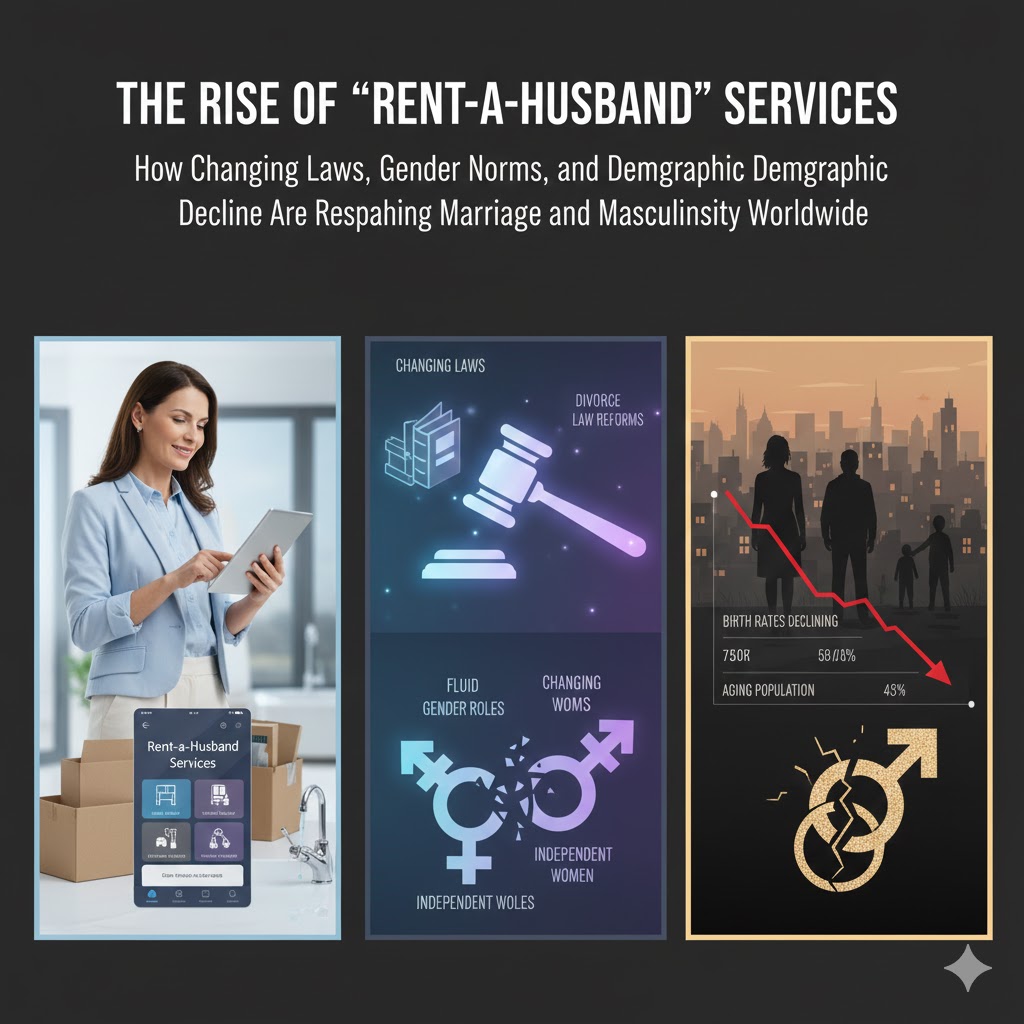
Across the world, a quiet but profound social transformation is unfolding—one that challenges our assumptions about marriage, gender roles, emotional connection, and even the structure of human society itself. In cities from Riga to Tokyo, London to Seoul, a growing number of women are turning to “Rent-a-Husband” handyman services, male companionship platforms, and paid intimacy substitutes for tasks and emotional support once supplied by long-term partners.
What might seem like a quirky lifestyle trend is, in reality, a symptom of deep structural shifts:
- declining marriage rates
- demographic collapse
- soaring loneliness
- increasing legal and financial risks associated with marriage
- widespread male withdrawal from traditional roles
- economic independence of women
- and the rapid expansion of the gig economy into the domain of human relationships
This emerging ecosystem of rented masculinity—ranging from practical home-repair help to non-sexual companionship and “rental families”—is not the cause of social change but the mirror reflecting the pressures shaping 21st-century life.
In many societies, men face legal and financial systems where marriage carries high potential costs: property division, child-support obligations, long-term alimony, reputational risk, and strict domestic-violence frameworks that, while essential for protection, can create perceptions of vulnerability among some men. Simultaneously, women, now more economically independent than any previous generation, often choose professional stability over traditional partnerships; when they need a masculine role fulfilled—whether emotional presence, heavy lifting, furniture assembly, social accompaniment, or safety—they can simply buy it from the marketplace.
At the same time, the global loneliness epidemic has produced unprecedented demand for emotional labor. In Japan, agencies rent husbands, brothers, fathers, and entire families; in Europe, “handy husbands” fill the practical gaps of single living; in America and the UK, “rent-a-friend” and “professional companion” services have quietly become mainstream. What used to be social networks and intimate relationships is now increasingly facilitated by paid human substitutes—a trend that may foretell the future of intimacy itself.
Taken together, these phenomena reveal a deeper story:
The traditional foundation of human society—stable partnerships, reciprocal gender roles, and interdependent households—is dissolving, and in its place is emerging a system where relationship functions are outsourced, gig-based, and commodified.
This study does not judge these developments; instead, it seeks to understand them. Why are people opting out of marriage? Why are basic household and emotional needs moving into the market? Why is masculinity being repackaged as a rentable service? And most importantly, what does this mean for the future of human relationships, family formation, and social cohesion?
In the chapters ahead, we will examine demographic, legal, cultural, psychological, and economic forces across multiple societies to understand how and why this shift is happening globally—and what the world may look like if these trends continue.



Global Comparative Deep Dive
To understand why “Rent-a-Husband” and male companionship services are emerging worldwide, we must examine each region’s unique demographic realities, legal structures, cultural shifts, and gender dynamics. The rise of rented masculinity is not a single story—it is a network of intertwined pressures, shaped differently in each society. Some nations struggle with severe male shortages due to emigration and mortality; others face marriage laws that discourage partnership formation; some wrestle with loneliness epidemics caused by hyper-individualism; others confront cultural expectations that no longer align with modern economic or emotional realities. By exploring each country and region, we can uncover the deeper forces dissolving traditional family structures and pushing people toward transactional solutions for emotional and domestic needs.
2.1 Latvia and Eastern Europe: The Perfect Storm of Demographic Collapse, Gender Imbalance, and Social Fragmentation
Why we begin with Latvia
Latvia is one of the clearest examples of how severe demographic decline, a shrinking male population, and economic migration produce a fertile environment for “Rent-a-Husband” handyman services and masculine role outsourcing. What looks like a quirky trend is actually a rational response to serious structural issues.
A. Demographic Collapse: When a Country Shrinks Faster Than It Can Recover
Latvia has one of the fastest-shrinking populations in the world.
Since the early 1990s:
- Over a quarter of the population has disappeared.
- Massive emigration followed EU membership in 2004.
- Young men left in disproportionately high numbers.
- Birth rates remain among the lowest in Europe.
- Male life expectancy remains significantly lower than female life expectancy.
This creates a gender imbalance in major cities:
- Fewer men in marriageable age groups
- Women disproportionately single
- Difficulty forming stable long-term partnerships
The outcome is not merely social—it is structural.
Where men are scarce, their household labor becomes scarce, too.
Women—especially single, divorced, elderly, or working professionals—still need:
- furniture assembled
- appliances repaired
- shelves installed
- snow removed
- safety-related tasks handled
- a physically present figure for certain errands or situations
This demand naturally produces:
Rent-a-Husband handyman services — not as luxury, but necessity.
B. Economic Migration: The Export of Young Men
A defining reality across Eastern Europe:
- Millions of young, working-age men emigrated to richer EU countries.
- Latvia, Lithuania, Poland, Romania, and Bulgaria all experienced this.
- Many never returned.
- Those who stayed often face unstable employment or health issues.
Women, who tend to migrate less, are left behind with:
- jobs
- children
- households
- aging parents
But without male partners performing traditional household tasks.
Thus, practical masculinity becomes:
- outsourced
- marketed
- gig-based
- fragmented
- transactional
C. Changing Gender and Legal Structures
Eastern Europe transitioned rapidly:
- from traditional patriarchal households
- to highly liberalized Western legal frameworks
- with European Union standards on gender equality, domestic-violence laws, and property rights
For men who grew up in traditional settings but live under modern EU legal structures, marriage appears increasingly risky.
Some perceive:
- financial vulnerability
- reputational risks
- lack of bargaining power in divorce
- stringent domestic-violence frameworks (including preventive detentions)
- child custody uncertainty
This perception—not always the statistical reality—shapes behavior.
Men avoid long-term commitments.
Women become more economically independent and self-reliant.
But the household tasks remain.
So:
The market steps in where relationships step out.
D. The Rise of “Husband for Hire” as a Cultural Phenomenon
The branding itself is revealing.
A “Rent-a-Husband” service signals:
- reliability
- trust
- accountability
- blended domestic + masculine roles
- non-romantic male presence
- low emotional cost compared to partnership
Many women prefer:
- pay for a service
- get the job done
- no emotional baggage
- no negotiation
- no dependence
- no power imbalance
In a shrinking society with social fragmentation, this becomes not just practical—but emotionally safer.
E. Emotional Outsourcing in Eastern Europe
Although less developed than in Japan, emotional outsourcing is rising:
- divorced women hire male companions for events
- elderly women hire men for safety walks or errands
- young professionals hire non-sexual companions for social functions
- social isolation increases with migration and urban anonymity
Traditional extended families have collapsed.
Church-based communities weakened.
Modern social networks are fragile.
Thus, emotional labor—formerly free—becomes paid.
F. What Latvia Teaches Us About the Future
Latvia is a preview of global trends:
- Demographic decline => marriage decline => relational outsourcing
- Male scarcity => higher demand for masculine labor => gig services
- Economic migration => social atomization => loneliness industries
- Modern legal systems => cautious men => fewer marriages
- Female independence => less tolerance for partner dysfunction => on-demand male services
Latvia is not an outlier.
It is simply ahead in the demographic timeline.
Japan, Korea, Italy, Spain, and even the United States are moving in the same direction.




2.2 Japan — The World’s Laboratory for Rented Intimacy, Surrogate Families, and the Outsourcing of Masculine Roles
If Latvia shows us how demographic decline and migration pressures can create demand for “Rent-a-Husband” handyman services, Japan shows us what happens when an entire society systematically replaces emotional, familial, and social bonds with paid substitutes.
Japan is not merely a participant in the global outsourcing of masculinity — it is the world’s most developed ecosystem for rentable husbands, fathers, boyfriends, brothers, friends, and even entire families.
Where Eastern Europe commercializes practical masculine labor, Japan commercializes emotional and relational labor at a level unmatched anywhere else on Earth.
Japan is a window into the future — a society where traditional relationships have collapsed so deeply that new markets arise to sell human presence itself.
A. Japan’s Marriage Collapse: The Social Earthquake That Created a New Industry
Japan has one of the lowest marriage rates among developed nations.
Some core realities:
- 1 in 4 men in their 50s has never married.
- Women delay marriage until mid-30s or avoid it entirely.
- Fertility has fallen to the lowest level in Japanese history.
- Married couples often live emotionally distant, with separate finances and obligations.
- Many women prefer career and autonomy to traditional marriage.
- Many men feel unable to fulfill idealized husband/father roles.
Marriage, once the foundation of Japanese society, is now:
- financially risky
- emotionally demanding
- socially optional
- legally constrained
- economically inefficient for many individuals
Thus, marriage becomes a declining institution — and the vacuum is filled by paid substitutes for husband-like roles.
B. Why Japan Became the Capital of Rented Companionship
Japan’s companion-rental industry is not caused by one factor.
It is the result of a perfect convergence of social forces:
1. Chronic Loneliness & Social Isolation (Hikikomori)
Japan has millions of socially withdrawn men — some who do not leave their rooms for months or years.
Isolation is not fringe; it is a visible societal phenomenon.
2. Extreme Work Cultures
Long work hours reduce time for relationships.
Overworked men have little energy for emotional investment.
Women, frustrated by absent husbands, seek connection elsewhere.
3. Gender Norms Frozen in the Past
Women are highly educated and professionally active,
yet marriage expectations remain deeply traditional:
- woman cooks
- woman cares for children
- woman leaves job
- man works endlessly
This contradiction makes marriage unattractive to many.
4. Legal/Financial Pressures
Family courts, custody systems, and alimony structures create perceptions of risk for men — similar to concerns emerging in Western nations.
5. Declining Fertility & Fewer Children
Without children, future generations lose built-in social networks.
6. Safety, anonymity, and cultural politeness
Renting a companion in Japan carries less stigma, because the culture frames emotional needs as practical rather than shameful.
The result?
Japan pioneered industries that fill emotional and relational voids.
C. The Categories of Rented Masculinity in Japan
Japan offers the most diverse catalogue of male role-outsourcing services in the world.
1. Rental Boyfriend / Husband Services (Non-Sexual Emotional Support)
Clients (primarily women) hire men for:
- dinners
- walks
- conversations
- emotional support
- attending funerals or ceremonies
- playing the role of boyfriend or husband in social situations
Payment is for time, presence, and emotional labor — not romance.
2. “Rental Family” Companies
Some agencies offer:
- a rented father
- a rented grandfather
- a rented brother
- even a rented entire family unit
Clients use this for:
- social appearances
- school interviews
- emotional comfort
- loneliness
- family reconciliation events
- escaping stigma (single mothers hire a rental husband for school meetings)
Japan’s deeply image-conscious culture fuels this demand.
3. The “Do-Nothing Man” Phenomenon
One of Japan’s most globally famous services:
A man who does nothing except be physically present.
Clients rent him for:
- eating together
- sitting quietly
- walking
- listening without judgment
This popularity reveals a profound truth:
Many people do not want a partner.
They want presence without obligation.
4. Elderly Women Hiring Husbands for Safety
Japan’s elderly women, often widowed or single, hire men to:
- accompany them outside
- attend social gatherings
- help with chores
- provide emotional reassurance
The aging population creates this market.
5. Handyman + Emotional Hybrid Roles
A hybrid model: men perform practical tasks while offering conversation and companionship.
This combines the Latvian handyman with the Japanese emotional rental model.
D. Japan’s Shrinking Male Population and High Male Non-Participation
Japan’s male social retreat intensifies demand for male role outsourcing.
Male issues include:
- fear of failure in relationships
- inadequate wages for family support
- social anxiety
- low confidence
- hikikomori withdrawal
- low libido or lack of romantic interest
- preference for digital relationships
As Japanese men retreat from traditional roles,
women and older citizens fill the gap by paying the market to provide masculinity.
E. Gender, Law, and Marriage Risk in Japan
Like many countries, Japan’s legal structure makes marriage a heavy responsibility:
- men are traditionally expected to be sole financial providers
- divorce can involve significant long-term obligations
- child custody almost always favors mothers
- visitation rights for fathers are limited
- long-term alimony can be imposed
- high social expectations add pressure
A man must be financially “ready” to marry —
but with stagnating wages and rising costs, fewer men qualify.
Thus:
Marriage becomes a luxury,
while masculine functions become a service.
F. Japan as a Warning for the World: The Future of Relationships
Japan is about 10–20 years ahead of other developed economies in demographic decline, loneliness, and relationship restructuring.
What Japan faces today, many countries will face tomorrow:
1. Marriage becomes optional and risky
People choose independence or transactional arrangements.
2. Emotional labor becomes commodified
Presence itself becomes a paid service.
3. Household labor becomes outsourced
Men’s practical roles shift from husband → handyman.
4. Loneliness becomes normalized
Paid companionship replaces organic relationships.
5. Fertility collapses
Japan’s fertility rate is the lowest in its history — a preview for Europe and East Asia.
6. Traditional masculinity becomes fragmented
Different parts of the husband role become separate gigs:
- emotional listener → rental companion
- social husband → rental boyfriend
- father figure → rental family
- fixer/repair role → handyman
- safety provider → bodyguard companion
Marriage used to bundle all these roles into one relationship.
Now each role is divided into separate purchasable functions.
G. The Deeper Lesson: Japan Shows Us the End Stage of Relationship Marketization
Japan demonstrates:
- what happens when work culture destroys social time
- what happens when marriage laws fail to adapt to gender equality
- what happens when emotional needs go unmet
- what happens when a country ages rapidly
- what happens when fertility collapses
- what happens when men exit society en masse
- what happens when women gain full autonomy but lose social partnership options
Japan is not “weird” or an outlier —
Japan is a preview of the global future.
Where Latvia shows the beginning of relational outsourcing,
Japan shows the final form:
A society where relationships are replaced not by robots or AI,
but by paid human substitutes filling fragmented emotional and domestic roles.




2.3 South Korea — When Partnership Collapses Under Economic Pressure and Social Withdrawal
South Korea represents one of the most acute—and instructive—cases of contemporary relationship breakdown. It combines extreme economic pressures on young people, deeply entrenched gender expectations, hyper-competitive work culture, rising housing unaffordability, and a powerful youth disaffection that together have produced precipitous declines in marriage and fertility. The result is an economy and culture where many young men withdraw from dating and family formation, many women postpone or reject marriage, and marketplaces for compensated companionship, household help, and “husband-for-hire” services expand to meet basic practical and emotional needs. Studying South Korea exposes how structural economic trends, social norms, and policy choices can produce an ecosystem in which renting aspects of partnership becomes a rational — if troubling — adaptation.
1. The demographic and economic context
1.1 Collapse in marriage and fertility
Over the past two decades South Korea’s marriage rate and fertility have fallen sharply. Marriage is delayed or foregone by a growing share of young adults; total fertility has reached among the lowest levels globally. These are not merely cultural preferences in isolation — they are responses to an environment in which the economic case for marriage and childbearing has weakened for many people.
1.2 Economic precarity for young adults
A constellation of economic realities matters here:
- Housing unaffordability and the expectation of owning an apartment as a precondition for marriage.
- High youth unemployment and precarious, contract-heavy labor markets, particularly affecting men in their 20s and 30s.
- Student debt and high private-education (hagwon) costs that leave potential breadwinners financially constrained.
- The social expectation that men provide substantial material security before marriage, which raises the bar to enter partnerships.
When the cost of entering marriage becomes an expensive, multi-year accumulation problem, rational postponement or refusal becomes common.
2. Gender expectations, masculinity crisis and male withdrawal
2.1 Traditional gender contract and its breakdown
South Korea historically combined strong male-breadwinner expectations with a gendered domestic division of labor. As women’s educational attainment and labor-market participation rose rapidly, the social contract did not adjust symmetrically. Many women now demand greater emotional engagement and equality in domestic sharing; many men feel unable to meet either the material or emotional expectations of the evolved partnership model.
2.2 The masculinity crisis
A subset of South Korean men have disengaged from relationship-seeking — a phenomenon with multiple labels (e.g., “hikikomori-like” withdrawal, unwilling bachelors, “gireogi” related stresses). Contributing factors include:
- perceived competition with wealthier peers (“ability to marry” stratified by asset ownership);
- humiliation and stigma in a status-conscious society if one fails to secure housing or a stable job;
- social anxieties exacerbated by military service, intense schooling, and rigid corporate hierarchies;
- online subcultures that valorize withdrawal, misogyny, or alternative masculinity narratives.
The withdrawal reduces both the pool of available partners and the incentive structure for women considering traditional family formation.
3. Market responses: renting presence, handyman services, and paid companionship
3.1 Practical “husband-for-hire” services
In South Korea, as elsewhere, practical tasks (heavy lifting, installation, appliance repair, assembly) are commonly outsourced. The specific drivers in Korea are:
- high rates of single-person households that lack co-resident practical labor;
- elderly widowed women who cannot safely perform heavy domestic tasks;
- dual-income households who outsource maintenance rather than rely on a partner with time/skills.
These services are often marketed in neutral handyman terms, but culturally they can be framed as “husband-like” for single women or elderly clients who want a male-present helper.
3.2 Paid companionship and “rental boyfriend/husband” offerings
South Korea has also seen growth in paid social services that deliver non-sexual companionship: rental partners for events, companion escorts for social outings, and curated “appearance” partners who attend family or social functions. These services are often discreet and framed in ways that avoid social stigma.
3.3 Platformization and trust mechanisms
Mobile apps and platforms facilitate matching, verification, and payment. Platforms provide ratings, identity checks, and insurance options that make it safer to hire a stranger for intimate or practical tasks. The gig economy lowers transaction costs and normalizes outsourcing domestic and emotional labor.
4. Legal, social, and cultural drivers shaping decisions on marriage
4.1 Divorce law, custody, and perceived risk
Although Korea’s divorce/family law regime differs from Western models in particulars, perceptions among some men that divorce carries high social and financial penalties influence their risk calculus. Combined with the cultural premium on status and the material prerequisites for marriage, these perceptions discourage entry into marriage.
4.2 Social stigma, shame, and status anxiety
Korean culture places high emphasis on social standing and “face.” Failing to meet the financial prerequisites for marriage can carry stigma, which amplifies male withdrawal and pushes women to alternative strategies (delaying marriage, seeking transactional support).
4.3 Youth culture and altered priorities
A notable cohort of young Koreans prioritizes personal freedom, consumption, travel, and career over earlier-generation expectations of early marriage and family. This wider social shift supports the viability of rental services as alternatives when occasional companionship or domestic help is needed.
5. Psychological and societal impacts
5.1 Loneliness and mental health
Paid companionship can address acute loneliness but is an imperfect substitute for the mutual obligations of long-term partnerships. Widespread loneliness is associated with mental health risks: depression, anxiety, and lower life satisfaction. Transactional relationships tend to be short-term and do not necessarily build the deep social capital protective of mental well-being.
5.2 Gendered inequality and social stratification
The emergence of rental male labor as a purchasable commodity risks entrenching inequality: wealthier individuals can buy household support and companionship, while those with fewer resources experience cumulative social deficits. This can exacerbate class stratification and reproductive inequality (wealthy couples more likely to marry and have children).
5.3 Fertility and intergenerational effects
Where marriage and long-term co-residence fall, fertility declines follow. Long-term low fertility produces aging populations, shrinking workforces, and rising dependency ratios that burden future public finances. The Korean case is a cautionary example of the downstream macroeconomic consequences of widespread relational withdrawal.
6. Policy responses and public strategies
6.1 Economic policy levers
To restore the economic viability of family formation, governments can act on:
- housing affordability (public housing, subsidies for young households);
- labor market reform (reduce precarious contracts, promote work–life balance);
- childcare affordability and availability (reduces the perceived cost of early parenthood);
- tax incentives that lower the financial start-up cost of family formation.
6.2 Social and cultural interventions
Policy must also address cultural norms:
- paternity leave & active fatherhood policies to rebalance domestic responsibility expectations;
- public campaigns normalizing diverse family forms while reinforcing community supports;
- programs to reduce stigma attached to men in lower-income or precarious positions.
6.3 Directly regulating or supporting “rental” markets
Given that rental services already exist, governments can ensure safety and equity by:
- licensing platforms and providers;
- setting background-check requirements;
- providing training and worker protections for emotional-labor providers;
- funding non-profit community-based companion services for vulnerable populations (elderly, isolated youth).
7. Cultural and moral questions: commodification of relational roles
South Korea’s experience forces hard normative questions:
- Is it socially desirable for intimate functions to be purchased?
- What are the long-term effects on mutual obligations, reciprocity, and civic solidarity when relationship roles become marketized?
- Can societies preserve the benefits of partnership (shared risk, pooled resources, mutual caregiving) while respecting modern values of autonomy and gender equality?
There are no easy answers. Policy and culture must balance protective social infrastructure with personal freedom — seeking to prevent the worst outcomes of commodification (deep social atomization, fertility collapse) without coercing individuals into unwanted partnerships.
8. What South Korea suggests about the future globally
South Korea models an accelerated pathway: rapid economic development + intense social expectations + delayed institutional adjustment = early entry into the marketization of relational roles. Other countries with similar pressures (Japan, urbanized parts of China, some Western metropolitan areas) may follow similar trajectories unless economic, legal, and cultural policies are rebalanced.
If the global economy produces more precarious young adults, housing unaffordability, and unequal gender role evolution, the market for rented masculine labor and companionship will spread. South Korea shows how quickly an advanced society can transform intimate life when structural incentives shift.



2.4 United Kingdom & United States — Western Variants: Law, Litigation Risk, Gig Platforms, and the Marketization of Intimacy
Introductory paragraph
In the Anglophone West—epitomized by the United Kingdom and the United States—the phenomenon of “rent-a-husband” and paid companionship manifests through two interlocking dynamics: (1) legal and financial frameworks around marriage and divorce that have altered incentives and perceived risks for would-be partners, and (2) a highly developed gig-economy and platform ecosystem that makes transactional substitution for spouse-functions easy, vetted, and marketable. Unlike Japan’s emotional-labour specialization or Latvia’s demographic scarcity, the UK and US combination highlights how litigation risk, asset-division rules, child-support regimes, and consumerized services intersect with cultural shifts—women’s labor force participation, changing masculinity, housing unaffordability, and loneliness—to produce an environment where outsourced handyman labor, paid companionship, and “rent-a-friend” services become normalized coping strategies for households and individuals.
1. Demographic and social context
1.1 Declining marriage, rising single households
Both the UK and the US have seen prolonged declines in marriage rates and sustained increases in single-person households. Large cohorts defer marriage until older ages or opt out entirely; cohabitation and non-marital childbearing have become mainstream. These shifts create more households in which spouse-provided tasks must be performed by someone other than a live-in partner.
1.2 Economic pressures and housing
Housing costs—especially in metropolitan centers—along with student debt (more pronounced in the US), precarious early-career earnings, and the cost of childrearing create a high financial bar for marriage. Young adults frequently cite economic instability as a major reason to delay or forgo marriage.
1.3 Loneliness and social fragmentation
Public-health research documents rising loneliness and weak social ties across age groups. The breakdown of extended families, increased mobility, and digital substitution for in-person interaction leave many people seeking companionship, often through commercial channels.
2. Legal frameworks: divorce, asset division, alimony, and litigation risk
2.1 United States: a complex, state-by-state patchwork
- No single federal approach: In the US, family law is primarily state law. States vary widely on whether they follow community property (roughly 9 states) or equitable distribution frameworks for dividing marital assets.
- Alimony / spousal support: The factors, duration, and formulae for maintenance differ by state; high-earning spouses often face significant post-divorce obligations in some jurisdictions.
- Child support enforcement: Well-developed and strictly enforced, which many men view as a long-term financial liability.
- Litigation costs: US litigation culture (high attorney fees, discovery, and adversarial practice) can make divorce extremely expensive and reputationally risky.
Consequences: The variability creates uncertainty and perceived risk for men and women. The possibility of costly litigation, punitive settlements, or long-term support payments influences decisions about marriage, prenuptial agreements, and cohabitation structures.
2.2 United Kingdom: equitable principles and the “sharing” approach
- England & Wales: Courts use a welfare-and-needs approach with wide judicial discretion; high-profile cases can result in substantial awards. The 1970s and 1990s reforms progressively enhanced renegotiation and welfare support for economically disadvantaged spouses post-divorce.
- Scotland & Northern Ireland: Distinct legal traditions produce different outcomes and administrative procedures.
- Maintenance and pensions: Courts can order lump sums, periodical payments, and pension sharing — outcomes that have made some men cautious about marriage.
Consequences: In the UK, the combination of judicial discretion and media coverage of landmark settlements contributes to a social perception that divorce can leave one financially exposed—even where empirical incidence of ruinous claims is low.
2.3 Perception vs. reality
It is crucial to distinguish perceived risk from systematic injustice. Data show many divorces result in modest settlements, particularly among lower-income couples. Yet the public perception—amplified by sensational cases in media, high-profile celebrity divorces, and online discourse—magnifies perceived downside risk and deters marriage or encourages prenuptial protections.
3. How law and perception change behavior: delay, prenuptialization, and outsourcing
3.1 Delay and avoidance of marriage
When individuals view marriage as a transaction with asymmetric legal exposures, they rationally delay or avoid formalizing unions. Household formation becomes a spectrum of conditional arrangements (cohabitation, limited legal cohabitation contracts, serial dating), increasing reliance on market services to fulfill partner tasks.
3.2 Prenuptial and contract cultures
We see increased use of prenuptial agreements, postnuptial contracts, and explicit cohabitation agreements. For some men, this legalization of limits is necessary but insufficient—so they prefer to remain un-married to preserve maximum legal flexibility.
3.3 Outsourcing spouse-functions
Functional husband roles split into marketized services:
- Handyman / maintenance: On-call technicians, task platforms (TaskRabbit, Handy, local equivalents) smooth the gap of absent practical labor.
- Childcare & schooling logistics: Paid childminding, after-school care, and nanny services substitute for co-parent time.
- Domestic labor: Cleaning, grocery shopping, meal kits, and delivery services monetize domestic provision.
- Emotional labor / companionship: “Rent-a-friend,” paid companions for events, or professional cuddling services meet immediate social needs.
This fragmentation is visible in Western cities where single households are prevalent: purchases replace cohabitation bargains.
4. The gig economy: platforms, verification, and social normalization
4.1 Platformization lowers transaction costs
Apps and marketplaces (TaskRabbit, Thumbtack, Handy, Airtasker in the UK, and localized alternatives) enable rapid matching of buyers and providers for short, transient tasks. Rating systems, identity verification, and integrated payments reduce trust frictions and make hiring a stranger socially acceptable.
4.2 Companion and paid-presence platforms
Sites and apps list companions, platonic escorts, and “rent-a-friend” services. They are framed as platonic, lawful, and therapeutic, but blur lines between friendship and service. Insurance, background checks, and platform moderation vary widely; reputable operators emphasize non-sexuality and safety.
4.3 Consumer sophistication and cultural acceptability
In the West, paying for convenience is normalized. Women and men increasingly view outsourcing not as failure but as a rational allocation of time and resources. The market responds by offering both practical and emotional services that mimic spouse functions.
5. Gender norms and masculinity in the West
5.1 Shifts in male identity
While male breadwinner models recede, cultural scripts for masculinity lag in many subcultures. Some men struggle to reconfigure identity around joint caregiving, domestic contribution, and emotional labor. For others, structural incentives (weak labor prospects, homelessness risk, lack of training) reduce marriageability.
5.2 Women’s expectations and bargaining power
Women’s rising labor market presence raises expectations for the quality of partnership (emotional availability, domestic sharing, financial stability). When men do not meet these standards—or are perceived as legal/financial risks—women rationally substitute through market services, social networks, or single living.
6. Market examples and empirical signals
6.1 Handyman and home-services boom
In both countries, demand for on-demand home services (assembly, repair, installation) has surged. Task platforms report rising female clients booking male contractors in traditionally male roles; some providers brand themselves in ways that nod to traditional spouse roles.
6.2 Paid companionship, platonic escorting, and “professional cuddlers”
Therapeutic and platonic companionship businesses operate legally in many jurisdictions, often under wellness or social-support rubrics. Professional cuddlers, companion agencies, and high-end “date without intimacy” businesses are examples of the marketization of emotional needs.
6.3 Media and cultural reinforcement
High-profile divorce settlements and sensationalist coverage influence public perception. Social media amplifies stories of unfair settlements, legal pitfalls, and “overnight” transformations of assets — strengthening the narrative that marriage is risky.
7. Societal impacts: fertility, inequality, and mental health
7.1 Fertility implications
Delayed marriage and singlehood correlate with lower fertility. Western fertility rates have fallen below replacement in most regions; commercialization of spousal functions does not reverse fertility — it accommodates single life.
7.2 Inequality and access to relational services
Outsourcing domestic and emotional tasks is affordable for higher-income households; low-income individuals rely more on fragile social networks. This differential access accentuates class divides in well-being and family formation prospects.
7.3 Mental health and social capital
Market substitutes reduce acute loneliness for some but do not restore the durable reciprocity of family ties. Overreliance on transactional companionship can leave people with fewer deep, reciprocal relationships — increasing vulnerability to mental health challenges.
8. Policy responses and legal reforms
8.1 Legal clarity to reduce ex-ante fear
- Promote standardized, accessible prenuptial templates to reduce fear and misinformation.
- Reform disclosure and mediation practices to make divorce less adversarial and expensive.
- Improve public education on typical divorce outcomes to correct sensationalized perceptions.
8.2 Support for family formation
- Housing assistance for young couples (down-payment aid, affordable housing supply).
- Parental leave policies encouraging shared caregiving (reducing gendered risks).
- Childcare subsidies to lower the cost of family formation.
8.3 Regulation of companion markets
- Consumer protections, identity checks, and standards for companionship services.
- Labor protections for gig workers engaged in emotional labor.
- Local authorities can license and set standards to reduce abuse and exploitation.
9. Cultural interventions and private-sector roles
9.1 Reframing masculinity
- Encourage cultural narratives and workplace norms that value caregiving, emotional labor, and flexible work for men.
- Invest in male-targeted mental health, relationship education, and vocational programs.
9.2 Platform responsibility
- Platforms should require vetting, provide insurance options, and offer transparent scope-of-service contracts for intimacy-adjacent roles.
- Develop referral pathways from companionship services to social services for vulnerable clients.
10. Conclusion: Western pattern — transactional substitution rather than institutional replacement
In the UK and US, the rise of marketized spouse-functions is driven less by extreme demographic shortages and more by changing legal incentives, economic pressures, cultural transformation, and technological enablement. The pattern is characterized by substitution: the market absorbs tasks once embedded in family life, commodifying both domestic labor and elements of emotional presence. This enables individual autonomy and convenience for many, but also raises questions about long-term social cohesion, equality of access to relational goods, and the durability of intergenerational reciprocity.
As policymakers, civil society, and families grapple with these changes, the challenge is to balance market innovation and personal freedom with policies and cultural shifts that preserve mutual care, protect vulnerable populations, and lower the barriers to forming stable, reciprocal relationships—if society chooses to value them.


