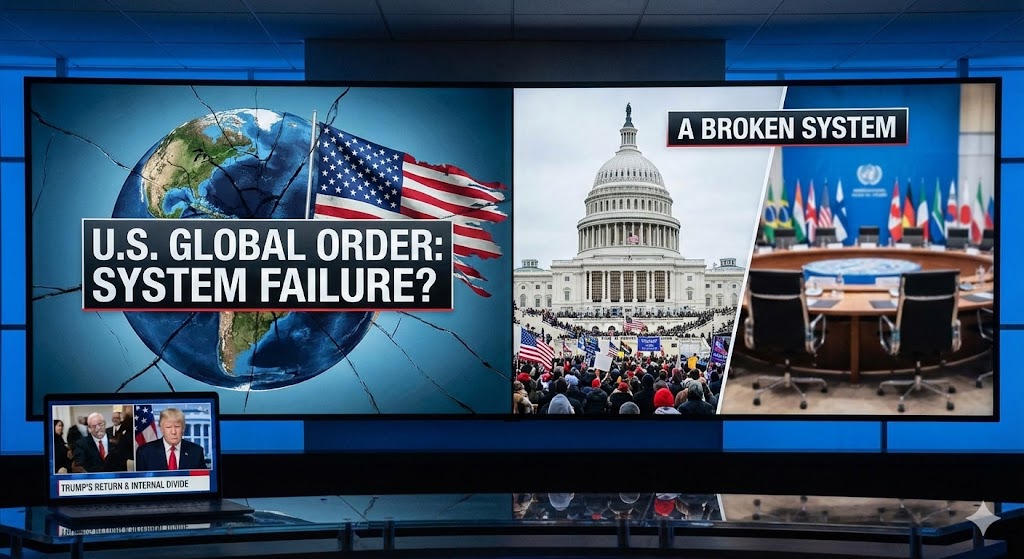








How Resources, Alliances, and Strategic Overreach Are Reshaping the Global Order
Introduction: A War Without Battlefields
The contemporary global confrontation is frequently reduced to familiar labels: a trade war, a diplomatic breakdown, a technological rivalry, or a clash of personalities centered on figures such as Donald Trump. These descriptions, while not entirely false, are fundamentally insufficient. They mistake symptoms for structure and events for causes. What is unfolding is not a temporary disruption of the international system, but a systemic struggle over the foundations of power itself.
This is a war without battlefields, without formal declarations, and without clear timelines. Yet it penetrates deeper than conventional wars because it targets the invisible architecture of modern dominance: control over critical resources, technological chokepoints, financial infrastructure, narrative legitimacy, and—most importantly—time. Who controls the future supply chains? Who sets the standards? Who absorbs shocks, and who transmits them?
At the center of this conflict lies a disturbing paradox. The United States remains the most militarily powerful country in history, yet it increasingly behaves like a power under siege. Why does a state with unmatched force projection feel compelled to threaten allies, weaponize trade, coerce financial systems, and destabilize regions it once managed through consensus? Why does it appear more focused on preventing alternatives than on strengthening its own foundations?
The struggle over rare earth minerals exposes this contradiction with unusual clarity. These materials are not valuable because of their price, but because of their position within the technological ecosystem. Whoever controls their extraction, refinement, and distribution effectively controls the pace and direction of industrial, military, and digital development. The question, then, is not merely why rare earths matter—but why the world’s dominant power allowed itself to become structurally dependent on a strategic competitor in the first place.
This raises deeper, more uncomfortable questions. Is the current American strategy aimed at restoring dominance—or merely delaying decline? Is the confrontation with China a proactive effort to shape a new order, or a reactive attempt to preserve an old one? And if the latter is true, can coercion succeed where adaptation has failed?
Equally critical is the role of alliances. For decades, American power rested not only on force, but on consent. Today, that consent is eroding. Europe speaks of strategic autonomy, Asia practices careful hedging, the Middle East diversifies its partnerships, and Latin America increasingly resists unilateral pressure. Are these shifts the result of ideological disagreement—or are they rational responses to an unpredictable hegemon? At what point does pressure designed to enforce loyalty instead accelerate disengagement?
The monetary dimension further complicates the picture. The dollar remains central to global finance, yet its weaponization has transformed trust into risk. If access to the system can be revoked for political reasons, why would states not seek alternatives? Is de-dollarization a coordinated rebellion, or an emergent defensive behavior? And if it is defensive, what does that imply about the future of American financial leverage?
Perhaps the most overlooked aspect of this war without battlefields is its psychological and temporal dimension. China appears patient, incremental, and structurally focused. The United States appears urgent, reactive, and increasingly loud. One power is building redundancy; the other is enforcing dependency. One is playing a long game; the other seems trapped in electoral and financial cycles. In such a mismatch, who truly holds the advantage?
Finally, there is a question that hovers uncomfortably over all others: is external confrontation masking internal fragility? Historically, great powers under internal strain often project force outward to reaffirm coherence at home. If so, where does the boundary lie between strategic assertiveness and strategic overreach? And what happens when a state attempts to stabilize a changing world without first stabilizing itself?
This essay approaches the rare earths war not as an isolated conflict, but as an entry point into a broader crisis of global order. It seeks to understand how resources, alliances, currencies, and strategic behavior intersect—and whether the current trajectory represents a managed transition to multipolarity, or the early stages of a far more disorderly transformation.
The absence of battlefields does not mean the absence of war. It means the war is being fought where it is least visible—and where its consequences will be hardest to reverse.
Rare Earths: The Material Foundation of 21st-Century Power
Rare earth elements are frequently misunderstood because their importance is framed in commercial or environmental terms rather than strategic ones. In reality, they are neither rare nor inherently valuable in isolation. Their true power lies in their position within the technological hierarchy. They sit at the narrowest chokepoints of modern production—where complexity is highest, substitution is hardest, and disruption is most damaging.
Unlike oil or gas, rare earths do not fuel economies directly; they enable everything that defines advanced power. Precision-guided munitions, satellite systems, fifth-generation fighter jets, quantum computing, artificial intelligence hardware, electric vehicles, wind turbines, and advanced telecommunications all depend on rare earths at multiple stages of production. Remove access to these materials, and military superiority, industrial leadership, and technological sovereignty become theoretical rather than real.
The critical distinction, therefore, is not possession but control across the entire value chain. Mining alone is insufficient. The decisive advantage lies in refining, processing, alloying, and component integration—stages that are capital-intensive, environmentally costly, and politically unpopular. This is where strategic foresight diverged sharply between major powers.
For decades, the United States approached rare earths through a market-efficiency lens. Environmental regulation, cost minimization, and shareholder value drove production offshore. Strategic vulnerability was treated as an abstract risk rather than a concrete constraint. Supply chains were optimized for speed and price, not resilience. This logic assumed that globalization itself was stable, neutral, and apolitical.
China rejected this assumption. It treated rare earths not as commodities but as strategic infrastructure. By accepting environmental damage, subsidizing extraction and processing, and tolerating short-term inefficiencies, it built overwhelming dominance in refining and downstream production. Control was consolidated not through monopoly pricing, but through systemic indispensability. Once embedded, that control became self-reinforcing: industries clustered where materials were available, talent followed industry, and innovation followed scale.
This created a structural asymmetry. The United States retained superiority in design, intellectual property, and advanced research, but surrendered the material foundations that make these advantages operational. Innovation without production depth is fragile. Military planning without secure supply chains is theoretical. In this sense, rare earth dependency is not a logistical problem—it is a strategic contradiction.
Efforts to reverse this dependency now confront harsh realities. Rebuilding domestic or allied rare earth capacity is not merely a matter of investment. It requires years of environmental permitting, public acceptance of ecological trade-offs, industrial workforce reconstruction, and sustained political commitment across electoral cycles. Even if these obstacles are overcome, diversification does not eliminate vulnerability—it merely redistributes it.
This leads to a deeper question: why did the dominant power allow itself to lose control over materials it knew were critical? The answer lies not in ignorance, but in ideology. The post–Cold War order assumed that economic interdependence would neutralize strategic competition. Production was separated from security planning. Efficiency was mistaken for resilience. Markets were expected to substitute for strategy.
Rare earths expose the limits of that worldview. They demonstrate that globalization did not erase power politics; it relocated them into supply chains. Control is no longer exercised primarily through territory, but through standards, bottlenecks, and dependencies that operate quietly until they are activated.
This is why rare earths are central to the current confrontation. They are not the cause of conflict, but the terrain on which it unfolds. Whoever controls these materials does not need to threaten; denial alone is leverage. And leverage exercised at the material level is more effective than military force because it operates continuously, invisibly, and without escalation thresholds.
Ultimately, the struggle over rare earths is a struggle over who defines the future’s industrial and technological rhythm. It is about deciding which systems scale, which innovations reach deployment, and which militaries retain credible deterrence. In this context, the “rare earths war” is not a sectoral dispute—it is the material expression of a deeper transition from unipolar dominance to contested multipolarity.
The danger for the United States is not that it lacks resources, but that it is attempting to rebuild strategic depth in a world where time, coordination, and legitimacy are increasingly scarce.
Alliance Breakdown: When Power Becomes Transactional
American global leadership was never sustained by coercion alone. Its durability rested on something far more fragile and far more powerful: the perception that U.S. leadership was predictable, rules-based, and ultimately stabilizing. Alliances functioned not merely as security arrangements, but as trust networks—mechanisms through which costs were shared, risks were pooled, and long-term planning became possible.
The postwar alliance system transformed American power from dominance into legitimacy. Europe accepted U.S. military primacy because it came with economic integration and political consultation. Japan and South Korea accepted security dependence in exchange for strategic shelter and access to global markets. Even asymmetrical relationships were stabilized by the assumption that the United States would act as a system manager rather than a short-term negotiator.
The shift toward transactionalism disrupted this equilibrium at its core. When alliances are reframed as financial obligations rather than strategic partnerships, their political meaning collapses. Security guarantees become conditional. Commitments appear reversible. Reliability—once America’s greatest asset—turns into a variable.
This transformation had immediate and long-term consequences. Public pressure on allies to “pay their share” signaled not fiscal discipline but conditional protection. Trade disputes with allies blurred the distinction between competitor and partner. Diplomatic norms were discarded in favor of leverage, and leverage was exercised without regard for cumulative trust erosion. In doing so, American power became louder but thinner.
The most damaging effect of this approach was not resistance, but adaptation. Allies did not revolt; they hedged. Europe accelerated discussions on strategic autonomy, defense coordination, and industrial policy. Japan deepened regional partnerships while quietly expanding its own military capacity. India pursued selective alignment, engaging the United States without surrendering strategic independence. Middle Eastern states diversified security and economic relationships to reduce exposure to a single patron.
These responses were rational, not ideological. Transactional power incentivizes diversification. When loyalty is priced rather than cultivated, actors seek alternatives—not to defect, but to insure against unpredictability.
A critical miscalculation lay in assuming that dependence could be enforced without cost. While many allies remain structurally tied to U.S. systems, their political commitment has weakened. Compliance has replaced enthusiasm. Alignment has become tactical rather than strategic. This distinction matters because systems held together by obligation fracture under stress, whereas systems held together by belief adapt.
The alliance breakdown also intersected with the rare earths and supply chain crisis. Many U.S. allies possess critical resources, industrial capacity, or geographic advantages essential to diversification efforts. Yet trust deficits complicate coordination. Asking partners to absorb environmental costs, industrial risks, and political backlash requires a level of confidence that transactional diplomacy erodes.
Moreover, the transactional approach blurred the line between deterrence and coercion. When allies are treated as potential adversaries, the credibility of collective defense weakens. Deterrence relies not only on capability, but on shared intent. Once intent is questioned, deterrence becomes brittle.
This fragmentation has broader systemic implications. The erosion of alliance cohesion accelerates multipolarity not because alternatives are stronger, but because the center is less cohesive. Power diffuses not through overthrow, but through disengagement. The global system becomes less hierarchical and more unstable—not because rules disappear, but because no actor is willing or able to enforce them consistently.
In this context, transactionalism reveals itself as a strategic error rather than a negotiating tactic. It converts long-term advantages into short-term leverage while ignoring the asymmetry between gains and losses. Trust takes decades to build and moments to destroy. Influence lost through uncertainty is rarely recovered through pressure.
Ultimately, alliances do not collapse when partners disagree; they collapse when partners stop believing in the future of the relationship. By reducing alliances to balance sheets, American strategy weakened the very architecture that allowed it to exercise power without constant confrontation.
What emerges is a paradox: the United States sought to extract greater value from its alliances, but in doing so, reduced their value altogether.
Latin America, Greenland, and Strategic Panic
At first glance, American pressure on Latin America and the sudden fixation on Greenland appear disconnected—separate theaters driven by unrelated concerns. In reality, they reflect a single strategic condition: a growing awareness within Washington that influence is eroding not at the margins, but at the structural core of its geopolitical position.
Latin America has long occupied a unique place in American strategic thinking. It was not merely a region of interest; it was assumed to be a zone of default influence. This assumption shaped policy more than active engagement did. For decades, stability was maintained not through development or integration, but through inertia—the belief that alternatives would remain limited and external actors would remain peripheral.
That assumption no longer holds. China’s expanding presence in Latin America is not ideological or military; it is infrastructural. Ports, logistics networks, digital systems, energy projects, and commodity agreements embed influence far more quietly than bases or treaties. This mode of engagement presents a challenge the United States is poorly structured to counter, because it does not trigger traditional security thresholds.
American responses—sanctions, diplomatic pressure, and episodic coercion—signal a loss of strategic confidence. They are reactive measures designed to reassert control rather than rebuild relevance. Crucially, they communicate insecurity. Influence sustained by threat rather than attraction is influence already in retreat.
The deeper issue is not Chinese presence, but American absence. Development gaps, inconsistent engagement, and a reliance on punitive tools have hollowed out long-term influence. When Washington frames regional relationships primarily in terms of compliance, it narrows its own options. Regional actors, faced with asymmetric pressure, respond not with defiance but with diversification.
This dynamic is mirrored in the Arctic and the focus on Greenland. Unlike Latin America, the Arctic represents the future rather than the past. Melting ice transforms geography into opportunity: new shipping routes, untapped mineral reserves, and strategic depth in a world increasingly shaped by resource competition. Greenland’s value lies not only in rare earth deposits, but in its position within emerging Arctic corridors that will define mid-21st-century trade and security flows.
The urgency with which Greenland entered political discourse is revealing. Strategic assets that are truly secure are managed quietly. Those perceived as slipping away are named loudly. The fixation on acquisition, rather than partnership, reflects a mindset shaped by scarcity rather than confidence.
Both regions illustrate a shift from strategic patience to strategic panic. The United States is attempting to secure future leverage through present pressure. This approach confuses possession with control and visibility with influence. In complex systems, forced alignment often produces the opposite effect: resistance without confrontation, disengagement without rupture.
There is also a psychological dimension at work. Great powers accustomed to uncontested influence struggle to recognize gradual loss. When decline is incremental rather than catastrophic, it triggers denial rather than adaptation. Policy becomes louder, faster, and less coherent. Symbolic gestures replace structural investment.
Latin America and Greenland thus serve as mirrors reflecting the same anxiety: the fear that once-automatic advantages are becoming contested. The response has been to assert rather than integrate, to demand rather than persuade. Yet influence in the 21st century increasingly flows toward actors that can offer stability, infrastructure, and long-term commitment rather than episodic dominance.
What appears as assertiveness is better understood as anticipatory loss management—an attempt to lock in strategic positions before systemic shifts make them unattainable. The danger is that such efforts accelerate the very processes they are meant to prevent.
In both cases, the underlying issue is not geography, resources, or rivals, but time. The United States is acting as though the window for shaping the future is closing. History suggests that when great powers begin to rush, they reveal not strength, but fear of irrelevance.
China’s Strategic Patience: Winning Without War
China’s most misunderstood characteristic in the current global confrontation is not its ambition, but its tempo. Much Western analysis assumes that rising powers seek rapid, decisive confrontation to overturn the existing order. China has pursued the opposite path. Its strategy is not built around dramatic rupture, but around gradual absorption of advantage—economic, technological, institutional, and psychological.
This patience is not cultural romanticism; it is structural rationality. War introduces uncertainty, destroys markets, accelerates counter-coalitions, and freezes capital flows. For a power whose primary strength lies in manufacturing scale, infrastructure depth, and long-term planning, war is not an accelerator—it is a risk multiplier. The optimal strategy, therefore, is to allow competitors to exhaust themselves while China consolidates position.
Unlike the United States, which still frames power primarily through military dominance and alliance leadership, China frames power through irreversibility. Its objective is not to defeat rivals in battle, but to make reversal of Chinese centrality prohibitively costly. Infrastructure that cannot be easily replaced, supply chains that cannot be quickly relocated, standards that shape markets by default—these are victories that do not require confrontation.
This logic explains China’s restrained posture even under intense pressure. Tariffs, sanctions, diplomatic isolation attempts, and military signaling have not provoked symmetrical escalation. Instead, China has responded asymmetrically: accelerating domestic substitution, deepening South–South trade, expanding currency settlement options, and embedding itself further into global production networks. Each response reduces vulnerability without triggering escalation thresholds.
The Taiwan question illustrates this strategy with particular clarity. Taiwan is often framed as an inevitable flashpoint, yet inevitability is precisely what China seeks to avoid. Military action would unite fractured Western alliances, justify containment, and disrupt the very economic flows that underpin Chinese growth. As long as time favors China, restraint is strength.
China’s patience is also enabled by a favorable asymmetry in political time horizons. American strategy is constrained by electoral cycles, market expectations, and media pressure. Chinese strategy operates across decades. This allows Beijing to absorb short-term pressure without altering long-term objectives. The result is a mismatch: one side seeks immediate leverage, the other seeks cumulative advantage.
Another critical dimension of China’s approach is delegated pressure. Rather than confronting the United States directly, China allows structural forces to do the work. When Washington alienates allies through transactional diplomacy, China does not intervene—it benefits. When sanctions push countries to seek alternatives, China offers markets without conditions. When supply chains fragment, China positions itself as the node that still functions at scale.
This is not passivity; it is strategic non-intervention. The most effective move is often to allow an opponent’s strategy to reveal its own limits. Overextension, alliance fatigue, and credibility erosion cannot be imposed externally—they must be self-generated.
China’s internal focus further reinforces this approach. Massive investment in education, industrial upgrading, logistics, and technological ecosystems creates resilience. Even when inefficiencies exist, they are absorbed by scale and planning continuity. This internal consolidation reduces the need for external assertion. Power that feels secure does not need to prove itself constantly.
Importantly, China’s strategy is not without risk. Demographic pressures, debt accumulation, regional distrust, and internal control mechanisms impose constraints. But these risks are managed through gradualism rather than confrontation. Beijing prefers slow correction to sudden shock.
What emerges is a form of competition in which victory is not announced. There is no decisive moment, no surrender ceremony. Success is measured by defaults: whose standards are adopted, whose infrastructure is used, whose currency is accepted, whose markets set the pace. By the time these defaults are visible, they are already entrenched.
In this context, China’s greatest advantage is not military capability, but strategic composure. It is willing to let others escalate, isolate, and exhaust themselves. It understands that in complex systems, collapse rarely comes from attack—it comes from imbalance.
Winning without war, in this sense, is not avoidance of conflict. It is the transformation of conflict into a domain where patience outperforms force, and where time itself becomes the decisive weapon.
The Dollar and the Slow Erosion of Monetary Power
The dominance of the U.S. dollar has never rested solely on economics. It is the monetary expression of a broader system of power—military reach, alliance trust, legal predictability, deep capital markets, and the assumption that the United States would act as a custodian of the system rather than its owner. When these assumptions hold, dollar dominance appears natural and self-sustaining. When they weaken, the system does not collapse—but it begins to leak.
Crucially, reserve currencies do not fall the way governments do. There is no dramatic replacement, no single challenger that takes over. Monetary power erodes through behavioral shifts, not declarations. States do not abandon the dollar because they dislike it; they reduce exposure because dependence becomes risky.
The weaponization of the dollar system marked a structural turning point. Sanctions, asset freezes, and financial exclusions demonstrated that access to dollar clearing and Western financial infrastructure was conditional—not merely on legality, but on political alignment. From a tactical perspective, these tools were effective. From a systemic perspective, they altered the incentive structure of the entire global economy.
The key question for other states quietly became:
If reserves can be frozen, payments blocked, and assets rendered unusable, are reserves still reserves—or merely permissions?
This question does not require ideological opposition to the United States. It requires prudence. Even close partners began to explore hedging mechanisms: local currency settlements, bilateral swap lines, alternative payment systems, gold accumulation, and diversified reserve baskets. None of these moves aim to overthrow the dollar. They aim to reduce single-point failure.
What makes this erosion particularly dangerous for American power is its invisibility. The dollar remains dominant in trade invoicing, reserves, and debt markets. This surface stability creates complacency. Yet beneath it, marginal decisions accumulate. Each contract settled in another currency, each reserve portfolio diversified, each financial channel replicated elsewhere reduces the dollar’s monopoly on necessity.
Monetary power, unlike military power, depends on voluntary participation. The more indispensable the system appears, the less coercion is needed. The more coercion is used, the more participants seek redundancy. This creates a paradox: the tools designed to enforce monetary dominance simultaneously incentivize its circumvention.
There is also a temporal mismatch at play. The benefits of weaponizing the dollar are immediate and measurable. The costs are delayed, diffuse, and nonlinear. Political systems driven by short-term outcomes tend to discount long-term systemic damage. By the time erosion becomes visible in macro indicators, reversal is extraordinarily difficult.
Another underestimated dimension is legitimacy. The dollar system historically benefited from the perception that rules, though American-centered, were broadly fair and consistently applied. When exceptions multiply and enforcement appears selective, the system shifts from rule-based to power-based. In such an environment, rational actors plan for contingency rather than loyalty.
Importantly, no alternative currency currently offers the depth, liquidity, legal stability, and global confidence of the dollar. This is why de-dollarization is evolutionary, not revolutionary. The threat is not replacement by a single rival, but fragmentation. A world of multiple partial systems is less efficient, more volatile, and less centered on any one power.
Fragmentation also weakens the feedback loop that once disciplined American policy. Dollar dominance lowered borrowing costs, financed deficits, and absorbed shocks. As that privilege erodes, fiscal and strategic trade-offs become sharper. Power becomes more expensive to maintain.
The United States thus faces a dilemma. Preserving dollar dominance requires restraint, predictability, and system stewardship. Enforcing compliance through monetary coercion provides short-term leverage but undermines long-term centrality. The more the dollar is treated as a weapon, the less it functions as a commons.
The slow erosion of monetary power does not announce itself with crisis headlines. It appears instead as diminished shock absorption, higher risk premiums, parallel systems, and declining marginal influence. By the time these effects are widely recognized, the structural shift is already well underway.
In this sense, the dollar’s future will not be decided by challengers alone, but by whether the United States can reconcile control with credibility—and power with restraint.
The Core Pattern: Strategic Overreach in a Multipolar World
At the center of the current global disorder lies a fundamental mismatch between structure and strategy. The international system has moved toward multipolarity, yet American strategic behavior remains largely unipolar. This is not merely a lag in adaptation; it is a systemic overreach rooted in outdated assumptions about control, compliance, and centrality.
Strategic overreach does not mean doing too much everywhere. It means attempting to enforce outcomes that the underlying balance of power can no longer sustain. The United States still possesses unparalleled military capabilities, financial depth, and technological influence. What it increasingly lacks is the uncontested authority to translate those assets into predictable results across multiple domains simultaneously.
Multipolarity alters the logic of power. In a unipolar system, pressure works because alternatives are limited. In a multipolar system, pressure accelerates substitution. States no longer need to defeat the dominant power; they need only reduce dependence on it. Overreach, therefore, does not produce submission—it produces adaptation.
This pattern is visible across every major arena of American engagement. In trade, tariffs intended to coerce behavior have fragmented supply chains and encouraged regionalization. In security, demands for alignment without consultation have weakened alliance cohesion. In finance, sanctions designed to punish adversaries have motivated hedging by partners. Each move, rational in isolation, compounds system-wide diffusion of power.
The underlying assumption driving this behavior is that leverage can substitute for legitimacy. Yet legitimacy is not an optional supplement to power; it is what allows power to scale efficiently. Without it, enforcement becomes expensive, constant, and politically corrosive. Strategic overreach emerges precisely when a state tries to compensate for declining legitimacy with increased coercion.
A multipolar world also collapses the distinction between external and internal pressure. When power projection abroad strains resources, credibility, and cohesion at home, domestic fragmentation feeds back into foreign policy instability. Overreach abroad amplifies polarization at home; polarization at home narrows strategic options abroad. The system enters a self-reinforcing cycle of constraint.
Another dimension of overreach is temporal compression. The United States increasingly acts as though strategic windows are closing rapidly—and in many cases, they are. But urgency can distort judgment. Long-term competition requires endurance, coordination, and institutional patience. Overreach prioritizes speed over sustainability, signaling anxiety rather than confidence.
Multipolarity also reshapes the behavior of secondary powers. Instead of choosing sides, they choose flexibility. They cooperate issue-by-issue, diversify partnerships, and avoid binding commitments. Strategic overreach misunderstands this behavior as disloyalty rather than rational risk management. The result is misplaced pressure applied to actors who are not adversaries but hedgers.
The most dangerous aspect of overreach is that it often feels necessary from within the dominant power. Declining relative influence creates a sense of encirclement. Loss of automatic compliance feels like betrayal. Every compromise is interpreted as weakness. This psychology transforms adjustment into retreat and adaptation into defeat.
History suggests that great powers rarely collapse because challengers overpower them. They falter when they attempt to freeze a changing system—expending increasing energy to preserve arrangements that no longer reflect reality. Overreach becomes a tax on future flexibility.
In a multipolar world, influence flows toward actors that can offer consistency, optionality, and long-term participation rather than immediate alignment. Power is less about commanding outcomes and more about shaping environments. Strategic overreach reverses this logic, attempting to command environments through outcomes.
The core pattern, then, is not American decline per se, but American misalignment with structural change. The danger is not loss of dominance, but loss of agency—the inability to choose which battles matter and which adjustments are necessary.
If uncorrected, strategic overreach does not lead to sudden collapse. It leads to gradual exhaustion: rising costs, shrinking margins, brittle alliances, and diminishing returns on power. In such conditions, even vast capabilities struggle to produce decisive advantage.
Multipolarity does not require abdication. It requires recalibration. The question is whether American strategy can evolve from enforcement to orchestration—before overreach hardens into irreversibility.
This is the pivot on which the future order will turn.
Conclusion: Power, Time, and the Cost of Delay
The conflict examined in this essay is not a dispute over rare earths, trade balances, or diplomatic etiquette. It is a contest over who sets the conditions of the future—and who must adapt to them. Rare earth minerals, fractured alliances, monetary leverage, and strategic patience are not separate phenomena. They are expressions of a single structural transition: the movement from a unipolar system built on American centrality to a multipolar system defined by diffusion, redundancy, and choice.
What distinguishes the current moment is not the rise of competitors, but the loss of automatic compliance. Power no longer travels frictionlessly through military dominance or financial primacy alone. It now depends on trust, coordination, and temporal endurance. The United States still possesses extraordinary capabilities, but capabilities do not translate into outcomes when legitimacy erodes and partners hedge.
The rare earths dilemma reveals how deeply material foundations matter in an era of technological competition. Alliance breakdown shows how transactionalism converts strength into fragility. The slow erosion of dollar dominance demonstrates that coercive tools, when overused, undermine the systems that make them effective. China’s restraint highlights a strategic asymmetry: patience can outperform pressure when structural trends favor the long game.
Taken together, these dynamics expose the central risk facing American strategy: strategic overreach driven by urgency. Acting as though history can be frozen, and alternatives suppressed indefinitely, accelerates adaptation by others. Overreach does not prevent multipolarity; it hastens it.
This does not imply inevitability or collapse. Multipolarity is not synonymous with American irrelevance. It does, however, require a different mode of leadership—one that prioritizes orchestration over enforcement, resilience over leverage, and credibility over coercion. Adjustment delayed becomes adjustment denied.
The most consequential wars are rarely fought where they are most visible. This war unfolds in supply chains, standards bodies, financial networks, and perceptions of reliability. Its outcomes will be determined not by decisive moments, but by cumulative choices.
History is not ending; it is reorganizing. The question is not whether the United States remains powerful, but whether it can remain central in a world that no longer revolves around a single axis. Power, ultimately, belongs not to those who act fastest, but to those who understand when to act—and when to adapt.
The absence of battlefields should not be mistaken for the absence of stakes. This is a war over the architecture of the future, and the cost of miscalculation will not be measured in territory lost, but in influence that cannot be recovered.