






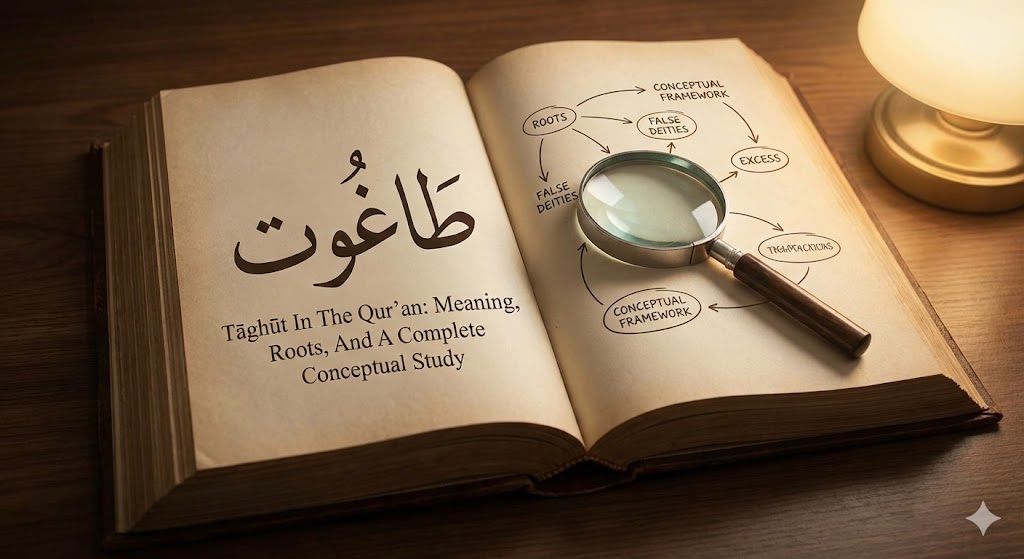
Among the many terms introduced by the Qur’an, few are as conceptually dense, philosophically challenging, and historically unprecedented as the word Tāghūt. While many Qur’anic terms existed linguistically before revelation, Tāghūt stands apart because the Qur’an transformed a simple root denoting excess into a comprehensive framework describing rebellion against rightful limits—whether within the self, society, or systems of power. This transformation did not merely add a religious label; it introduced a new way of diagnosing human deviation.
Unlike words that denote specific actions or objects, Tāghūt names a condition: the moment when something crosses its God-given boundary and claims ultimate authority. This article explores Tāghūt not as a slogan but as a Qur’anic theory of excess—one that explains why faith, justice, and freedom collapse when limits are ignored.
1. Linguistic Root and Morphological Structure of Tāghūt
The root of Tāghūt is ṭ-gh-y (ط غ ي), whose primary meaning in classical Arabic is to exceed, overflow, or transgress established bounds. Importantly, this root is not inherently moral. The Qur’an itself uses it in a purely descriptive sense when speaking about natural phenomena: “Indeed, when the water overflowed (ṭaghā al-mā’), We carried you in the Ark” (Qur’an 69:11). Here, ṭughyān simply denotes excess beyond containment.
What makes Tāghūt distinct is its morphological form. It is not a standard active participle (ṭāghī) nor a simple verbal noun. Classical linguists note that it follows an intensive, system-forming pattern similar to jabarūt (coercive domination) and malakūt (sovereign dominion). This structure indicates not a single act of transgression but a sustained condition that enforces excess as a norm.
Thus, Tāghūt linguistically signifies not merely someone who transgresses, but a force—personal or institutional—that legitimizes transgression and demands allegiance. This morphological nuance is essential to understanding why the Qur’an applies Tāghūt to diverse entities without contradiction.
2. Tāghūt Before the Qur’an and the Qur’anic Innovation
Pre-Islamic Arabic was familiar with the root ṭ-gh-y, particularly in poetry describing pride, arrogance, or uncontrollable natural forces. However, there is no evidence that Tāghūt existed as a stable theological or philosophical category before the Qur’an. The Arabs named idols, tyrants, and demons, but they did not possess a unified concept that explained why different forms of domination shared the same moral pathology.
The Qur’an innovated by converting a linguistic root into a diagnostic concept. It did not invent new sounds; it invented new meaning. Tāghūt became a lens through which idol worship, tyrannical rule, moral autonomy, and epistemic arrogance could be understood as manifestations of the same underlying deviation: claiming authority beyond rightful limits.
This Qur’anic method—using known language to articulate unprecedented conceptual depth—is a hallmark of revelation and explains why Tāghūt cannot be reduced to any single historical object.
3. Tāghūt in the Qur’an: Usage and Semantic Range
The Qur’an uses Tāghūt in multiple contexts, each revealing a different aspect of its meaning. The most foundational verse states: “Whoever disbelieves in Tāghūt and believes in Allah has grasped the firmest handhold” (Qur’an 2:256). The order here is deliberate: rejection of Tāghūt precedes belief in God. This sequence establishes that faith is not merely affirmation but reorientation of allegiance.
Another verse clarifies Tāghūt as a rival source of judgment: “They wish to seek judgment from Tāghūt, though they were commanded to reject it” (Qur’an 4:60). Tāghūt here is not a physical idol but an authority that claims the right to determine truth and justice independently of divine guidance.
Across its Qur’anic occurrences, Tāghūt consistently denotes any entity—human, institutional, or conceptual—that positions itself as an ultimate reference point.
4. Psychological Dimension: Tāghūt Within the Self
One of the most radical and intellectually unsettling aspects of the Qur’anic concept of Tāghūt is that it refuses to confine rebellion to external idols, tyrants, or institutions. Instead, the Qur’an identifies the human self as a primary site where Tāghūt can emerge. This move fundamentally transforms the discussion of faith from a purely theological issue into a deeply psychological one. The Qur’an suggests that no external form of domination can truly succeed unless it is first internalized.
This insight marks a decisive departure from simplistic understandings of disbelief. Tāghūt is not merely something opposed from outside; it is something that can be generated from within. The inner life of the human being—desires, fears, ambitions, and self-conceptions—can itself assume the role of ultimate authority.
Desire (Hawāʾ) as Tāghūt
The Qur’an presents its most explicit psychological diagnosis of Tāghūt in a question that is both rhetorical and confrontational:
“Have you seen the one who takes his desire (hawāʾ) as his god?”
(Qur’an 45:23)
This verse does not accuse the individual of idol worship in any conventional sense. There is no shrine, no ritual, no declared theology. Instead, the Qur’an identifies desire itself as a functional deity when it assumes sovereignty over judgment, values, and action. Desire becomes Tāghūt when it ceases to be guided and instead becomes the guide.
Crucially, the Qur’an does not condemn desire as such. Desire is part of human nature. It becomes Tāghūt only when it crosses its proper boundary—when it claims the right to decide what is true, what is good, and what is worth sacrificing for. At that point, desire is no longer an impulse; it is an authority.
This distinction explains why modern societies, even those that consider themselves secular or rational, often reproduce patterns of idolatry without idols. When personal preference becomes the final criterion of truth, morality, and identity, the individual does not become free; rather, the self becomes tyrannical.
The Nafs as a Potential Tyrant
The Qur’an frequently discusses the nafs (self), not as an inherently evil entity, but as a dynamic reality capable of multiple states. One of these states is described as commanding toward harm:
“Indeed, the soul is surely inclined to command toward evil.”
(Qur’an 12:53)
This inclination does not automatically make the nafs Tāghūt. It becomes Tāghūt only when its commands are obeyed without restraint, critique, or higher reference. When the self claims autonomy from any transcendent moral order, it effectively enthrones itself.
In psychological terms, this resembles what modern thinkers describe as ego absolutism—the belief that one’s internal perspective is self-justifying. The Qur’an’s analysis goes further by identifying this posture not merely as cognitive bias or emotional immaturity, but as a moral and existential rebellion. The self is no longer oriented toward truth; it becomes the measure of truth.
Autonomy and the Illusion of Neutrality
A central myth of modern psychology and philosophy is the idea of neutral autonomy: the belief that human beings can choose values without already being governed by some authority. The Qur’an decisively rejects this assumption. It insists that human beings are always oriented toward something—desire, fear, power, approval, or truth.
The question is never whether one submits, but to what.
This is why the Qur’an frames disbelief not as intellectual ignorance, but as misplaced allegiance. When the self insists on being answerable only to itself, it does not escape authority; it merely conceals it. The self becomes both judge and defendant, lawgiver and subject.
Why Internal Tāghūt Precedes External Tāghūt
The Qur’an’s psychological insight explains a historical pattern: oppressive systems rarely impose themselves on societies that have not already internalized their logic. Tyranny thrives where people have learned to obey fear, desire, or identity without question. External Tāghūt is sustainable only when internal Tāghūt has already normalized submission.
This is why the Qur’an consistently links guidance and misguidance to the state of the heart rather than to external conditions alone. The heart, in Qur’anic language, is not merely emotional; it is the center of moral perception and commitment. When the heart becomes captive to the self’s unchecked impulses, perception itself becomes distorted.
Modern Psychology and the Qur’anic Diagnosis
Modern psychology increasingly recognizes that human behavior is shaped less by rational deliberation and more by unconscious drives, emotional needs, and identity preservation. Concepts such as motivated reasoning, confirmation bias, and narcissistic reinforcement echo the Qur’an’s insistence that the self is not a neutral observer.
However, psychology stops short of making a normative claim about ultimate authority. It can describe dysfunction, but it cannot declare rebellion. The Qur’an completes the picture by naming what psychology observes but cannot judge: the self becomes Tāghūt when it refuses accountability beyond itself.
Implications for Faith and Ethics
This psychological reading of Tāghūt has profound implications. It means that rejecting Tāghūt is not primarily a political or ritual act; it is an inner realignment. One can dismantle idols and overthrow regimes and still remain under the rule of an internal tyrant. Conversely, one can live under external constraint and yet be inwardly free if the self is restrained by truth.
Faith, in the Qur’anic sense, begins when the self relinquishes its claim to ultimacy. This surrender is not self-annihilation; it is self-restoration. By placing the self back within its proper limits, the human being becomes capable of wisdom, justice, and genuine freedom.
In this sense, the Qur’an’s critique of Tāghūt within the self is not pessimistic—it is liberating. It identifies the true source of human bondage and, by doing so, reveals the path to inner coherence. The greatest tyranny, the Qur’an suggests, is not imposed from outside. It is the tyranny of a self that refuses to be governed by anything higher than itself.
5. Systemic Tāghūt: Power, State, Knowledge, and Capital
While the Qur’an’s psychological analysis of Tāghūt exposes rebellion within the self, it does not stop there. The Qur’an consistently expands its critique outward, identifying systems as potential carriers of Tāghūt. This expansion is critical. A purely internal reading would individualize responsibility to the point of obscuring structural injustice, while a purely external reading would ignore the inner dispositions that sustain oppressive systems. The Qur’an holds both together.
Systemic Tāghūt emerges when institutions, ideologies, or structures claim ultimate authority—when they cease to be instruments serving human well-being and instead become sources of meaning, legitimacy, and obedience independent of divine guidance.
Political Power as Tāghūt: The Case of Pharaoh
The Qur’anic archetype of systemic Tāghūt is Pharaoh. Importantly, Pharaoh’s defining sin is not personal immorality alone but a claim of absolute sovereignty:
“I am your highest lord.”
(Qur’an 79:24)
This statement is not a theological argument; it is a political declaration. Pharaoh is not asking to be worshipped through ritual alone; he is asserting that no higher authority exists above the state. Law, fear, reward, punishment, and identity all flow from him.
The Qur’an thus presents Pharaoh as a model of political absolutism. His Tāghūt lies in collapsing all sources of legitimacy into himself. By doing so, he transforms the state from a means of order into an object of submission.
This distinction is crucial. The Qur’an does not reject governance, law, or authority. It rejects unaccountable authority. Power becomes Tāghūt when it refuses transcendence—when it answers only to itself.
Judgment and Law as Tāghūt
The Qur’an further clarifies systemic Tāghūt in the context of legal authority:
“They wish to seek judgment from Tāghūt, though they were commanded to reject it.”
(Qur’an 4:60)
Here, Tāghūt is explicitly linked to judgment—the power to decide right and wrong, just and unjust. This verse is decisive evidence that Tāghūt cannot be reduced to idols or demons. It refers to any authority that claims the right to adjudicate reality independently of divine moral limits.
In modern terms, this includes legal systems that elevate procedural legality over justice, or sovereignty over accountability. Law becomes Tāghūt when it is severed from ethical truth and presented as self-legitimating.
The Qur’an’s critique is not anarchic; it is hierarchical. Law must exist, but it must exist under moral truth, not above it.
Knowledge as Tāghūt: Epistemic Absolutism
One of the most misunderstood aspects of Qur’anic critique is its treatment of knowledge. The Qur’an repeatedly praises knowledge, reflection, and understanding. Yet it also issues a sharp warning:
“You have been given of knowledge only a little.”
(Qur’an 17:85)
This verse is not anti-intellectual. It is anti-absolutist. Knowledge becomes Tāghūt when it denies its own limits—when it claims total explanatory power and dismisses all that lies beyond its method.
In the modern world, this manifests most clearly as scientism: the belief that empirical science is not merely a powerful tool, but the sole arbiter of truth. When scientific methodology is transformed into an ontology—when it claims to define what exists rather than merely what can be measured—it crosses into Tāghūt territory.
The Qur’an anticipates this danger by consistently distinguishing between knowledge and wisdom. Knowledge without humility produces arrogance; information without moral orientation produces domination. Tāghūt is not knowledge itself, but knowledge that refuses accountability to anything beyond itself.
Economic Power and Capital as Tāghūt
The Qur’an also identifies wealth as a potential source of false sovereignty. It does not condemn wealth as such, but it condemns wealth when it becomes self-sufficient:
“He says, ‘I have destroyed vast wealth.’”
(Qur’an 90:6)
And elsewhere:
“Woe to every slanderer and backbiter who amasses wealth and counts it, thinking that his wealth will make him immortal.”
(Qur’an 104:1–3)
Wealth becomes Tāghūt when it defines human worth, secures immunity from accountability, or replaces moral value with market value. In such systems, dignity is measured by productivity, and justice by profitability.
The Qur’an’s critique anticipates modern capitalist pathologies without rejecting economic activity itself. It rejects the transformation of economic instruments into moral authorities.
Ideology as Tāghūt
Perhaps the most dangerous form of systemic Tāghūt is ideology—especially when it cloaks itself in moral language. Ideology becomes Tāghūt when it claims historical inevitability, moral infallibility, or exemption from critique.
The Qur’an warns repeatedly against following inherited narratives uncritically:
“We found our forefathers upon a way, and we are following their footsteps.”
(Qur’an 43:23)
This critique applies equally to modern ideologies—nationalism, secularism, even religious extremism—when they become closed systems that define truth internally and dismiss all external moral challenge.
Ideological Tāghūt is especially dangerous because it often presents itself as liberation while quietly demanding total loyalty.
Why Systems Become Tāghūt
The Qur’an’s analysis suggests that systems become Tāghūt when they perform three moves simultaneously:
- They claim final authority.
- They deny higher accountability.
- They demand obedience as a moral duty.
When these conditions are met, the system no longer serves humanity; humanity serves the system.
The Qur’anic Balance
Crucially, the Qur’an does not call for the destruction of systems but for their reordering. Power, law, knowledge, and wealth are necessary. They become destructive only when detached from transcendence.
Tāghūt, in this sense, is not an enemy external to civilization; it is the distortion of civilization itself.
Continuity Between Inner and Outer Tāghūt
The Qur’an’s psychological and systemic critiques are inseparable. A society dominated by systemic Tāghūt is composed of individuals who have internalized false authorities. Conversely, inner liberation without structural justice remains incomplete.
This integrated vision explains why the Qur’an places the rejection of Tāghūt at the foundation of faith. Without this rejection, systems inevitably become sacred, and the sacred becomes a tool of domination.
6. Why Rejection of Tāghūt Precedes Faith: Qur’anic, Philosophical, and Existential Logic
One of the most striking and often misunderstood features of the Qur’anic worldview is the sequence it establishes between disbelief in Tāghūt and belief in God. The Qur’an does not present faith as a simple affirmation that God exists. Instead, it frames faith as a reorientation of ultimate allegiance, a restructuring of authority within the human being and society.
This logic is stated most clearly in the verse:
“Whoever disbelieves in Tāghūt and believes in Allah has grasped the firmest handhold that never breaks.”
(Qur’an 2:256)
The order here is not rhetorical. It is foundational. Rejection comes before affirmation because faith, in the Qur’anic sense, is not merely cognitive assent but exclusive commitment. Where Tāghūt remains operative, faith cannot fully take root.
Faith as Allegiance, Not Mere Belief
The Qur’an consistently treats īmān (faith) as a matter of loyalty and submission, not abstract belief. To believe in God is to recognize God as the final authority over meaning, morality, judgment, and destiny. This recognition cannot coexist with competing sources of ultimate authority.
From a philosophical standpoint, this is a matter of coherence. Two ultimate authorities cannot occupy the same conceptual space. If the self, the state, ideology, desire, or knowledge retains final say, then God’s authority is necessarily conditional. Conditional authority, by definition, is not ultimate.
This is why the Qur’an repeatedly criticizes those who claim belief while deferring judgment elsewhere:
“Have you not seen those who claim to believe in what was revealed to you and what was revealed before you, yet they wish to seek judgment from Tāghūt?”
(Qur’an 4:60)
The issue here is not theological inconsistency but divided allegiance. Faith collapses when authority is fragmented.
The Logic of Negation Before Affirmation
The structure of Islamic monotheism itself reflects this principle. The testimony of faith begins with negation:
Lā ilāha — there is no deity
illā Allāh — except God
This negation is not symbolic; it is functional. It clears conceptual space. As long as false absolutes remain unchallenged, true faith has nowhere to reside.
Tāghūt represents precisely those false absolutes—entities that claim what belongs only to God: the right to define truth, value, and obligation. Rejecting Tāghūt is therefore not an optional supplement to faith; it is the precondition of faith’s intelligibility.
Existential Implications: Why Neutrality Is Impossible
The Qur’an rejects the idea that human beings can occupy a neutral space between authorities. Every person lives under some form of sovereignty. The only question is whether that sovereignty is acknowledged or concealed.
The Qur’an’s repeated challenge—“Do they not reflect?”—is not an invitation to detached contemplation. It is a call to recognize the forces already governing one’s choices. Neutrality, in this sense, is an illusion. Silence is itself a form of submission.
This is why the Qur’an describes misguidance not primarily as ignorance but as misplaced obedience. One does not drift into Tāghūt; one consents to it, often gradually and unconsciously.
Freedom, Responsibility, and the Cost of Clarity
A common objection arises at this point: if God is truly the ultimate authority, why does the Qur’an not impose belief through overwhelming clarity? Why allow Tāghūt to exist at all?
The Qur’anic answer is subtle and deeply existential. Faith that is coerced is not faith. Recognition must remain possible without becoming compulsory. Tāghūt exists not because truth is weak, but because freedom carries risk. The Qur’an envisions a moral universe in which human beings are accountable precisely because they are capable of refusal.
Rejection of Tāghūt, therefore, is not an intellectual exercise; it is a moral act. It involves cost—loss of comfort, status, or certainty. This cost explains why Tāghūt persists even in the presence of clear signs. Acceptance of truth often demands transformation, and transformation threatens established identities.
Why Partial Faith Is Not Faith
The Qur’an does not recognize partial sovereignty. To accept God in worship but not in judgment, ethics, or meaning is to divide what must remain unified. This division is what the Qur’an identifies as shirk, even when no idols are involved.
Modern individuals often imagine that they can “believe privately” while delegating public meaning to other authorities. The Qur’an rejects this compartmentalization. Faith is holistic or it is hollow.
This is why the rejection of Tāghūt precedes belief: because without dismantling false centers of authority, belief becomes symbolic rather than operative.
The Firmest Handhold
The verse concludes with a promise: whoever rejects Tāghūt and believes in God “has grasped the firmest handhold that never breaks.” This image suggests stability, coherence, and security. In a world of shifting authorities and fragile systems, faith offers not certainty of outcome but clarity of orientation.
The Qur’an does not promise ease; it promises grounding. By removing false absolutes, it liberates the human being from perpetual submission to unstable powers. What remains is not chaos, but alignment.
Synthesis of the Argument
The Qur’anic insistence on rejecting Tāghūt before affirming God is not theological rigidity. It is psychological realism and philosophical necessity. Faith cannot coexist with rival ultimates. Authority cannot be divided without collapsing into contradiction.
Tāghūt must be rejected not because it is external, but because it is seductive. It offers certainty without accountability, power without humility, meaning without transcendence. Faith, by contrast, demands surrender—but offers coherence.
In this light, rejection of Tāghūt is not the loss of freedom; it is its recovery. It is the refusal to live under false sovereignty and the courage to accept responsibility under the One authority that does not exploit submission.
7. Tāghūt in the Modern World: Why It Is Harder to Recognize Today
One of the defining challenges of the modern age is not the absence of Tāghūt, but its invisibility. In earlier societies, Tāghūt often appeared in recognizable forms—idols, deified rulers, overt claims of divine authority. These forms were tangible and therefore confrontable. Modern Tāghūt, by contrast, is abstract, dispersed, and normalized. It rarely announces itself as absolute authority; instead, it presents itself as neutral, inevitable, or self-evident.
This transformation makes modern Tāghūt more difficult to identify and more resistant to critique.
From Sacred Kings to Sacred Systems
In pre-modern contexts, power often concentrated in identifiable figures. Pharaoh could say, “I am your highest lord,” because sovereignty was personal. Modern power, however, operates through systems rather than individuals. Authority is embedded in bureaucracies, technologies, markets, and narratives. As a result, no single actor claims ultimate authority, yet authority itself becomes unquestionable.
This diffusion creates an illusion of objectivity. Decisions are no longer framed as moral choices but as technical necessities. “The system requires it,” “the market demands it,” or “science has settled the matter” become substitutes for ethical reasoning. When systems claim inevitability, they quietly assume Tāghūt-like status. They are obeyed not because they are just, but because they are perceived as unavoidable.
The Qur’an’s concept of Tāghūt is uniquely suited to expose this phenomenon. It identifies false sovereignty not by its form, but by its function: anything that demands submission without accountability to higher moral truth.
The Myth of Value-Neutral Authority
Modern societies often insist that their dominant institutions are value-neutral. Law is procedural, science is objective, economics is mathematical. Yet this neutrality is itself a claim to authority. Decisions about what counts as evidence, what qualifies as harm, and what defines success are inherently normative.
When these norms are shielded from moral critique, neutrality becomes a disguise for dominance. The Qur’an anticipates this by refusing to accept neutrality as a legitimate position. Silence toward injustice, uncritical acceptance of power, and suspension of moral judgment are all forms of allegiance.
Tāghūt thrives where responsibility is diffused and accountability dissolved.
Identity, Recognition, and the New Absolutes
Another modern manifestation of Tāghūt appears in the domain of identity. Contemporary discourse often treats identity as the ultimate source of meaning and authority. Personal experience becomes unchallengeable, and recognition becomes the highest moral currency.
While the Qur’an affirms human dignity, it rejects the absolutization of identity. When identity itself becomes sacred—when it is exempt from critique and elevated above shared moral truth—it functions as Tāghūt. The self no longer seeks truth; truth is required to affirm the self.
This dynamic mirrors the Qur’anic warning against taking desire as a god, but on a collective scale. Identity-based absolutes generate moral certainty without moral accountability, producing conflict rather than coherence.
Technology and the Quiet Expansion of Authority
Technology represents another domain where modern Tāghūt operates subtly. Algorithms increasingly shape perception, attention, and choice. Yet their authority is rarely questioned. Decisions are outsourced to systems that claim efficiency rather than wisdom.
The Qur’an’s critique does not oppose tools; it opposes unexamined authority. When technological systems shape human values while remaining beyond ethical scrutiny, they become functionally sovereign. Tāghūt here does not command obedience; it engineers consent.
Why Modern Humans Resist the Concept of Tāghūt
Modern resistance to the concept of Tāghūt stems from a deeper discomfort with transcendence. The Qur’anic framework requires acknowledging limits—limits of knowledge, power, and autonomy. Modern thought, however, often equates freedom with limitlessness.
To name Tāghūt is to reintroduce boundaries. It is to insist that not every desire deserves legitimacy, not every system deserves obedience, and not every narrative deserves trust. This insistence is deeply unsettling in cultures that equate critique with oppression and restraint with regression.
The Qur’an’s Enduring Diagnostic Power
Despite these resistances, the Qur’an’s analysis remains remarkably precise. It does not require belief in its metaphysical claims to recognize its descriptive accuracy. Societies collapse not because they lack intelligence or innovation, but because they elevate contingent forces into absolutes.
Tāghūt names this elevation. It is the moment when tools become masters, means become ends, and authority forgets its limits.
From Recognition to Responsibility
Recognizing modern Tāghūt is not an act of withdrawal from the world, nor a call to nostalgia. It is a call to moral vigilance. The Qur’an does not demand that believers reject modernity; it demands that they refuse to sanctify it.
True faith, in this light, is not resistance to change but resistance to false necessity. It is the refusal to treat any human construct as ultimate.
Toward the Final Synthesis
The Qur’anic concept of Tāghūt offers more than critique; it offers orientation. By identifying where authority exceeds its bounds, it restores coherence between inner life, social structures, and moral responsibility. It allows human beings to participate in systems without surrendering conscience, to use power without worshipping it, and to engage the world without being consumed by it.
In this sense, Tāghūt is not merely something to be rejected. It is something to be understood, so that faith may become conscious rather than reactive, and freedom disciplined rather than illusory.
Conclusion: Tāghūt, Faith, and the Reordering of Reality
The Qur’anic concept of Tāghūt is not a marginal theological term, nor a relic of a pre-modern worldview concerned only with idols and tyrants. It is a diagnostic category—a lens through which the Qur’an explains why individuals, societies, and civilizations repeatedly drift toward injustice, confusion, and self-destruction despite possessing intelligence, resources, and moral language. Tāghūt names the moment when something finite claims infinite authority.
Across its linguistic structure, Qur’anic usage, psychological depth, and systemic applications, Tāghūt consistently refers to excessive sovereignty—authority that refuses limits, accountability, or transcendence. Whether this authority manifests as desire within the self, power within the state, knowledge within institutions, wealth within markets, or ideology within culture, the pattern remains the same: means become ends, tools become masters, and servants become sovereigns.
The Qur’an’s insistence that rejection of Tāghūt precedes belief in God is therefore not dogmatic rigidity, but philosophical clarity. Faith, as the Qur’an understands it, is not mere belief in a metaphysical proposition; it is alignment. It is the conscious decision to recognize a single ultimate source of meaning, judgment, and moral order. Where authority is divided, faith becomes incoherent. Where false absolutes persist, belief becomes symbolic rather than operative.
What makes the Qur’anic analysis particularly compelling is its refusal to isolate inner life from social structure. Psychological Tāghūt and systemic Tāghūt reinforce one another. A self that has absolutized desire will naturally submit to systems that promise satisfaction without accountability. A society that sanctifies power or efficiency will produce individuals who internalize those values as identity. The Qur’an addresses both simultaneously, recognizing that reform without inner restraint is shallow, and spirituality without justice is incomplete.
Modernity has not eliminated Tāghūt; it has refined it. By dissolving visible idols into abstract systems, modern societies have made false sovereignty harder to name and easier to obey. Authority now appears as inevitability, neutrality, or necessity rather than command. Yet the Qur’anic criterion remains decisive: who defines truth, who determines value, and who demands obedience. Wherever these questions are answered without reference to a higher moral order, Tāghūt has merely changed its form.
Importantly, the Qur’an does not call for withdrawal from the world. It does not demand the rejection of reason, science, law, or progress. It demands only that none of these be mistaken for ultimates. Knowledge must remain humble, power accountable, wealth subordinate, and identity open to critique. This is not negation of human achievement; it is its protection from self-destruction.
In this light, rejecting Tāghūt is not an act of negation alone. It is an act of restoration—returning every force to its proper place, every authority to its rightful limit, and every human capacity to its ethical orientation. Faith becomes not escape from reality, but clarity within it.
The enduring relevance of Tāghūt lies precisely here. It explains why societies that proclaim freedom often produce new forms of domination, why intelligence without wisdom amplifies harm, and why moral language without transcendence collapses into power struggles. The Qur’an does not merely condemn these outcomes; it explains their cause.
Ultimately, Tāghūt is not the opposite of belief in God—it is the alternative to it. To reject Tāghūt is to refuse false necessities and to accept responsibility under a higher truth. It is to live with limits, not as constraints, but as conditions for justice, coherence, and genuine freedom.
In naming Tāghūt, the Qur’an does not simplify the human condition; it clarifies it. And in calling for its rejection, it offers not a retreat from the modern world, but a way to inhabit it without surrendering conscience, meaning, or dignity.