







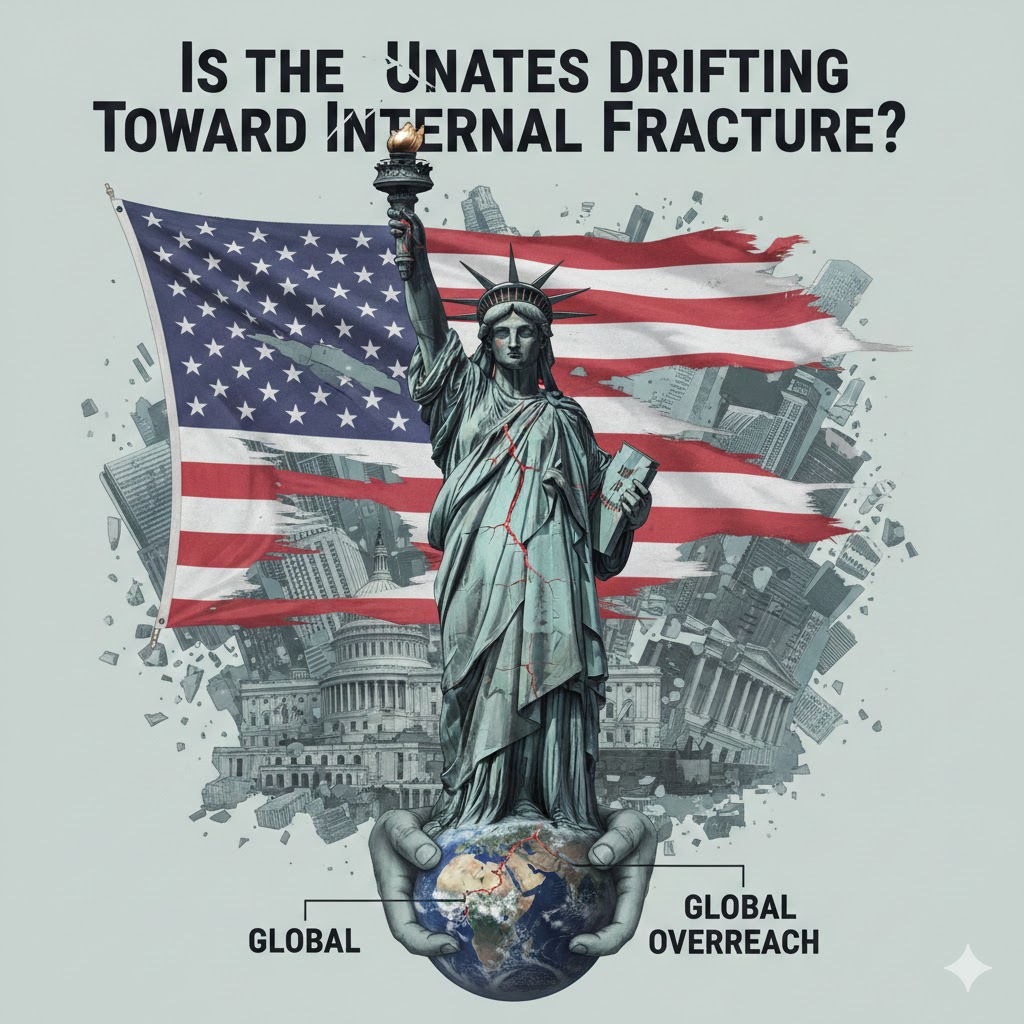
Introduction: Fracture Without Collapse
The question of whether the United States is heading toward civil war is often asked in dramatic, historically loaded terms. Images of armed militias, contested elections, political violence, and irreconcilable polarization feed comparisons with 19th-century America. Yet this framing, while emotionally compelling, misunderstands the nature of power, conflict, and state stability in the 21st century. The more relevant question is not whether the United States will collapse suddenly, but whether it is entering a prolonged phase of internal fracture without formal breakdown.
The United States remains territorially intact, economically vast, and militarily dominant. But strength at the surface can coexist with erosion beneath. Modern states do not fail only through secession or battlefield defeat; they weaken when shared legitimacy dissolves, when institutions lose moral authority, and when citizens no longer agree on the basic rules of political life. In such conditions, conflict becomes chronic rather than decisive.
What makes the current American moment distinct is not polarization alone—many societies are polarized—but the breadth of institutional mistrust. Elections, courts, federal agencies, media, and even the idea of objective truth have become contested terrain. When disagreement extends beyond policy into the legitimacy of the system itself, governance shifts from problem-solving to survival management.
Equally important is the timing of this internal strain. The United States is experiencing domestic fragmentation at the same moment it faces unprecedented external pressure: strategic competition with China, erosion of alliance cohesion, supply chain vulnerability, and the gradual dilution of monetary dominance. Historically, great powers could absorb internal tensions while projecting confidence abroad. Today, internal division and external overreach appear to be reinforcing one another.
This raises uncomfortable but necessary questions. Can a state lead a global order while its own social contract is contested? Can institutions command obedience when belief in their neutrality collapses? And what happens when political identity becomes existential—when compromise is perceived not as negotiation, but as surrender?
Unlike classical civil wars, modern internal conflict does not require two armies or declared fronts. It unfolds through legal defiance, parallel information systems, selective enforcement of laws, and episodic violence normalized as political expression. Authority persists, but coherence weakens. The state functions, but increasingly through friction rather than consent.
Another critical distinction lies between capacity and legitimacy. The United States retains immense capacity: surveillance, enforcement, military professionalism, and fiscal reach. But legitimacy cannot be enforced indefinitely. When power relies more on compulsion than consent, stability becomes expensive, brittle, and reactive. The question is not whether the state can impose order, but whether it can sustain trust.
This internal fracture is often personalized—attributed to leaders, parties, or cultural shifts—but personalization obscures structure. Political figures may accelerate division, but they do not create the underlying conditions. Those conditions are rooted in economic dislocation, cultural divergence, institutional opacity, and a political system struggling to reconcile 20th-century frameworks with 21st-century realities.
Finally, there is a global dimension to this internal story. A fragmented America does not withdraw quietly; it becomes unpredictable. Domestic instability narrows strategic consensus, shortens time horizons, and encourages symbolic action over structural reform. In this way, internal fracture becomes not just a domestic issue, but a variable in global instability.
This essay does not argue that the United States is destined for collapse. It argues something more precise—and more concerning: that America may be entering a long phase of managed instability, where institutions endure but cohesion erodes, where conflict simmers without resolution, and where the cost of maintaining order steadily rises.
Understanding this trajectory requires moving beyond sensationalism and asking a harder question: not whether the United States can survive internal division, but whether it can adapt fast enough to restore legitimacy before fracture becomes permanent.
The Nature of Modern Internal Conflict
Internal conflict in advanced states no longer follows the historical patterns that shape popular imagination. The classic model of civil war—two identifiable sides, territorial division, armed confrontation, and a decisive outcome—belongs to an earlier era of statehood. In complex, networked societies, power is diffuse, institutions are layered, and conflict migrates away from battlefields into systems.
Modern internal conflict is therefore less about overthrow and more about delegitimation. It does not aim to seize the state outright; it seeks to render the state ineffective, untrusted, or selectively obeyed. Authority persists formally, but compliance becomes conditional. Laws exist, but their application is contested. Elections occur, but their outcomes are disputed. Governance continues, but without consensus on its moral basis.
In this context, violence is episodic rather than total. It appears as protests that cross into unrest, political intimidation, isolated attacks, and threats normalized through rhetoric. These incidents do not escalate into nationwide warfare precisely because the state retains overwhelming coercive capacity. Yet that capacity is rarely decisive, because the conflict is not about force—it is about belief.
A defining feature of modern internal conflict is asymmetry of engagement. Different segments of society experience the state in radically different ways. For some, institutions remain protective and responsive. For others, they appear distant, punitive, or captured by elites. This divergence produces incompatible interpretations of legitimacy. When legitimacy fragments, obedience fragments with it.
Another critical shift lies in the relationship between law and politics. In stable systems, law arbitrates political disagreement. In fractured systems, law becomes a political weapon. Courts, regulatory bodies, and enforcement agencies are perceived not as neutral arbiters but as extensions of partisan struggle. Each legal decision reinforces suspicion rather than resolution.
Information ecosystems amplify this process. Modern internal conflict thrives on epistemic fragmentation—the breakdown of a shared factual baseline. Competing narratives do not merely interpret events differently; they construct entirely different realities. In such conditions, persuasion becomes impossible. Politics shifts from debate to mobilization, from consensus-building to identity defense.
Federal systems are particularly vulnerable to this form of conflict. When authority is distributed across national and subnational levels, selective compliance becomes structurally feasible. States, municipalities, and institutions can resist, reinterpret, or delay enforcement without declaring rebellion. This produces what might be called constitutional drag: the system functions, but only through friction and negotiation.
Importantly, modern internal conflict is often self-stabilizing in the short term and destabilizing in the long term. The absence of full-scale violence creates the illusion of resilience. Institutions continue to operate. Markets function. Daily life proceeds. Yet beneath this surface continuity, trust erodes incrementally. Each crisis resolved procedurally but not morally deepens the fracture.
Unlike revolutionary conflict, this form of internal struggle lacks a clear endpoint. There is no victory condition, no surrender, no decisive reform moment. Instead, it produces chronic instability—a permanent state of political exhaustion in which energy is consumed managing crises rather than solving underlying problems.
This is what makes modern internal conflict so dangerous. It does not announce itself with collapse. It normalizes dysfunction. Over time, citizens adapt to instability as a baseline condition. Expectations lower. Cynicism rises. Participation becomes transactional or performative rather than civic.
In such systems, the greatest risk is not violence, but irreversibility. Once trust in institutions collapses across generations, restoration becomes exponentially harder. Legitimacy cannot be rebuilt quickly, and coercion cannot substitute for it indefinitely.
Understanding the nature of modern internal conflict is therefore essential to understanding why the United States is not on the brink of a dramatic civil war—and why it may nonetheless be entering one of the most strategically vulnerable phases in its history.
Institutional Legitimacy as the Primary Battleground
The central struggle within the United States is not over policy outcomes, electoral victories, or ideological dominance. It is over institutional legitimacy—the shared belief that the rules of the system are fair, neutral, and binding even when they produce unfavorable results. Once this belief weakens, the state enters a dangerous zone where authority exists but acceptance does not.
Legitimacy differs fundamentally from power. Power compels behavior; legitimacy elicits consent. A state can function temporarily with power alone, but it cannot remain stable indefinitely without legitimacy. The American system was historically resilient because institutions were trusted even when contested. Elections could be lost without being rejected. Courts could rule without being delegitimized. Federal authority could be challenged without being denied outright.
That equilibrium is now breaking down.
Large segments of the population no longer view core institutions—electoral bodies, courts, federal agencies, law enforcement, and media—as impartial. Instead, they are perceived as aligned, captured, or selectively enforced. This perception matters more than objective reality, because legitimacy is psychological before it is legal. Once belief erodes, every institutional action is interpreted through suspicion.
This creates a self-reinforcing cycle. Institutions, facing defiance and distrust, respond by asserting authority more aggressively. Enforcement becomes more visible, more legalistic, and more centralized. Yet each assertion of authority, rather than restoring confidence, is seen by skeptics as confirmation of bias. The harder institutions push, the more resistance hardens.
The battleground thus shifts from governance to interpretation. The same election, ruling, or investigation produces opposite conclusions depending on the observer’s prior trust in the system. Institutions cease to resolve conflict and instead become sites of conflict.
Federalism amplifies this dynamic. Because authority is divided between national and state levels, legitimacy can fracture unevenly. Some states and localities continue to recognize federal authority fully; others comply selectively or symbolically. This does not constitute rebellion, but it erodes uniformity. The law remains national in theory, but local in practice.
Equally destabilizing is the politicization of enforcement. When laws are perceived as applied inconsistently—strictly against some groups, leniently toward others—the idea of equal citizenship weakens. Even accurate enforcement loses legitimacy if it is believed to be partisan. In such conditions, legality no longer confers moral authority.
Another critical dimension is generational. Younger cohorts inherit skepticism as a default orientation rather than a reaction to specific events. Institutions once defended as flawed but necessary are now viewed as obsolete or irredeemable. This shift matters because legitimacy lost across generations is far harder to restore than legitimacy lost in a single crisis.
Importantly, legitimacy erosion does not require institutional failure. It can occur even when institutions function efficiently. Performance without trust does not stabilize systems; it alienates them. A population that obeys but does not believe is not loyal—it is merely compliant, and compliance is fragile under stress.
This is why the crisis of legitimacy is more dangerous than polarization alone. Polarization can exist within a shared system. Legitimacy collapse questions the system itself. When political conflict moves from what should be done to who has the right to decide, compromise becomes nearly impossible.
The state’s greatest vulnerability emerges precisely here. Coercive capacity remains intact, but its use accelerates the perception of authoritarianism. Restraint, meanwhile, is interpreted as weakness or complicity. Institutions are trapped between enforcement that erodes trust and restraint that invites defiance.
Historically, states that lose legitimacy do not fall immediately. They enter prolonged periods of instability marked by legal ambiguity, episodic unrest, and constant institutional crisis. Authority becomes expensive to maintain and brittle under shock.
The United States is approaching this threshold—not because its institutions have collapsed, but because belief in their neutrality has fractured. This is the defining feature of modern internal conflict: the battle is not over who controls the institutions, but over whether the institutions are worth controlling at all.
Until legitimacy is restored—or reconstituted through a new social settlement—every political victory will deepen division, and every institutional assertion will carry diminishing returns.
Geographic Polarization and the Rise of Soft Secession
One of the most consequential yet least dramatized developments in the United States is the growing divergence between regions—not merely in political preference, but in how authority itself is recognized and exercised. This is not secession in the historical sense. No flags are being raised, no borders redrawn. Instead, the country is experiencing what can be described as soft secession: the gradual withdrawal of functional cooperation within a formally unified state.
American federalism was designed to accommodate diversity while preserving coherence. States were granted autonomy, but within a shared constitutional framework that assumed baseline agreement on federal authority. That assumption is weakening. Increasingly, states are not just experimenting with policy—they are selectively contesting legitimacy.
This shift is visible across multiple domains:
- States refusing to enforce federal immigration directives
- States openly defying federal rulings on abortion, gun regulation, or environmental policy
- States creating parallel regulatory regimes that contradict national standards
- Governors positioning themselves as counterweights to federal authority rather than partners
None of this constitutes rebellion. Yet collectively, it erodes the idea of uniform governance. The federal government remains sovereign in theory, but sovereignty becomes negotiated in practice.
Soft secession is especially destabilizing because it exploits the design of federal systems. Authority is distributed, enforcement is decentralized, and compliance depends heavily on cooperation. When political disagreement turns into institutional non-alignment, the system slows, fragments, and becomes inconsistent without formally breaking.
Geographic polarization reinforces this dynamic. “Red” and “blue” states are no longer just voting blocs; they increasingly resemble distinct political ecosystems with different legal norms, economic priorities, and social expectations. Citizens experience radically different versions of the state depending on where they live. Over time, this produces divergent understandings of citizenship itself.
Crucially, soft secession is not driven primarily by ideology, but by trust asymmetry. States that distrust federal institutions justify defiance as protection of local sovereignty. States that trust federal authority view defiance as lawlessness. Each side sees itself as defending constitutional order. The constitution becomes a shared text with incompatible interpretations.
Economic incentives deepen the divide. States increasingly compete for investment, labor, and cultural alignment by signaling political identity. Laws become branding tools. Governance turns performative. Policy choices are shaped as much by symbolic defiance as by practical outcomes. This incentivizes escalation rather than compromise.
The danger of soft secession lies in its cumulative effect. Each instance of selective compliance sets precedent. Each unresolved conflict normalizes fragmentation. Over time, the cost of reasserting uniform authority rises, while the political appetite for doing so declines. The center weakens not because it is overthrown, but because it is exhausted by constant negotiation.
There is also a feedback loop between geography and identity. As political identities harden, citizens self-sort—moving to regions that reflect their values. This demographic sorting amplifies polarization, making regional differences more durable and less negotiable. Politics becomes territorial without becoming territorialized.
Historically, states survive regional diversity when differences are moderated by shared purpose or external threat. Today, external pressures coexist with internal disagreement about priorities and obligations. The result is fragmentation without coordination—states responding to national challenges independently rather than collectively.
Soft secession does not produce dramatic moments. It produces institutional drag. Federal initiatives stall. Court rulings are unevenly applied. National crises are met with regional solutions. Over time, the idea of a single national response becomes implausible.
This form of fragmentation is particularly dangerous because it is reversible only at high political cost. Reasserting cohesion would require restoring trust in federal neutrality, renegotiating the balance of authority, and rebuilding a sense of shared destiny. Without such a recalibration, soft secession hardens into structural separation.
The United States is not splitting apart on maps. It is drifting apart in practice. And in modern states, functional separation often precedes—and sometimes replaces—formal rupture.
Economic Stratification and the Transformation of Political Identity
Economic inequality, by itself, does not fracture states. Many societies have endured vast disparities without systemic breakdown. What destabilizes political order is not inequality as a condition, but inequality as a narrative—when large segments of the population come to believe that the system is structurally closed, rigged, or indifferent to their future. In the United States, this belief has become widespread and politically catalytic.
The American social contract was historically anchored in mobility rather than equality. Disparities were tolerated because they were perceived as temporary or navigable. That assumption has weakened. For many citizens, particularly outside major urban centers, economic outcomes now appear decoupled from effort, education, or conformity to social norms. When upward mobility stalls, inequality stops being an economic issue and becomes a legitimacy crisis.
This shift transforms material stress into political identity. Economic position hardens into worldview. People no longer interpret hardship as misfortune, but as evidence of systemic exclusion. The language of class blends with the language of culture, geography, and resentment. Politics ceases to be about redistribution or reform and becomes about recognition and blame.
What makes this transformation especially dangerous is that it resists technocratic solutions. Policy interventions—tax credits, retraining programs, stimulus measures—address material symptoms but not perceived injustice. When individuals believe the system itself is hostile, incremental improvements are dismissed as cosmetic or manipulative. Trust in expertise collapses alongside trust in institutions.
Economic stratification also maps onto cultural and spatial divides. Prosperity clusters in metropolitan regions integrated into global finance, technology, and services. Decline concentrates in areas tied to deindustrialization, resource extraction, or logistics without upward mobility. These regions experience the global economy not as opportunity, but as extraction without return. The result is geographic resentment, which reinforces political polarization.
Over time, this produces two incompatible moral economies. One views globalization, automation, and diversification as progress. The other experiences them as dispossession. Each side sees the other not merely as mistaken, but as complicit in harm. Economic debate becomes moralized. Policy disagreement becomes existential.
This dynamic is intensified by the personalization of blame. Structural forces—technological change, capital mobility, demographic shifts—are abstract and impersonal. Political identity requires tangible antagonists. Elites, institutions, immigrants, corporations, and distant governments become symbolic stand-ins for systemic complexity. Simplified narratives gain power precisely because they offer emotional clarity.
Another critical feature of this transformation is loss of future orientation. When people believe that tomorrow will be worse than today, politics becomes defensive. Preservation replaces ambition. Compromise becomes suspect because it implies acceptance of decline. In such conditions, radical narratives outperform pragmatic ones—not because they are more accurate, but because they acknowledge despair.
Economic stratification also reshapes political participation. Those who feel excluded disengage from conventional civic processes while becoming more receptive to disruptive action. Voting loses meaning if outcomes feel predetermined. Protest, obstruction, and symbolic defiance gain appeal because they offer agency where formal channels do not.
Importantly, this process does not require absolute poverty. Relative decline, status loss, and perceived humiliation are often more politically potent than deprivation. A population that feels it is falling behind reacts more aggressively than one that has always been marginalized. This helps explain why internal fracture intensifies even amid overall economic growth.
Once economic grievance crystallizes into political identity, it becomes self-reinforcing. Media ecosystems cater to it. Political entrepreneurs mobilize it. Institutions struggle to address it because doing so requires acknowledging structural failure. Each unaddressed grievance deepens alienation.
The danger, then, is not inequality alone, but the point at which inequality convinces citizens that the system no longer offers a future worth investing in. At that point, loyalty becomes conditional, compliance becomes transactional, and politics becomes a vehicle for expression rather than resolution.
When economic stratification reaches this stage, internal conflict no longer needs organization or ideology. It sustains itself through perception. And once identity replaces interest as the driver of politics, reconciliation becomes exponentially harder.
This is the silent engine behind modern internal fracture—and one of the hardest to shut down once it gains momentum.
Information Fragmentation and the End of a Shared Reality
Every stable political system depends on a minimum level of shared reality—a common understanding of facts, procedures, and legitimate sources of authority. Disagreement is normal; disagreement without a shared factual baseline is destabilizing. In the United States, this baseline is rapidly eroding, producing one of the most dangerous conditions for internal cohesion: epistemic fragmentation.
This is not simply a problem of misinformation or partisan media. It is a structural transformation in how information is produced, consumed, and trusted. Digital platforms have collapsed the hierarchy of knowledge. Expertise competes with virality. Authority competes with familiarity. Emotion outperforms verification. As a result, truth becomes personalized rather than institutional.
In such an environment, societies do not merely argue over interpretations of events; they disagree on what has occurred at all. Elections are either legitimate or fraudulent. Institutions are either neutral or captured. Crises are either real or fabricated. These positions are not debated—they are asserted as axiomatic truths within separate information ecosystems.
This fragmentation creates parallel publics. Citizens inhabit distinct narrative worlds reinforced by algorithms, social networks, and identity alignment. Exposure to contradictory information does not correct belief; it hardens it. Evidence becomes suspect if it originates from the “wrong” source. Trust shifts from institutions to tribes.
The political consequences are severe. Democratic governance assumes that persuasion is possible—that arguments, evidence, and accountability can shift opinion. When shared reality collapses, persuasion fails. Politics shifts from deliberation to mobilization. The goal is no longer to convince, but to activate, defend, and outlast.
Institutions are uniquely vulnerable in this environment. Courts, election bodies, public health agencies, and regulatory institutions rely on credibility rather than force. When their outputs are filtered through fragmented narratives, legitimacy collapses asymmetrically. An institution may be trusted by half the population and rejected by the other half. Functionally, this is worse than universal distrust—it politicizes every decision.
Information fragmentation also lowers the threshold for conflict. When opponents are perceived not as mistaken but as malicious or delusional, restraint erodes. Political competition becomes moralized. Compromise is reframed as collaboration with falsehood. This dynamic legitimizes extreme rhetoric and, eventually, extreme action.
Another destabilizing effect is temporal acceleration. Fragmented media environments reward immediacy over reflection. Crises unfold in real time, leaving little space for institutional response or correction. Governments appear perpetually behind events, reinforcing perceptions of incompetence or conspiracy. Rapid cycles of outrage replace sustained engagement.
Importantly, this condition is self-reinforcing. As institutional trust declines, people rely more heavily on alternative sources. As alternative sources gain influence, institutions lose further credibility. The feedback loop deepens fragmentation even in the absence of deliberate manipulation.
Foreign influence often receives attention in this context, but it is not the primary driver. External actors exploit existing fractures; they do not create them. The deeper issue is loss of narrative sovereignty—the inability of the state or society to establish authoritative accounts of reality that command broad acceptance.
This has profound implications for crisis management. In moments of emergency—pandemics, elections, security threats—states require compliance based on trust. When trust is absent, enforcement becomes the default tool. Enforcement without legitimacy escalates tension. Each crisis leaves deeper scars.
Over time, citizens adapt to this condition by lowering expectations. Confusion becomes normal. Contradiction becomes tolerated. Cynicism replaces outrage. This adaptation is dangerous because it stabilizes dysfunction. A society that no longer expects truth from its institutions becomes governable only through coercion or spectacle.
The end of a shared reality does not produce immediate collapse. It produces chronic instability—a state of constant contestation where governance is possible but ineffective, and legitimacy is perpetually contested.
In such an environment, the most powerful actors are not those with the best arguments, but those who can dominate attention, frame identity, and sustain emotional engagement. This marks a fundamental shift in the nature of power—from institutional authority to narrative control.
Without restoring some form of shared epistemic ground, no amount of economic reform, institutional redesign, or political turnover can resolve internal fracture. Governance requires agreement not on values, but on facts. When facts themselves become political, the state enters one of the most fragile phases of its existence.
This is not merely a media problem. It is a structural threat to democratic coherence—and one of the hardest to reverse once entrenched.
Political Figures as Accelerants, Not Causes
Periods of internal fracture often become personalized. Complex structural failures are compressed into familiar names, faces, and leaders. In the current American context, few figures illustrate this tendency more clearly than Donald Trump. He is frequently described as the source of polarization, the trigger of institutional distrust, or the embodiment of democratic erosion. While his role is significant, this framing mistakes acceleration for origin.
Political figures do not create fractures of this magnitude in functioning systems. They emerge because fractures already exist. Their success depends on unmet grievances, institutional opacity, and widespread perception that traditional channels no longer represent large segments of society. In this sense, such leaders are symptoms that gain agency, not anomalies that hijack stable systems.
The function of polarizing figures is catalytic. They articulate what institutions have failed to resolve. They collapse complex anxieties into emotionally legible narratives. They transform diffuse frustration into identity. This is not accidental; it is structurally enabled. When trust in institutions erodes, personalization becomes inevitable because institutions no longer mediate conflict effectively.
What makes such figures dangerous is not merely their rhetoric, but their ability to reframe legitimacy itself. Instead of contesting policy within accepted rules, they contest the rules as biased. Instead of challenging outcomes, they challenge the authority that produces outcomes. This move resonates precisely because many citizens already suspect institutional unfairness.
Equally important is the reaction such figures provoke. Institutional responses—investigations, legal challenges, media condemnation—often aim to defend norms. Yet in a fragmented legitimacy environment, these responses backfire. Enforcement is interpreted as persecution. Accountability is reframed as suppression. Each institutional assertion deepens the narrative of capture.
This creates a destructive feedback loop. The figure thrives on conflict with institutions. Institutions, in turn, feel compelled to assert authority to preserve credibility. Neither side can retreat without appearing to concede legitimacy. The system becomes locked into performative confrontation, where symbolism outweighs resolution.
Crucially, removing or marginalizing individual figures does not resolve the underlying fracture. The narratives they activate do not disappear; they migrate. New figures adopt similar rhetoric. Movements persist without centralized leadership. This continuity reveals the structural nature of the problem. The demand for disruption outlives the disruptor.
Another misconception is that such figures polarize evenly. In reality, their impact is asymmetric. They mobilize one segment intensely while radicalizing opposition in response. The political center erodes not because it is attacked directly, but because it becomes irrelevant to a conflict framed as existential. Neutrality is interpreted as complicity. Moderation becomes politically costly.
This dynamic also alters elite behavior. Political actors who might otherwise resist polarization adapt to survive it. Language hardens. Positions simplify. Strategic ambiguity disappears. Over time, even institutional actors begin to mirror the rhetoric of conflict, further collapsing the boundary between governance and mobilization.
Importantly, political accelerants thrive in environments where outcomes feel disconnected from participation. When citizens believe voting, litigation, or civic engagement no longer produce meaningful change, they gravitate toward figures who promise disruption rather than reform. The appeal is not ideology, but agency.
The fixation on personalities thus obscures the more difficult task of structural repair. It allows societies to imagine that stability can be restored through removal rather than transformation. History suggests otherwise. When legitimacy fractures, leadership changes without institutional recalibration merely reshuffle conflict.
The real analytical danger lies in moral reductionism—casting internal fracture as a battle between good leaders and bad leaders. This framing absolves institutions of responsibility and delays reform. It converts structural crises into character dramas.
Political figures matter. They can hasten breakdown or restraint. But they operate within constraints created by economic stratification, information fragmentation, and institutional mistrust. Treating them as causes misdiagnoses the illness and prescribes ineffective cures.
In fractured systems, the question is not who leads, but what conditions leadership responds to. Until those conditions change, new accelerants will continue to emerge, regardless of who occupies formal power.
This is why internal fracture persists even as political actors rise and fall. The stage remains unstable, even as the cast changes.
Conclusion: Fracture as a Condition, Not an Event
The United States is not approaching civil war in its classical sense, nor is it on the verge of sudden institutional collapse. What it is experiencing is something more ambiguous and, in many ways, more difficult to resolve: a prolonged condition of internal fracture. This fracture is not defined by territorial separation or organized rebellion, but by the erosion of shared legitimacy, coherence, and trust across institutions, regions, and narratives.
Modern states rarely fail through dramatic rupture. They weaken through normalization of dysfunction. In the American case, institutional authority still exists, but it is increasingly contested; governance still functions, but through friction rather than consent; political participation continues, but is driven more by identity than by belief in outcomes. These are the markers not of imminent collapse, but of managed instability.
What makes this condition particularly consequential is its interaction with external power. Internal fracture narrows strategic consensus, compresses time horizons, and incentivizes symbolic action over structural reform. As a result, foreign policy becomes reactive and erratic, while global leadership becomes harder to sustain. External overreach, in turn, feeds domestic polarization by raising costs, intensifying elite conflict, and reinforcing perceptions of systemic failure. The two dynamics reinforce one another in a closed loop.
The focus on political personalities obscures this reality. Leaders may accelerate division, but they do not manufacture the conditions that sustain it. Structural forces—economic stratification, information fragmentation, institutional opacity, and geographic polarization—shape the environment in which political actors operate. Until these forces are addressed, changes in leadership will alter tone but not trajectory.
The most dangerous aspect of internal fracture is not violence, but irreversibility. Trust lost over generations cannot be quickly restored. Legitimacy, once hollowed out, cannot be imposed through law or force without escalating resistance. States can endure such conditions for long periods, but at rising cost and diminishing effectiveness.
Yet fracture does not eliminate agency. The United States retains immense institutional capacity, social capital, and adaptive potential. The challenge is not survival, but recalibration. Restoring legitimacy requires more than procedural fixes; it demands a renewed social settlement that aligns economic opportunity, institutional neutrality, and narrative coherence with contemporary realities.
History suggests that great powers do not fail because they face internal conflict, but because they fail to recognize the form that conflict has taken. The American fracture is not visible in borders or armies, but in belief and consent. Addressing it requires abandoning the comfort of dramatic metaphors and confronting the harder truth: stability in the 21st century is not maintained by dominance alone, but by credibility, restraint, and shared meaning.
The United States is not yet broken. But it is being tested—not by revolution, but by endurance. Whether it emerges renewed or diminished will depend on its ability to adapt its institutions, narratives, and global role to a world—and a society—that no longer accepts authority by default.