





How a spiritual message ignited the greatest scientific transformation in human history
The Night That Changed the World
In the silent stillness of a cave on Mount Hira, in the year 610 CE, an unlettered man stood trembling before an unseen reality. He expected death — but instead received a command that would reshape history:
“Iqra’!” – “Read!”
This was not merely the birth of a religion.
This was the birth of a civilization of knowledge.
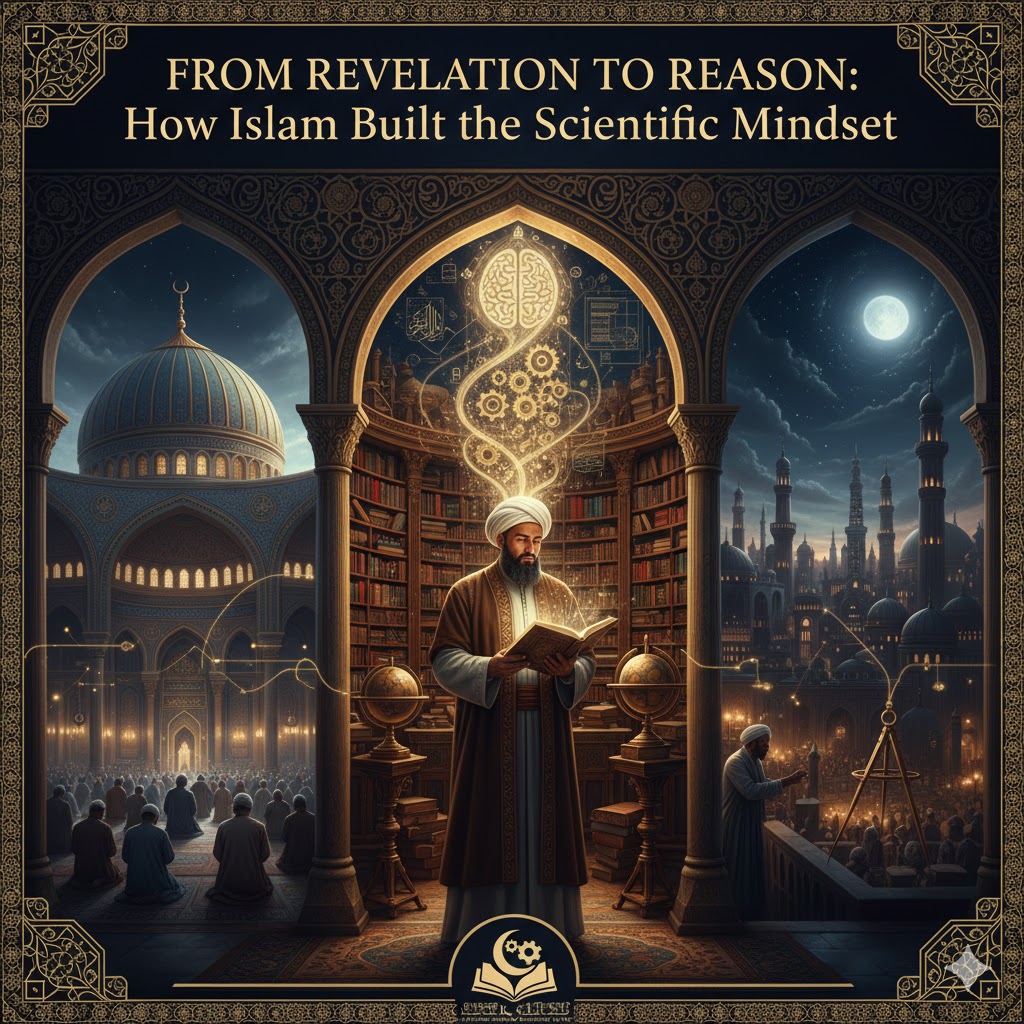
The rise of modern science is often narrated as a European phenomenon beginning with the Renaissance. However, this narrative overlooks a critical civilizational chapter that laid the intellectual and methodological foundations of modern knowledge: the Golden Age of Islam. Between the eighth and fourteenth centuries, the Muslim world produced a scientific culture that transformed inherited philosophy into systematic experimentation, theory into application, and belief into disciplined inquiry. This transformation did not occur by historical accident—it was rooted in the worldview established by Islam itself.
Islam introduced a radical reorientation of humanity’s relationship with knowledge. The very first revelation of the Qur’an began with the command “Read” (Iqra’)—a directive that positioned learning not as a privilege, but as a moral responsibility. Unlike earlier civilizations where knowledge was confined to elites, priests, or royal courts, Islamic civilization universalized access to education and made intellectual pursuit a religious obligation for all members of society, regardless of class or gender. This principle dismantled previous educational hierarchies and produced an unprecedented culture of learning.
At the heart of this intellectual revolution was Tawhid (the Oneness of God), which stripped nature of mythical divinity and redefined it as an ordered system governed by divine laws. By rejecting superstition and sacred cosmology, Islam rendered the universe intelligible, measurable, and open to investigation. Phenomena such as disease, planetary motion, physics, and natural forces were no longer explained through myth, but through observation, reason, and directed study. This theological framework created the philosophical conditions necessary for the emergence of empirical science.
Moreover, the Qur’an repeatedly calls upon humans to observe the heavens and the earth, reflect upon history, analyze societies, study the human body, and contemplate the laws governing nature. These commands converted reflection into worship and inquiry into devotion. As a result, scholarship in the Muslim world did not develop in opposition to faith, but as an extension of it. Scientific investigation became an act of religious fulfillment rather than intellectual rebellion.
This foundational mindset produced a civilization in which mosques functioned as universities, scholars were publicly honored, state institutions funded research, and the preservation and expansion of knowledge became a political priority. Within a century of Islam’s emergence, the Muslim world had developed sophisticated educational networks, vast libraries, and specialized scientific institutions. This environment paved the way for breakthroughs in medicine, mathematics, astronomy, engineering, navigation, historiography, and experimental science—centuries before similar systems emerged in Europe.
This first part of the series explores how Islam established the intellectual framework that made scientific civilization possible. Before laboratories, observatories, hospitals, and mechanical industries could exist, a deeper transformation was required: the transformation of how humanity understood knowledge itself. The Golden Age of Islam began not with instruments, but with a worldview that united faith and reason into a single, powerful engine of progress.
1. Knowledge as a Sacred Duty: The Qur’anic Foundations of the Scientific Mindset
The scientific revolution of the Muslim world did not emerge merely from political power or economic prosperity; it was rooted in a religious worldview that elevated knowledge to the highest spiritual rank. Unlike earlier civilizations where learning was largely confined to priesthoods, royal courts, or philosophical elites, Islam democratized knowledge by transforming it into a universal moral obligation. This shift represents one of the most significant intellectual turning points in human history.
The Qur’an repeatedly establishes knowledge as the defining trait of human superiority. In its earliest revelations, learning is not presented as optional or utilitarian, but as an essential component of faith itself. The declaration “Are those who know equal to those who do not know?” (39:9) defines knowledge as a moral boundary between intellectual responsibility and negligence. Similarly, the Qur’an consistently links observation with belief: humans are commanded to study the heavens, analyze the earth, reflect upon the alternation of night and day, and examine the origins of life. These directives transformed nature into an open book—one to be read, measured, and understood.
This Qur’anic worldview created a revolutionary synthesis between faith and reason. In contrast to civilizations where religion and rational inquiry stood in tension, Islamic thought placed them in a relationship of mutual reinforcement. Knowledge was no longer viewed as dangerous to belief; rather, ignorance became the true spiritual threat. This principle reshaped educational priorities across the Muslim world. Children were taught literacy as a religious act. Scholars were respected not only as intellectual authorities but as moral leaders. Scientific inquiry was no longer detached from ethics—it was guided by moral responsibility.
The Prophetic tradition further institutionalized this ethos. The statement “Seeking knowledge is obligatory upon every Muslim” carries an unprecedented historical implication: education became mandatory across gender, class, and ethnicity. In a world where most civilizations restricted formal education to narrow elites, Islam imposed learning as a collective civilizational duty. This single principle transformed society into a network of students and teachers, travelers and researchers, scribes and observers.
As a result, the Muslim world soon developed a knowledge-centered social structure. Mosques evolved into centers of education. Study circles became permanent institutions. Scholars received public funding. Libraries were integrated into urban planning. The pursuit of knowledge became one of the highest paths to social mobility. A poor student could surpass a noble by mastery of science and scholarship alone—an idea radically ahead of its time.
Most importantly, this Qur’anic epistemology reshaped the purpose of scientific activity itself. Science was not pursued merely for prestige, profit, or military advantage. It was pursued as an act of worship, service to humanity, and obedience to divine command. This moral orientation gave Islamic science both ethical discipline and long-term continuity, protecting it from becoming a tool of exploitation or destruction.
Thus, before Islam produced hospitals, observatories, and engineering systems, it produced something far more fundamental: a civilization that believed ignorance was a sin and knowledge was an act of devotion. This belief became the invisible foundation upon which the entire scientific structure of the Golden Age was built.
2. Tawhid and the Demythologization of Nature: How Islam Made Scientific Observation Possible
One of the most profound intellectual contributions of Islam to the development of science lies in its doctrine of Tawhid—the absolute Oneness of God. While Tawhid is primarily a theological principle, its epistemological and scientific consequences were revolutionary. By affirming that only God is divine and that everything else is creation governed by divine law, Islam fundamentally transformed how human beings understood nature, causality, and the structure of the universe.
Before Islam, many civilizations viewed nature through a mythological lens. The sun was a god, storms were driven by spirits, disease was caused by demons, and celestial bodies controlled human destiny. These beliefs made large parts of the natural world intellectually untouchable, beyond investigation or experimentation. To study such forces was often considered sacrilegious or dangerous. As long as nature was regarded as divine or magically animated, systematic scientific inquiry remained limited.
Islam dismantled this worldview at its root. By declaring that:
- the sun, moon, stars, wind, rain, and mountains are all created entities,
- and that they operate under fixed divine laws (sunan Allah),
Islam removed nature from the realm of superstition and placed it into the realm of ordered causality. The universe was no longer a battlefield of competing gods and spirits—it became a coherent, law-governed system designed for human observation and understanding.
This intellectual shift is clearly reflected in the Qur’anic language itself. Natural phenomena are not presented as objects of worship but as “signs” (ayat)—indications pointing beyond themselves to a higher order. The Qur’an repeatedly invites humans to:
- observe the motion of celestial bodies,
- study the formation of clouds and rainfall,
- analyze the growth of plants,
- reflect upon the development of the human body,
- and consider the rise and fall of civilizations.
In this framework, nature becomes meaningful precisely because it is not divine. It can be measured because it is not sacred in itself. It can be tested because it does not possess supernatural autonomy. This is a critical philosophical requirement for experimental science: nature must be stable, predictable, and governed by consistent laws. Tawhid provided exactly that foundation.
Furthermore, Tawhid also eliminated the concept of divine intermediaries within the physical world. There were no sacred priests controlling cosmic secrets, no hidden classes possessing special access to natural truth. Knowledge became universally accessible through observation, reasoning, and disciplined study. This theological equality translated directly into intellectual equality: any person, regardless of background, could investigate the workings of the universe.
This worldview also reshaped the understanding of causality. While Islam affirms that God is the ultimate cause of all things, it simultaneously affirms the existence of consistent secondary causes within the natural order. Fire burns, medicine heals, water flows, and celestial bodies follow precise trajectories—not randomly, but according to laws established by God. This balance preserved both divine sovereignty and scientific causation, preventing the collapse of science into either blind materialism or mystical fatalism.
As a result, Muslim scholars approached nature with both reverence and analytical confidence. They were not afraid to experiment, dissect, test, and revise previous theories. They believed they were uncovering God’s design rather than violating it. This confidence is what allowed Muslim scientists to:
- challenge Greek astronomy,
- revise Galenic medicine,
- correct Ptolemaic models,
- and invent entirely new scientific disciplines.
Thus, Tawhid did not merely shape Muslim theology—it reconstructed the intellectual architecture of science itself. By stripping nature of myth and anchoring it in law, Islam created the philosophical conditions required for observation, experimentation, and scientific progress. Without this transformation, the laboratories, observatories, hospitals, and mathematical sciences of the Golden Age could never have emerged.
In short, Islam made science possible not by weakening faith, but by redefining the universe as an intelligible system under One God.


3. From Reflection to Experimentation: The Birth of the Scientific Method in Islamic Civilization
While earlier civilizations made remarkable philosophical and mathematical contributions, their approach to knowledge remained largely theoretical. Greek thinkers emphasized logical speculation, Indian scholars advanced numerical concepts, and Persian traditions preserved medical knowledge. However, none of these civilizations fully established a systematic experimental methodology where observation, testing, verification, and revision became the standard path to truth. That transformation occurred within Islamic civilization.
Islam did not merely encourage reflection (tafakkur); it elevated verification (tahqiq) as a core intellectual value. The Qur’an repeatedly criticizes blind imitation and inherited assumptions, commanding believers to seek evidence and certainty. Statements such as “Bring your proof if you are truthful” (2:111) established an epistemic culture in which claims demanded demonstration. This demand for proof became the philosophical root of what is now known as the scientific method.
Muslim scholars developed a disciplined process of investigation that included:
- careful observation of natural phenomena,
- formulation of hypotheses,
- controlled experimentation,
- precise measurement,
- systematic documentation,
- and peer evaluation.
Unlike earlier traditions that often relied on inherited authority, Muslim scientists insisted that knowledge must be tested against reality itself. Texts were respected, but they were not immune to revision. This shift marked the transition from classical philosophy to experimental science.
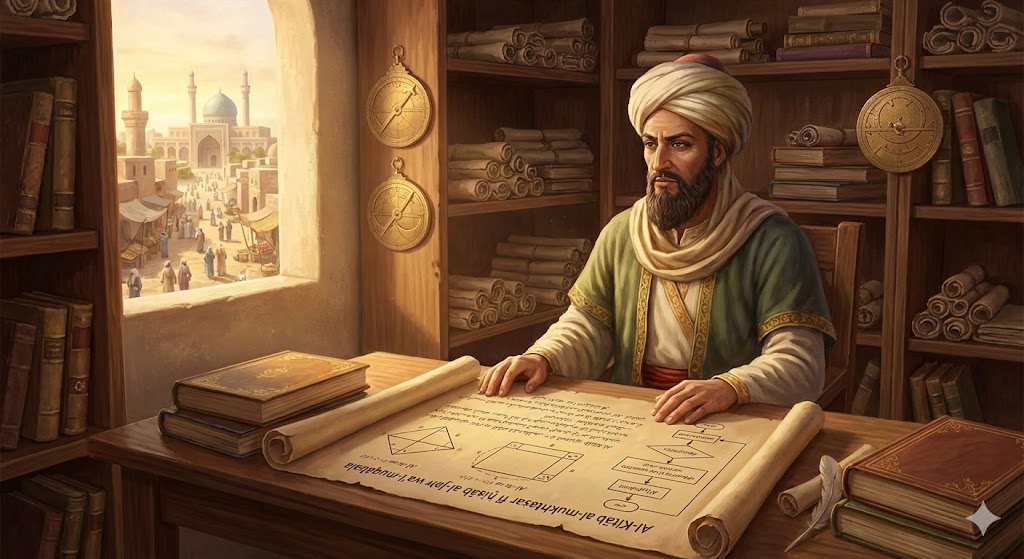
One of the clearest demonstrations of this transformation appears in the work of Ibn al-Haytham (Alhazen) in optics. Rejecting accepted Greek theories of vision, he constructed controlled experiments to test how light behaves, proving that vision occurs when light enters the eye rather than emanating from it. His method closely resembles the structure of modern scientific research: hypothesis, experiment, analysis, and conclusion. For this reason, many historians identify him as one of the first true experimental scientists in history.
In medicine, this experimental mindset revolutionized clinical practice. Muslim physicians no longer relied solely on ancient medical texts; they:
- tested drugs through observation,
- compared treatment outcomes,
- recorded patient histories,
- developed differential diagnosis,
- and introduced disease classification based on symptoms and causes.
Hospitals became laboratories, not merely places of care. Medical theory was constantly refined through practice. This dynamic relationship between theory and observation formed the backbone of modern clinical science.
In chemistry, Muslim scholars moved beyond alchemy as mysticism and transformed it into experimental laboratory science. Scholars such as Jabir ibn Hayyan established structured experimentation, standardized procedures, and systematic observation of chemical reactions. Techniques such as distillation, crystallization, filtration, and sublimation were refined and documented. These methods became essential to pharmacology, metallurgy, and industrial chemistry.
Astronomy likewise shifted from purely geometric speculation to instrument-based measurement. Muslim observers constructed large-scale observatories, built precise instruments, and created complex astronomical tables based on long-term observation rather than inherited models. Their systematic data collection corrected major errors in Greek astronomy and laid the groundwork for later celestial mechanics.
Equally important was the culture of documentation that accompanied experimentation. Muslim scholars meticulously recorded their procedures, errors, results, and revisions. Knowledge became cumulative rather than static. One scholar could build upon the verified findings of another across generations and continents. This continuity is the defining feature of true scientific civilization.
Thus, the scientific method did not emerge suddenly in early modern Europe—it matured gradually within Islamic civilization over several centuries. The Muslim world transformed reflection into verification, speculation into experiment, and theory into application. This institutionalization of experimental science became the engine that powered medicine, engineering, chemistry, astronomy, and physics throughout the Golden Age.
In essence, Islamic civilization did not merely inherit scientific knowledge—it invented the very method by which modern science operates.
4. Education, Institutions, and the Globalization of Knowledge in the Early Muslim World
The transformation of scientific thought in Islamic civilization was not limited to individual genius; it was supported by a vast and highly organized educational and institutional infrastructure. Unlike earlier civilizations where learning remained concentrated in elite circles, the Muslim world constructed a systematic, publicly accessible network of education that allowed knowledge to spread across regions, classes, and generations. This institutionalization of learning was a decisive factor in the success and longevity of the Islamic scientific tradition.
At the center of this intellectual expansion stood the mosque, which functioned not only as a place of worship but also as a primary educational institution. From the earliest period of Islam, mosques hosted study circles in Qur’anic studies, law, language, mathematics, medicine, and astronomy. These gatherings were open to all who wished to learn. The absence of rigid admission barriers created a knowledge culture defined by merit rather than lineage or wealth. A poor student from a distant village could sit beside the son of a ruler and compete solely through intellectual excellence.
By the ninth century, more specialized institutions began to emerge. The most famous among them was the Bayt al-Hikmah (House of Wisdom) in Baghdad, which served simultaneously as:
- a translation institute,
- a research academy,
- a massive library,
- and a center for interdisciplinary collaboration.
Here, scholars translated works from Greek, Persian, Indian, and Syriac sources into Arabic, critically analyzed them, and expanded upon them through original research. This was not passive preservation; it was an active process of verification, correction, synthesis, and innovation. The global history of science changed permanently once this knowledge entered the Arabic intellectual world.
Parallel to research institutions, the Muslim world also pioneered madrasah systems—formal colleges dedicated to higher education. These institutions offered structured curricula, professional certification, salaried professors, dormitories for students, and endowments (waqf) that ensured financial independence from political instability. Such features appear centuries later in European universities, strongly suggesting an institutional inheritance.
Libraries became core elements of urban identity. Cities such as Baghdad, Cairo, Cordoba, Nishapur, Samarkand, and Damascus housed libraries containing hundreds of thousands of volumes—at a time when Europe’s largest collections numbered in the hundreds. Books were copied professionally, sold commercially, and circulated widely. Knowledge thus became an economic commodity and a public good.
Equally transformative was the rise of a scholarly travel culture. Students journeyed across deserts and seas to study with recognized masters. A scholar might begin his education in Central Asia, continue it in Baghdad, complete it in Cairo, and transmit it in Andalusia. This circulation of knowledge produced a global scientific network connecting three continents. Ideas did not remain regional; they became universal within the Muslim intellectual domain.
Another remarkable feature of Islamic education was the culture of peer review and certification. Scholars granted authorizations (ijazah) only after rigorous examination of a student’s knowledge. A scientific claim gained authority not through political power, but through scholarly consensus. This system ensured intellectual quality control across generations.
Through these institutions, learning was no longer an individual struggle—it became a civilizational system. Knowledge could outlive rulers, survive political collapse, and move freely across cultural boundaries. Medicine taught in Iraq was practiced in Spain. Astronomy refined in Central Asia guided navigation in the Indian Ocean. Mathematical theories developed in Khwarezm shaped engineering in North Africa.
Thus, Islamic civilization did something unprecedented: it globalized knowledge centuries before modern globalization. This intellectual unity allowed discoveries to accumulate, interact, and accelerate across space and time. Without this institutional network, the scientific achievements of the Golden Age would have remained isolated rather than becoming the foundation of world civilization.
In summary, the scientific revolution of Islam was not only philosophical or methodological—it was institutional, global, and self-sustaining. By embedding education into social life, architecture, economy, and governance, the Muslim world created the first truly international scientific civilization.
5. The Scholar as a Social Ideal: How Islamic Civilization Replaced Warriors with Thinkers as Its Highest Figures
One of the most decisive cultural transformations introduced by Islam was the redefinition of social prestige. In many pre-Islamic societies, the highest status was reserved for warriors, kings, priests, or aristocrats. Power, lineage, and military force determined honor. Islamic civilization, however, introduced a radically different hierarchy—one in which the scholar (ʿalim) surpassed the warrior in social authority, and knowledge became a higher currency than bloodline or brute strength.
This shift was anchored directly in Islamic belief. The Qur’an explicitly elevates those who possess knowledge, declaring that God raises in rank those who believe and those who are given knowledge. The Prophet Muhammad ﷺ reinforced this hierarchy through numerous statements that placed scholars above martyrs in intellectual rank, described ink as more sacred than blood, and characterized scholars as the inheritors of prophetic authority. In doing so, Islam institutionalized a culture in which learning was not merely respected—it was revered as the highest form of service to God and society.
As a result, the public image of heroism changed across the Muslim world. Scholars became the most admired public figures. Their biographies were recorded with meticulous detail. Their journeys for knowledge were celebrated as acts of dedication. Their debates and writings shaped public policy, law, science, and ethics. In major cities, crowds gathered not for displays of luxury, but for public lectures on medicine, astronomy, philosophy, law, and theology.
This social transformation had profound scientific consequences. When scholars occupy the highest position in society, a powerful incentive emerges: intellectual excellence becomes the primary path to honor, authority, and lasting legacy. A poor student could surpass wealthy elites through scholarship alone. The son of a ruler had no automatic advantage over an unknown scholar without knowledge. This produced one of the most merit-based intellectual systems in pre-modern history.
The scholar was not a secluded monk detached from public life. In Islamic civilization, scholars actively shaped:
- legal systems,
- state administration,
- medical institutions,
- economic regulations,
- educational standards,
- and scientific priorities.
Physicians advised caliphs. Mathematicians designed state accounting systems. Astronomers determined calendars, navigation, and even military timing. Architects and engineers were trained scholars, not anonymous craftsmen. Thus, science was not isolated from governance—it was embedded directly within the structure of society.
Moreover, this scholarly culture produced an ethic of intellectual humility and continuity. Knowledge was regarded as a trust (amanah) rather than personal property. Scholars meticulously acknowledged sources, preserved earlier contributions, and saw themselves as links in a continuous chain of transmission rather than isolated geniuses. This prevented scientific knowledge from collapsing into individual ego and allowed it to accumulate systematically across centuries.
The elevation of scholarship also created a powerful ethical boundary for science. Because scholars were accountable to both society and divine law, scientific inquiry developed within a framework of responsibility. Medicine was bound by moral care. Engineering served public welfare. Chemistry was linked to pharmacology and health. Even military science operated within ethical constraints derived from religious law. This ethical anchoring prevented the collapse of science into exploitation alone.
Thus, Islamic civilization did more than educate its population—it reprogrammed its values. It transformed the foundations of social status so that knowledge stood above violence, scholarship above inheritance, and reason above superstition. This value system became one of the deepest engines behind the sustained scientific productivity of the Golden Age.
In essence, the rise of Islamic science was not only a triumph of methods and institutions—it was a triumph of values. A civilization that honors scholars as its highest heroes inevitably becomes a civilization driven by knowledge.
6. Conclusion – How a Worldview Became a Scientific Civilization
The emergence of the Golden Age of Islam was not the result of sudden political dominance, accidental prosperity, or the isolated brilliance of a few exceptional individuals. It was the natural outcome of a civilizational worldview that redefined the meaning, purpose, and moral value of knowledge itself. Before laboratories, observatories, and hospitals could transform the physical world, a deeper transformation had already taken place within the human mind.
Islam established this transformation through four foundational pillars. First, it declared knowledge a sacred duty, not a social privilege. Second, through the doctrine of Tawhid, it removed myth, superstition, and divine intermediaries from nature, making the universe intelligible, measurable, and governed by law. Third, it replaced blind philosophical speculation with verification, experimentation, and evidence-based reasoning, forming the earliest structure of the scientific method. Finally, it constructed a vast institutional network of education, global knowledge circulation, and scholarly certification that allowed science to grow across continents and generations.
Equally important was the moral reordering of society. By placing scholars above warriors, learning above lineage, and reason above superstition, Islamic civilization created a powerful social engine that continuously reproduced scientific talent. Knowledge was no longer an ornament of elites—it became the primary currency of honor, authority, and legacy. This value system ensured that talent from the poorest backgrounds could rise through scholarship alone, sustaining a permanent culture of intellectual competition and innovation.
Taken together, these elements explain a historical reality that modern narratives often overlook: the Golden Age of Islam did not begin with machines—it began with meaning. It began with a philosophy of existence that united God, nature, and human reason into a single coherent system. Only within such a system could large-scale scientific civilization emerge and endure.
This is why the Golden Age of Islam was not limited to one discipline or one region. It simultaneously produced revolutions in medicine, mathematics, astronomy, engineering, navigation, chemistry, historiography, and social science. The foundation established in this first phase of Islamic civilization would later support the vast scientific structures explored in the next parts of this series.
In historical terms, Part 1 establishes a critical truth:
modern science did not rise in opposition to religion—it rose from a religious worldview that demanded knowledge as a form of worship and inquiry as a moral responsibility. Without this intellectual revolution, the later material and technical revolutions of the Muslim world would never have occurred.


