

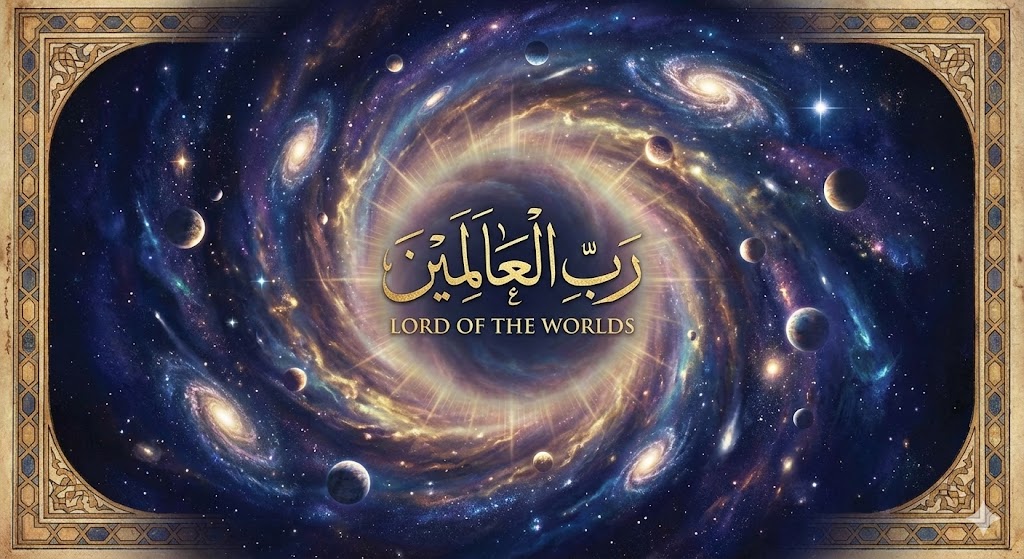





This article explores the relationship between Qur’anic cosmological discourse and modern scientific theories of the universe’s origin, particularly the Big Bang model. Rather than attempting to read science into scripture or derive theology from physics, this study maintains a clear epistemological distinction between the two domains. The Qur’an, as a book of guidance, addresses purpose, meaning, and moral responsibility, while science investigates mechanisms, laws, and observable order. By examining Qur’anic verses alongside established scientific evidence, the article argues that the Qur’anic worldview is not in conflict with modern cosmology but instead frames the universe as an intelligible, ordered system pointing beyond itself—toward Rabb al-‘Ālamīn (Lord of all worlds).
Introduction
The origin of the universe stands among the most profound questions ever confronted by human thought. Across history, this question has been explored through multiple epistemological frameworks, most notably religion and science. In the modern era, advances in physics and cosmology—particularly the development of the Big Bang theory—have provided a robust scientific model explaining how the observable universe emerged and evolved. At the same time, religious texts such as the Qur’an have long addressed the nature of creation, not through experimental description, but through a framework of meaning, purpose, and moral responsibility.
A significant intellectual tension arises when these two domains are misunderstood or misapplied. On one hand, science is sometimes expected to provide answers to existential questions of purpose, morality, and ultimate meaning—questions that lie outside its methodological scope. On the other hand, the Qur’an is often approached as if it were a scientific manual, expected to contain precise technical descriptions of cosmological phenomena. Both approaches result in conceptual confusion and category errors, obscuring the true contribution of each field.
The Qur’an explicitly presents itself as a book of guidance (hidayah), addressing why the universe exists, why human beings were created, and how moral accountability operates within and beyond worldly life. Its references to natural phenomena are not intended to establish scientific theories but to invite reflection, reasoning, and awareness of order in creation. Science, by contrast, is concerned with measurable reality: it investigates how the universe functions, how its laws operate, and how complex structures emerge over time. It remains intentionally silent on questions of metaphysical purpose.
This distinction is crucial for any meaningful dialogue between Qur’anic thought and modern cosmology. When respected, it allows for a constructive relationship in which scientific discovery enhances human understanding of the universe’s order, while the Qur’an situates that order within a broader existential and ethical framework. The Qur’anic concept of Rabb al-‘Ālamīn—the Lord of all worlds—presents a vision of reality that is comprehensive, inclusive, and open to reflection upon both known and unknown realms of existence.
This article adopts an interdisciplinary approach, examining selected Qur’anic verses alongside well-established scientific evidence concerning the origin and expansion of the universe. It does not seek to prove the Qur’an through science, nor to derive theology from physics. Rather, it aims to demonstrate that the Qur’anic worldview is not inherently at odds with modern cosmology and that many perceived conflicts arise from misinterpretation rather than genuine contradiction.
By maintaining clear epistemological boundaries and focusing on conceptual coherence rather than forced equivalence, this study argues that the Qur’an and science address different but complementary dimensions of human inquiry. Together, they offer a more holistic understanding of the universe—one that recognizes both its observable order and its deeper existential significance under Rabb al-‘Ālamīn.
The Qur’an as Guidance and the Limits of Scientific Expectation
The Qur’an defines its own purpose with remarkable clarity and consistency. Rather than positioning itself as a repository of technical or empirical knowledge, it explicitly presents itself as a source of guidance (hidayah) aimed at shaping human understanding, moral responsibility, and existential awareness:
“This is the Book in which there is no doubt, a guidance for those who are conscious of God.”
(Qur’an 2:2)
This self-definition is essential for avoiding interpretive errors that arise when the Qur’an is approached with expectations foreign to its stated aim. The Qur’an does not deny empirical inquiry, nor does it discourage the pursuit of knowledge; rather, it situates knowledge within a moral and purposeful framework.
From a Qur’anic perspective, knowledge is not an end in itself but a means toward ethical orientation and conscious living. Human beings are addressed as moral agents endowed with intellect, freedom of choice, and accountability:
“Indeed, We created man from a drop of mixed fluid to test him, and We made him hearing and seeing.”
(Qur’an 76:2)
Accordingly, the Qur’an’s engagement with the natural world is reflective and indicative rather than technical. Natural phenomena are repeatedly described as āyāt (signs), pointing beyond themselves:
“Indeed, in the creation of the heavens and the earth and the alternation of night and day are signs for people of understanding.”
(Qur’an 3:190)
These signs are not presented as scientific data points but as invitations to reflection, reasoning, and recognition of order. The Qur’an does not ask how the heavens function in a mechanical sense; it asks what such order signifies.
This orientation contrasts with the methodology of modern science, which is deliberately confined to observable, measurable, and falsifiable phenomena. Science excels at explaining processes, laws, and structures, but it remains silent on questions of ultimate meaning or moral purpose. This silence is not a weakness but a methodological necessity.
Difficulties arise when these distinct domains are conflated. When science is expected to answer questions of purpose, morality, or accountability, it exceeds its competence. Likewise, when the Qur’an is read as if it were a scientific treatise, its language is forced into an anachronistic framework, and its ethical and existential message is diminished. The Qur’an itself cautions against such misreadings by emphasizing reflection over technical scrutiny:
“Do they not reflect upon the Qur’an, or are there locks upon their hearts?”
(Qur’an 47:24)
The Qur’an’s references to creation and cosmic order serve a specific function: they establish intelligibility and coherence in existence. This coherence provides the foundation for moral responsibility and testing:
“He is the One who created death and life to test you as to which of you is best in conduct.”
(Qur’an 67:2)
A universe governed by order and law is essential for meaningful accountability. Without consistency in nature, ethical testing would lose its rational basis. By emphasizing order in creation, the Qur’an frames the universe as a suitable arena for human responsibility.
Crucially, this framework does not place the Qur’an in opposition to science. On the contrary, it encourages observation and reflection:
“Say: Observe what is in the heavens and the earth.”
(Qur’an 10:101)
Science, in uncovering the mechanisms of the universe, fulfills this call at the empirical level. The Qur’an, however, directs the human mind beyond mechanism toward meaning. Science clarifies how the universe operates; the Qur’an addresses why human beings exist within it.
Recognizing this division of intellectual scope allows for a coherent and non-confrontational relationship between scientific inquiry and Qur’anic guidance. Scientific advancement neither threatens the Qur’anic worldview nor serves as its validation. Instead, both operate within their respective domains, collectively contributing to a more comprehensive understanding of reality—one that integrates empirical knowledge with moral and existential insight.
Human Purpose, Vicegerency, and Moral Agency
Within the Qur’anic worldview, the creation of the universe is inseparable from the creation of human responsibility. Human beings are not portrayed as accidental byproducts of cosmic processes, but as intentional moral agents placed within an ordered universe for a defined purpose. This purpose is articulated through the concept of khilāfah (vicegerency), which establishes humanity’s unique role on Earth.
The Qur’an presents this role explicitly:
“And when your Lord said to the angels, ‘Indeed, I will place upon the earth a vicegerent.’”
(Qur’an 2:30)
Vicegerency does not imply divine status, but entrusted responsibility. It presupposes intellect, moral awareness, freedom of choice, and accountability. Humans are granted the capacity to act in accordance with divine guidance or in opposition to it, making ethical decision-making central to human existence. This framework places meaning at the heart of creation, something that lies entirely beyond the explanatory reach of scientific methodology.
From a scientific perspective, human beings are studied as biological organisms shaped by physical laws, chemistry, and evolutionary processes. Biology can explain how humans develop physically and cognitively, but it does not address why humans ought to act ethically or bear responsibility for their actions. The Qur’an fills this conceptual space by grounding human life in purpose rather than mere function.
The Qur’an repeatedly emphasizes that moral agency is inseparable from trial and testing:
“Indeed, We created man in the best of forms, then We reduced him to the lowest of the low—except those who believe and do righteous deeds.”
(Qur’an 95:4–6)
This testing is not arbitrary. It operates within a universe governed by consistency, predictability, and law. Without such order, moral accountability would be incoherent. Cause and effect, time, and consequence—all essential for ethical responsibility—depend on a stable cosmos. Here, scientific descriptions of natural laws indirectly support the Qur’anic framework by demonstrating that the universe is intelligible rather than chaotic.
The Qur’an further clarifies that this moral responsibility is not confined to worldly outcomes alone. Justice, from a Qur’anic perspective, cannot be fully realized within temporal life, where power, inequality, and circumstance often distort outcomes:
“Do you think that We created you without purpose and that you would not be returned to Us?”
(Qur’an 23:115)
This introduces the concept of accountability beyond empirical observation. While science can trace consequences within physical systems, it cannot adjudicate moral worth or ultimate justice. The Qur’an situates human action within a broader continuum that extends beyond material existence, thereby addressing questions science is neither designed nor equipped to answer.
Importantly, the Qur’anic emphasis on vicegerency does not discourage exploration of the natural world. On the contrary, stewardship implies understanding. To act responsibly within creation, humans must study its patterns, resources, and limits. Scientific inquiry thus becomes compatible with the Qur’anic vision, not as a source of meaning, but as a tool for informed responsibility.
In this way, the Qur’anic conception of human purpose complements scientific knowledge without competing with it. Science explains the conditions under which human life exists; the Qur’an explains why those conditions matter. Together, they present a coherent picture in which an ordered universe serves as the stage for moral agency under the sovereignty of Rabb al-‘Ālamīn.
Scientific Accounts of Cosmic Origin and the Question of Meaning
Modern science approaches the origin of the universe through empirical observation, mathematical modeling, and theoretical physics. The dominant cosmological model—the Big Bang theory—holds that the observable universe emerged from an extremely hot, dense initial state approximately 13.8 billion years ago. This model is not speculative theology but a scientific framework supported by multiple independent lines of evidence, including galactic redshift, cosmic microwave background radiation, and large-scale cosmic structure.
One of the most significant discoveries in modern cosmology is that the universe is not static. Observations beginning with Edwin Hubble demonstrated that distant galaxies are moving away from one another, implying that space itself is expanding. This finding fundamentally altered earlier assumptions of an eternal, unchanging cosmos and established that the universe has a temporal beginning, at least in its current form. Subsequent discoveries, such as the uniform background radiation permeating space, further confirmed that the universe evolved from a hotter and denser past.
Despite its explanatory power, science remains methodologically restrained. While it can reconstruct early cosmic conditions and trace the evolution of matter and energy, it does not address why the universe exists at all, nor why it is governed by laws that permit complexity, life, and consciousness. These questions are not ignored by science out of neglect but excluded by definition. Scientific inquiry operates within the limits of testability and observation; questions of ultimate cause, purpose, or intention fall outside its jurisdiction.
It is precisely at this boundary that the Qur’anic discourse situates its cosmological reflections. The Qur’an repeatedly points to the existence of order, balance, and proportion in the universe as indicators of deliberate creation:
“He created everything and determined it with precise determination.”
(Qur’an 25:2)
This verse does not provide a scientific model of cosmic origins, nor does it describe physical mechanisms. Instead, it frames the universe as a system governed by measure and intelligibility—conditions that modern science itself presupposes. Without consistent laws and stable regularities, scientific investigation would be impossible.
The Qur’an also draws attention to the temporal nature of creation, countering the ancient philosophical idea of an eternal, self-sustaining cosmos:
“Originator of the heavens and the earth.”
(Qur’an 2:117)
The emphasis here is on origination rather than process. While science describes how cosmic evolution unfolded after the initial state, the Qur’an addresses the deeper metaphysical assertion that the universe is contingent rather than necessary—that it did not have to exist, and therefore demands explanation beyond itself.
Importantly, the Qur’an does not discourage causal investigation. Instead, it repeatedly urges observation and reasoning:
“Have they not looked at the heaven above them—how We constructed it and adorned it, and how there are no cracks in it?”
(Qur’an 50:6)
Such verses legitimize scientific curiosity while redirecting its implications. The observable harmony of the universe becomes not merely a subject of technical analysis but a prompt for existential reflection. Science may describe the mechanisms by which stars form, galaxies evolve, and physical constants operate; the Qur’an asks what such coherence implies about reality as a whole.
The limitation of science becomes particularly evident when addressing the fine-tuning of the universe. Modern physics recognizes that slight variations in fundamental constants would render the universe incapable of supporting complex structures or life. While scientific explanations explore multiverse hypotheses or unknown physical laws, these remain theoretical and do not eliminate the philosophical question of why such a life-permitting structure exists at all.
The Qur’anic response to this question is not mathematical but interpretive. It frames cosmic order as intentional and meaningful:
“We did not create the heavens and the earth and what is between them in play.”
(Qur’an 21:16)
Here, purposelessness is explicitly denied. This claim does not compete with scientific accounts of cosmic evolution; rather, it addresses a different level of explanation. Science explains sequence and structure; the Qur’an addresses significance.
Misunderstanding arises when scientific success is mistaken for philosophical completeness. The ability to describe the early universe does not negate the question of why such a universe exists or why it is comprehensible to human reason. In fact, the very success of cosmology presupposes an underlying rationality that science itself does not generate but discovers.
In this sense, scientific cosmology and the Qur’anic worldview operate in complementary registers. Science maps the history and structure of the universe with increasing precision. The Qur’an situates that history within a broader narrative of purpose, responsibility, and accountability. The former reveals order; the latter interprets its meaning under the sovereignty of Rabb al-‘Ālamīn.
Reflection on Cosmic Order: Signs (Āyāt) and Human Reason
A central feature of the Qur’anic approach to the universe is its persistent appeal to human reason through observation and reflection. Rather than demanding blind acceptance, the Qur’an repeatedly calls upon the intellect to engage with the natural world, presenting cosmic order as a network of āyāt—signs that point beyond themselves. These signs are not proofs in a scientific sense but indicators meant to awaken awareness and reflection.
The Qur’an frames the universe as intelligible and law-governed, emphasizing balance, proportion, and harmony:
“The Most Merciful taught the Qur’an, created man, and taught him articulation. The sun and the moon move by precise calculation, and the stars and the trees submit.”
(Qur’an 55:1–6)
Here, regularity and calculation are highlighted as defining features of the cosmos. Such descriptions resonate with the scientific discovery that natural phenomena follow mathematical laws. Physics, astronomy, and cosmology operate precisely because nature exhibits consistency and predictability. Without this order, scientific inquiry would not be possible.
The Qur’an repeatedly challenges human beings to observe patterns in creation:
“Do they not look at the camels, how they are created, and at the sky, how it is raised?”
(Qur’an 88:17–18)
This invitation to observe is not limited to any specific object; it encompasses the entire natural world. The emphasis lies not on technical explanation but on intellectual engagement. Observation becomes a moral and cognitive act—one that bridges perception and understanding.
Modern science answers this call by uncovering layers of order previously unknown. From the predictable behavior of subatomic particles to the large-scale structure of galaxies, scientific discoveries consistently reveal a universe governed by precise laws. The Qur’anic emphasis on mīzān (balance) aligns conceptually with this reality:
“And the heaven He raised, and He established the balance—so that you may not transgress the balance.”
(Qur’an 55:7–8)
While the verse carries ethical implications, it also reflects a broader principle: order is foundational, and disruption leads to consequence. Scientific understanding of ecosystems, climate systems, and physical laws reinforces this notion by showing how imbalance produces instability.
Crucially, the Qur’an does not equate observation with certainty about ultimate reality. Reflection is meant to lead to humility rather than intellectual arrogance:
“They know what is apparent of the worldly life, but of the Hereafter they are heedless.”
(Qur’an 30:7)
This verse highlights a limitation intrinsic to empirical knowledge. Science excels at explaining observable processes, yet it does not exhaust reality. The Qur’an acknowledges the value of empirical knowledge while cautioning against reducing all truth to what is immediately measurable.
The concept of āyāt thus occupies a unique epistemological space. Signs are not coercive proofs; they allow room for acceptance or rejection. This openness preserves moral freedom and accountability. If the universe were an unmistakable empirical proof of divine presence, belief would become compulsion rather than choice.
In this framework, reason (‘aql) and revelation are not adversaries but partners operating at different levels. Reason examines patterns, causes, and relationships within the universe. Revelation contextualizes those findings within a narrative of purpose and responsibility. The Qur’an repeatedly appeals to reasoned reflection:
“Indeed, in that are signs for a people who reason.”
(Qur’an 16:12)
The harmony between reason and reflection underscores a key Qur’anic principle: understanding the universe is not merely an intellectual pursuit but an existential one. Scientific knowledge deepens awareness of cosmic order, while the Qur’anic lens invites humans to ask what such order implies about their role, responsibility, and ultimate return.
Thus, reflection on cosmic order becomes a meeting point rather than a battleground. Science reveals the depth and precision of the universe’s structure; the Qur’an interprets this precision as meaningful. Together, they point toward a reality that is not random or chaotic, but intelligible and purpose-laden under the sovereignty of Rabb al-‘Ālamīn.
Misconceptions, Category Errors, and the Illusion of Conflict
Perceived conflict between the Qur’an and modern science often arises not from their actual claims, but from misunderstandings about their respective domains of inquiry. These misunderstandings are best described as category errors—situations in which questions proper to one field are incorrectly imposed upon another. When this occurs, both science and scripture are burdened with expectations they were never intended to fulfill.
One common misconception is the assumption that scientific explanations eliminate the need for metaphysical or theological interpretation. As scientific cosmology has successfully described early cosmic conditions, some conclude that questions of meaning, purpose, or origin have been rendered obsolete. However, scientific explanation addresses mechanism, not significance. Describing the physical processes that led to the formation of the universe does not answer why such processes exist at all, nor why the universe is intelligible to human reason.
The Qur’an implicitly anticipates this misunderstanding by distinguishing between knowledge of appearance and knowledge of ultimate reality:
“They know what is apparent of the worldly life, but of the Hereafter they are unaware.”
(Qur’an 30:7)
This verse does not criticize empirical knowledge; rather, it highlights its limits. Apparent knowledge (ẓāhir) is valuable but incomplete. When taken as exhaustive, it leads to philosophical overreach rather than genuine understanding.
An opposing misconception emerges when the Qur’an is treated as a repository of scientific data. Attempts to map modern scientific theories directly onto Qur’anic verses—while often well-intentioned—risk reducing a rich, multi-layered text to a set of technical predictions. Such readings overlook the Qur’an’s rhetorical style, linguistic context, and primary purpose as guidance. The Qur’an itself warns against approaching revelation without reflection and intellectual humility:
“Do they not contemplate the Qur’an carefully?”
(Qur’an 4:82)
The invitation here is not to extract formulas, but to engage meaningfully with the text’s moral and existential message. When verses referring to natural phenomena are stripped of their broader context, they are vulnerable to forced interpretations that fluctuate with scientific paradigms.
Another source of confusion lies in the expectation that belief in divine creation requires rejection of natural causality. The Qur’an does not present divine action and natural law as mutually exclusive. On the contrary, it portrays the universe as operating according to established patterns:
“You will never find any change in the way of God.”
(Qur’an 35:43)
This consistency aligns with the scientific assumption that nature operates according to stable laws. Causality, from a Qur’anic perspective, is not a rival to divine agency but a manifestation of it. The regularity of natural processes enables both scientific investigation and moral accountability.
The illusion of conflict is further reinforced when science is unconsciously transformed into a worldview rather than retained as a method. As a method, science is neutral and limited; as a worldview, it can become philosophically reductionist, dismissing non-empirical questions as meaningless. The Qur’an challenges this reduction by affirming dimensions of reality that transcend measurement:
“And they encompass not a thing of His knowledge except for what He wills.”
(Qur’an 2:255)
This verse underscores epistemic humility. Human knowledge—scientific or otherwise—is partial, contingent, and provisional. Recognition of this limitation does not hinder progress; it safeguards intellectual honesty.
When the Qur’an and science are each allowed to operate within their proper domains, the narrative of conflict dissolves. Science investigates the structure, history, and behavior of the universe. The Qur’an addresses why that universe matters, what role human beings play within it, and how knowledge itself should be oriented ethically.
The persistence of misunderstanding, therefore, is not a consequence of genuine contradiction but of misplaced expectations. Once category boundaries are respected, the relationship between Qur’anic guidance and scientific knowledge emerges not as antagonistic, but as complementary—each illuminating a different dimension of reality under the encompassing sovereignty of Rabb al-‘Ālamīn.
Toward an Integrated Understanding of Creation under Rabb al-‘Ālamīn
When the Qur’anic worldview and modern scientific inquiry are approached with conceptual clarity, a more integrated and intellectually coherent understanding of creation becomes possible. This integration does not imply a fusion of methods or the collapse of boundaries; rather, it rests on recognizing that different forms of knowledge address different dimensions of reality. The Qur’an speaks to meaning, responsibility, and ultimate orientation, while science investigates structure, process, and law. Together, they contribute to a fuller human comprehension of existence.
The Qur’an’s description of God as Rabb al-‘Ālamīn—the Lord of all worlds—encapsulates this comprehensive vision:
“All praise belongs to God, Lord of all worlds.”
(Qur’an 1:2)
This title implies sovereignty not only over the observable universe but over all realms of existence, known and unknown. It frames reality as unified under a single sustaining principle, even as it manifests in diverse forms and levels. From a scientific standpoint, the universe appears vast, ordered, and governed by consistent laws. From the Qur’anic perspective, this same order reflects stewardship, care, and intentionality.
Notably, modern science itself increasingly points toward a universe that is finely structured and delicately balanced. The precise values of physical constants, the stability of cosmic laws, and the emergence of complexity from simplicity all suggest a reality that is intelligible rather than arbitrary. While science refrains from metaphysical conclusions, it nonetheless uncovers a depth of order that invites philosophical reflection. The Qur’an addresses this invitation directly:
“We did not create the heavens and the earth and what is between them without truth.”
(Qur’an 38:27)
Here, creation is explicitly associated with truth rather than randomness or futility. This assertion does not negate scientific explanations of cosmic development; instead, it situates them within a wider interpretive horizon. Scientific descriptions explain how complexity unfolds; the Qur’an affirms that such unfolding is meaningful.
An important implication of this perspective is the restoration of intellectual humility. Both science and theology acknowledge limits—science through provisional theories and ongoing revision, and the Qur’an through repeated reminders of the partial nature of human knowledge:
“You have been given of knowledge only a little.”
(Qur’an 17:85)
This humility guards against absolutism, whether scientific or theological. It encourages openness to discovery, reflection, and ethical responsibility. The pursuit of knowledge thus becomes not a means of domination, but a form of stewardship consistent with humanity’s role as vicegerent.
In this integrated view, scientific inquiry is neither a threat to faith nor a substitute for it. Instead, it becomes one of the ways through which humans fulfill the Qur’anic call to observe, reflect, and act responsibly within creation. The universe, studied through science, reveals its mechanisms and patterns; the universe, contemplated through the Qur’an, reveals its moral and existential significance.
Ultimately, the relationship between the Qur’an and science is best understood not as a debate to be won, but as a dialogue to be sustained. When each is allowed to speak in its own voice, the result is not contradiction but complementarity. The cosmos emerges as a coherent arena of order and meaning—an arena in which human beings are invited to understand, to choose, and to be accountable under the encompassing sovereignty of Rabb al-‘Ālamīn.
Conclusion: Knowledge, Purpose, and the Coherence of Creation
This study has examined the relationship between Qur’anic discourse on creation and modern scientific accounts of the universe with careful attention to epistemological boundaries. The central argument has been that much of the perceived conflict between science and the Qur’an arises not from genuine contradiction, but from misunderstandings about the aims, methods, and limits of each domain. When science is asked to provide moral guidance or ultimate purpose, and when the Qur’an is treated as a scientific manual, confusion is inevitable.
Modern cosmology, through theories such as the Big Bang, has offered compelling explanations of how the universe began and evolved. These explanations are grounded in observation, measurement, and mathematical modeling. They describe processes, structures, and laws with increasing precision, yet they remain methodologically silent on questions of meaning, intention, and moral significance. This silence is not a flaw, but a defining feature of scientific inquiry.
The Qur’an, by contrast, addresses these very questions. It situates the universe within a framework of purpose, order, and accountability under Rabb al-‘Ālamīn. Its references to creation, cosmic order, and natural phenomena are not attempts at technical explanation but invitations to reflection. The universe is presented as intelligible and law-governed so that human beings, as moral agents and vicegerents, may act responsibly within it and recognize that existence is not arbitrary or futile.
Crucially, the Qur’anic worldview does not negate natural causality or discourage empirical investigation. On the contrary, it repeatedly calls for observation, reasoning, and reflection upon the natural world. Scientific inquiry, when understood as the study of God’s established patterns in creation, becomes compatible with the Qur’anic vision. It deepens human understanding of cosmic order while leaving questions of ultimate purpose open to philosophical and theological reflection.
The coherence that emerges from this perspective is not one of forced harmony or selective proof-texting, but of complementary insight. Science explains how the universe works; the Qur’an explains why human existence within that universe matters. Together, they point toward a reality that is structured, meaningful, and ethically charged—one in which knowledge carries responsibility, and understanding demands humility.
In recognizing Rabb al-‘Ālamīn as the Lord of all worlds, the Qur’an offers a unifying vision that accommodates discovery without fear and faith without intellectual retreat. When each domain is allowed to operate within its proper scope, the study of the universe becomes not a source of existential conflict, but a pathway toward deeper understanding—of the cosmos, of human purpose, and of the profound coherence underlying creation itself.