




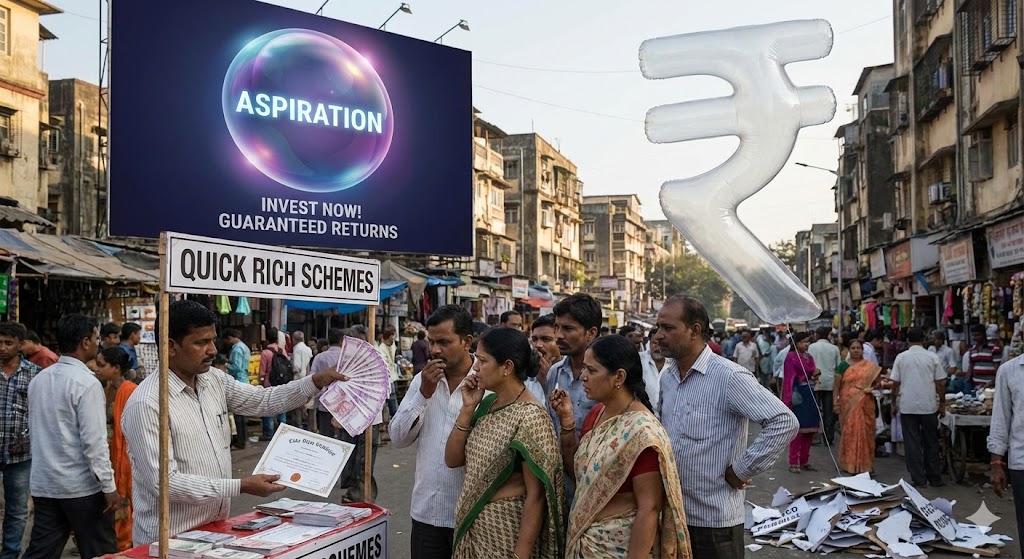


Introduction: India as an Aspiration-Driven Society
India is not a poor country in the traditional sense, nor is it a fully developed one. It exists in a unique and unstable middle zone — a society where aspiration has expanded far faster than opportunity, and where the promise of upward mobility has become louder than the reality of access.
Over the last three decades, India has experienced profound transformation: economic liberalization, digital connectivity, demographic expansion, and cultural exposure to global success narratives. Millions have indeed improved their lives. New industries have emerged. Social mobility, once rare, has become imaginable.
But imagination has outpaced structure.
India today is not simply a nation striving to grow; it is a nation straining to arrive. Arrival — into wealth, relevance, dignity, recognition — has become a collective obsession. For a population as large, young, and unequal as India’s, this obsession carries psychological weight. It shapes behavior not only at the margins but at the center of society.
In such an environment, hype is not decoration.
It is infrastructure.
Our Findings About Indian Society
Across sectors, Indian hype-fraud patterns share common traits:
- Extreme aspiration combined with deep insecurity
- Weak verification mechanisms
- Cultural tolerance for exaggeration
- Hero-worship and authority bias
- Low institutional trust, high emotional trust
- Urgency over scrutiny
- Scale that overwhelms accountability
This creates a society where belief travels faster than truth, and where fraud often succeeds before it is recognized.
Key Questions Addressed
- Why has hype become such a powerful force in India?
- How does startup and funding fraud operate?
- Why influencer and social-media hype dominates trust?
- How fake gurus and motivation scams exploit insecurity?
- Why political and ideological hype thrives?
- How spirituality becomes a marketplace for fraud?
- Why stock market and crypto hype spread rapidly?
- How media manufactures narratives instead of truth?
- Why education and coaching fraud is normalized?
- What unites all these patterns into one societal system?
1. Hype as a Structural Feature of Modern India
In India today, hype is not an occasional excess or a byproduct of marketing culture. It is a structural feature of how opportunity is perceived, distributed, and accessed. To understand why fraud repeatedly emerges across sectors, one must first understand why hype has become embedded in the social and economic fabric of the country.
Hype in India functions less as exaggeration and more as a substitute for institutional trust.
1.1 When Institutions Cannot Scale, Narratives Do
Modern India faces a basic structural mismatch:
- The population is vast and young
- Aspirations are rising rapidly
- Institutional capacity grows slowly
High-quality institutions — universities, employers, regulators, courts, media watchdogs — do not scale at the same speed as ambition. As a result, formal pathways become congested, opaque, and exclusionary.
When institutions cannot absorb aspiration, societies do not reduce aspiration. Instead, they re-route it.
Narratives scale where institutions cannot.
Hype is one such narrative mechanism. It offers:
- visibility without gatekeeping,
- credibility without verification,
- opportunity without waiting.
This is why hype does not operate on the margins in India. It operates at the center.
1.2 Hype as a Time-Compression Tool
One of hype’s most important functions is compressing time.
In a society where:
- generational mobility once took decades,
- and patience was socially rewarded,
modern India now signals the opposite:
- speed equals intelligence,
- waiting equals weakness,
- early entry equals superiority.
Hype collapses timelines:
- “overnight success”
- “10x growth”
- “one course can change your life”
- “this opportunity won’t come again”
These messages are effective because time feels scarce.
When millions compete simultaneously, the fear is not failure — it is being left behind.
Fraud thrives wherever urgency replaces deliberation.
1.3 The Cultural Normalization of Exaggeration
Another reason hype becomes structural in India is cultural tolerance for exaggeration.
Exaggeration in Indian society is often interpreted as:
- confidence,
- optimism,
- leadership,
- persuasive skill.
This tolerance has deep roots:
- storytelling traditions favor drama,
- political rhetoric rewards grand claims,
- social mobility narratives celebrate boldness.
As a result, exaggeration is rarely penalized early. It is often celebrated.
The shift from exaggeration to deception becomes visible only after consequences appear, and by then the damage is already done.
Hype exploits this ambiguity deliberately.
1.4 Authority Without Verification
In well-regulated systems, authority is linked to:
- credentials,
- accountability,
- institutional checks.
In India, authority is often conferred through:
- visibility,
- confidence,
- association,
- symbolism.
A person appears authoritative if they:
- speak fluently,
- display success markers,
- command attention,
- claim insider access.
Verification lags behind recognition.
This inversion — where recognition precedes proof — is a central structural weakness. It allows individuals and organizations to borrow legitimacy before earning it.
Hype is the bridge that enables this borrowing.
1.5 The Scale Problem: Too Many Aspirants, Too Few Filters
India’s demographic scale creates a filtering crisis.
When:
- millions apply for limited seats,
- millions follow the same trends,
- millions consume the same content,
filters break down.
Under such pressure:
- due diligence weakens,
- shortcuts proliferate,
- herd behavior intensifies.
Hype becomes a crowd-coordination mechanism. It signals where attention should go when individual evaluation feels impossible.
Fraud thrives because crowds amplify belief faster than institutions can correct it.
1.6 Emotional Urgency as Economic Fuel
India’s hype economy is not purely rational; it is deeply emotional.
It is powered by:
- fear of stagnation,
- shame of failure,
- visibility of inequality,
- family expectations,
- social comparison.
These pressures create emotional urgency, which hype converts into action.
The promise is not just financial gain, but:
- dignity,
- escape,
- recognition,
- relief.
When emotional urgency drives decision-making, skepticism feels like betrayal of hope.
Fraud leverages this moral framing.
1.7 Hype as a Low-Cost Entry Strategy
From the supply side, hype is attractive because it is cheap.
Building:
- robust institutions,
- reliable products,
- genuine expertise,
takes time and discipline.
Building hype requires:
- messaging,
- amplification,
- alignment with aspiration.
In a market that rewards speed, hype becomes the most efficient entry strategy.
This creates a perverse incentive structure:
- deliver later, if possible,
- explain later, if necessary,
- apologize later, if exposed.
By the time accountability arrives, attention has moved on.
1.8 Why Hype Feels Rational to Participants
It is important to stress that people participating in hype-driven systems are not acting irrationally.
Given the environment:
- delayed outcomes,
- uncertain pathways,
- visible winners,
- invisible failures,
aligning with hype feels like risk management, not recklessness.
People often think:
- “If I don’t try this, someone else will win.”
- “Everyone is doing it.”
- “This is how things work now.”
Fraud succeeds not because people believe lies, but because they cannot afford disbelief.
1.9 The Feedback Loop Between Hype and Inequality
Hype and inequality reinforce each other.
Inequality:
- intensifies aspiration,
- shortens patience,
- magnifies success stories.
Hype:
- amplifies inequality,
- concentrates rewards,
- obscures systemic barriers.
Those who succeed through hype appear to validate the system, encouraging others to follow — even when most will fail.
This loop sustains itself.
1.10 Summary: Why Hype Is Structural, Not Accidental
Hype in modern India is structural because:
- aspiration exceeds institutional capacity,
- time feels scarce,
- exaggeration is culturally tolerated,
- authority is conferred before verification,
- scale overwhelms filters,
- emotional urgency drives decisions,
- speed is rewarded over substance.
Fraud is not an external corruption of this system.
It is an internal consequence.
Where hype becomes infrastructure, fraud becomes method.
2. Startup Hype and Funding Fraud
India’s startup ecosystem is often presented as a symbol of national progress: innovation, entrepreneurship, global relevance, and youthful ambition. On the surface, it reflects energy and optimism. Beneath that surface, however, the ecosystem reveals how hype becomes a substitute for institutional maturity, and how fraud — subtle, delayed, and normalized — takes root long before collapse becomes visible.
Startup fraud in India is rarely crude or immediate. It is typically narrative-driven, gradual, and socially enabled.
2.1 The Narrative-First Startup Culture
In mature ecosystems, startups usually follow a sequence:
- problem identification,
- solution development,
- market validation,
- scaling.
In India, this sequence is often reversed.
Many startups begin with:
- a compelling story,
- a visionary founder persona,
- media visibility,
- early-stage funding announcements,
before demonstrating product-market fit or operational resilience.
This inversion is not accidental. It is rewarded.
Investors, media, and accelerators often prioritize:
- scalability narratives,
- market-size projections,
- founder charisma,
- alignment with global buzzwords.
Substance becomes something to “figure out later.”
2.2 Why Funding Rewards Hype Over Fundamentals
India’s venture funding environment is shaped by:
- intense competition among funds,
- fear of missing the “next big thing,”
- pressure to deploy capital quickly,
- global comparisons with Silicon Valley or China.
In such conditions:
- speed beats scrutiny,
- storytelling beats governance,
- traction optics beat unit economics.
Funding decisions are frequently based on:
- user growth (often subsidized),
- engagement metrics (often inflated),
- future revenue assumptions (rarely tested).
This does not always constitute legal fraud — but it creates fertile ground for strategic misrepresentation.
2.3 Inflated Metrics as an Industry Norm
One of the most common forms of startup fraud in India is metric inflation.
This includes:
- counting registered users as active users,
- presenting discounted or free usage as revenue,
- masking churn through aggressive acquisition,
- redefining key performance indicators mid-cycle.
Because these practices are widespread, they are rarely challenged early.
Everyone assumes correction will come later — during audits, exits, or scale.
But by the time correction arrives:
- funds have been raised,
- valuations have ballooned,
- founders have cashed partial exits,
- reputations have been built.
Fraud becomes retrospective.
2.4 Founder-Centric Mythology
India’s startup culture strongly favors the hero-founder narrative.
Founders are portrayed as:
- visionaries,
- disruptors,
- rebels against outdated systems.
This mythology discourages scrutiny.
Questioning founders is framed as:
- negativity,
- lack of belief,
- resistance to innovation.
As a result:
- internal dissent is suppressed,
- whistleblowers are sidelined,
- governance is weakened.
Fraud flourishes where belief replaces oversight.
2.5 Media’s Role in Amplifying Startup Hype
Business media in India plays a critical role in sustaining startup hype.
Coverage often emphasizes:
- funding rounds,
- valuations,
- founder lifestyles,
- global ambition.
Rarely emphasized:
- profitability timelines,
- regulatory compliance,
- worker conditions,
- consumer protection.
Media visibility becomes a form of validation, encouraging:
- more funding,
- more hype,
- less accountability.
Once media declares success, skepticism appears contrarian.
2.6 The Delay Between Fraud and Consequence
Startup fraud in India is often time-delayed.
It succeeds because:
- consequences are slow,
- regulation is reactive,
- investors absorb early losses quietly,
- employees bear hidden costs,
- consumers lack recourse.
By the time collapse occurs:
- narratives shift from “visionary” to “overambitious,”
- fraud is reframed as miscalculation,
- accountability diffuses.
This delay incentivizes repetition.
2.7 Employees and Consumers as Silent Casualties
While investors may diversify risk, employees and consumers cannot.
Employees experience:
- unpaid salaries,
- sudden layoffs,
- reputational damage,
- emotional burnout.
Consumers experience:
- service shutdowns,
- lost money,
- lack of redress.
Yet these voices rarely dominate post-mortems.
The ecosystem focuses on capital loss, not human cost.
2.8 Why Startup Fraud Persists Despite Repeated Failures
Despite repeated collapses, startup hype persists because:
- success stories overshadow failures,
- failure is individualized, not systemic,
- capital cycles renew belief,
- aspiration overrides memory.
Each generation believes it will spot fraud earlier —
yet hype always arrives wearing a new language.
2.9 Startup Fraud as a Mirror of Society
Startup fraud in India reflects broader social patterns:
- impatience with gradual progress,
- belief in shortcuts,
- tolerance for exaggeration,
- reverence for visible success.
Startups do not create these values — they amplify them.
2.10 Summary: Startup Hype as Institutional Substitution
Startup hype in India functions as:
- a substitute for slow institution-building,
- a shortcut through congested opportunity structures,
- a narrative solution to structural scarcity.
Fraud is not an aberration.
It is the shadow side of a narrative-first economy.
Until verification is rewarded as much as vision, and patience as much as speed, startup hype will continue to blur into fraud — not occasionally, but structurally.
3. Influencer and Social Media Hype
The rise of influencer culture in India is not a superficial trend driven by youth fascination or digital novelty. It is a structural shift in how trust, authority, and aspiration are produced and circulated. Influencer hype has become one of the most efficient vehicles for fraud because it operates in the space where institutional trust has collapsed but emotional trust remains intact.
In India, social media did not merely create influencers.
It replaced institutions with personalities.
3.1 From Institutional Trust to Personal Trust
In societies with strong institutions, people rely on:
- verified experts,
- regulated professionals,
- credentialed authorities,
- accountable media.
In India, institutional credibility is uneven:
- regulation is slow,
- enforcement is inconsistent,
- expertise is often inaccessible,
- institutions feel distant and opaque.
Social media filled this vacuum by offering direct human presence.
Influencers feel:
- relatable,
- accessible,
- authentic,
- emotionally familiar.
Trust shifts from systems to individuals — not because individuals are more reliable, but because they feel closer.
Fraud enters precisely through this intimacy.
3.2 Visibility as Proof of Credibility
On social media, visibility becomes evidence.
An influencer with:
- large following,
- polished lifestyle,
- confident speech,
is assumed to be knowledgeable, successful, or trustworthy.
This assumption bypasses verification.
In India, where traditional credentials are often:
- expensive,
- exclusionary,
- slow to acquire,
visibility feels like a democratic substitute.
Hype transforms popularity into authority.
3.3 Aspirational Identification and Emotional Transfer
Influencer hype works through aspirational identification.
Followers do not merely consume content; they:
- imagine themselves becoming the influencer,
- internalize the influencer’s lifestyle,
- associate products with transformation.
This creates emotional transfer:
- success appears contagious,
- proximity feels like progress,
- imitation feels like strategy.
Fraud thrives when aspiration is emotional rather than evaluative.
3.4 Monetization Without Accountability
Most influencers operate outside:
- professional regulation,
- advertising disclosure enforcement,
- consumer protection mechanisms.
This allows:
- undisclosed sponsorships,
- promotion of unverified products,
- false expertise claims,
- exaggerated outcomes.
Because the influencer is not framed as an institution, accountability expectations are low.
Failures are reframed as:
- personal opinion,
- individual choice,
- misunderstanding.
Fraud remains diffuse.
3.5 The Authenticity Illusion
One of the most powerful tools of influencer hype is manufactured authenticity.
Influencers cultivate:
- vulnerability narratives,
- rags-to-riches stories,
- behind-the-scenes content,
- emotional confessions.
These techniques create the illusion of honesty, even when the underlying claims are false.
In India, where emotional expression is often constrained in public life, such openness feels revolutionary.
Trust is granted emotionally, not rationally.
3.6 The Speed Advantage of Social Media Fraud
Social media fraud spreads rapidly because:
- content is algorithmically amplified,
- emotional content outperforms factual content,
- correction travels slower than virality.
By the time misinformation is challenged:
- audiences have moved on,
- money has been spent,
- trust has already been exploited.
Speed becomes protection.
3.7 Why Audiences Defend Influencers
When influencer fraud is exposed, audiences often defend the influencer.
This happens because:
- followers have invested identity,
- criticism feels like personal attack,
- admitting deception threatens self-image.
This creates collective denial, allowing fraud to persist even after exposure.
The influencer becomes a symbol of hope, not just a marketer.
3.8 Influencer Culture as Emotional Labor Outsourcing
Influencers perform emotional labor:
- motivation,
- reassurance,
- validation,
- aspiration.
Followers outsource:
- confidence,
- direction,
- belief,
to people they will never meet.
This is not trivial.
It reflects unmet emotional needs at scale.
Fraud exploits this dependency.
3.9 Why Regulation Struggles to Catch Up
Regulating influencer fraud is difficult because:
- boundaries between content and advertising blur,
- influencers operate across platforms,
- enforcement lacks scale,
- audiences resist intervention.
Hype evolves faster than law.
3.10 Summary: Influencer Hype as Trust Migration
Influencer hype in India represents:
- migration of trust from institutions to individuals,
- authority without verification,
- aspiration monetized through intimacy,
- accountability diffused through personality.
Fraud follows trust.
Until credibility is decoupled from visibility and emotional familiarity, influencer-driven hype will remain one of India’s most powerful fraud amplifiers.
4. Fake Gurus, Online Courses, and Motivation Scams
The explosion of fake gurus, online courses, and motivation scams in India is not a cultural accident or a temporary digital trend. It is a systemic outcome of an aspiration-heavy society where formal pathways feel blocked, slow, or humiliating, and where success is presented as both urgent and morally mandatory.
These scams do not primarily sell skills.
They sell certainty.
4.1 The Market for Certainty in an Uncertain Society
Modern India places enormous pressure on individuals to succeed, while offering few predictable routes to do so.
Young people face:
- intense academic competition,
- limited high-quality employment,
- unstable job markets,
- rising costs of living,
- constant social comparison.
In such conditions, uncertainty becomes psychologically unbearable.
Fake gurus and motivation entrepreneurs succeed because they promise:
- clarity instead of confusion,
- confidence instead of doubt,
- shortcuts instead of endurance,
- personal control instead of structural limitation.
They do not ask people to learn.
They ask people to believe.
4.2 The Illusion of Hidden Knowledge
A core feature of guru-based scams is the claim of secret insight.
Common narratives include:
- “What schools don’t teach you”
- “What the system hides”
- “The mindset of the top 1%”
- “The formula nobody tells you”
These claims are powerful because they reframe failure:
- not as lack of skill,
- but as lack of access to hidden knowledge.
This preserves self-esteem while redirecting blame outward.
Fraud thrives when people believe success is gated by secrets rather than systems.
4.3 Motivation as a Commodity
In India’s motivation economy, inspiration itself becomes a product.
Motivational figures sell:
- confidence,
- energy,
- positivity,
- belief in inevitable success.
These products feel valuable because:
- demoralization is widespread,
- emotional support is scarce,
- failure is stigmatized.
However, motivation without method is unstable.
It produces:
- temporary emotional uplift,
- followed by deeper disappointment,
- followed by renewed dependence.
This creates a repeat-customer model.
4.4 Blaming the Individual, Protecting the Scam
One of the most harmful features of motivation scams is how failure is explained.
When promised success does not materialize, blame is shifted to:
- the learner’s mindset,
- lack of belief,
- insufficient effort,
- negative thinking.
The system is never questioned.
This logic is devastating because:
- it internalizes failure,
- erodes self-trust,
- deepens shame,
- discourages critical thinking.
Fraud survives by redefining itself as personal development.
4.5 Online Courses and the Over-Promise Economy
India’s online course market is saturated with exaggerated claims:
- “Learn X in 30 days”
- “Guaranteed income”
- “No degree required”
- “Anyone can do this”
These claims exploit:
- digital illiteracy,
- desperation,
- impatience,
- aspirational envy.
The content itself is often:
- generic,
- freely available elsewhere,
- repackaged under new branding.
Value is not delivered through knowledge, but through marketing psychology.
4.6 The Guru Persona and Authority Without Accountability
Fake gurus cultivate authority through:
- confident speech,
- selective success stories,
- luxury aesthetics,
- emotional vulnerability narratives.
They avoid:
- transparent credentials,
- measurable outcomes,
- independent verification.
Because they position themselves as mentors, not institutions, they escape scrutiny.
Criticism is reframed as:
- negativity,
- jealousy,
- closed-mindedness.
This creates an insulated belief system.
4.7 Why Audiences Defend Gurus Even After Exposure
Even when scams are exposed, followers often remain loyal.
This happens because:
- people have invested money, time, and identity,
- admitting deception threatens self-worth,
- belief provides psychological stability.
The guru becomes not just a teacher, but:
- a symbol of hope,
- a protector against despair,
- an emotional anchor.
Fraud persists because it fulfills emotional needs that society neglects.
4.8 Motivation Scams as a Response to Structural Failure
It is critical to understand that fake gurus do not emerge in a vacuum.
They flourish where:
- education systems feel inadequate,
- employment feels inaccessible,
- institutions feel indifferent,
- success feels random.
Motivation scams offer narrative justice:
- “You failed because you didn’t know the right way.”
- “Now that you do, success is inevitable.”
This narrative is false — but emotionally soothing.
4.9 The Long-Term Damage
The damage caused by motivation scams extends beyond financial loss.
They:
- delay real skill acquisition,
- distort expectations,
- weaken patience,
- erode trust in genuine education,
- normalize blame-shifting.
Over time, this creates a population that:
- chases inspiration instead of competence,
- consumes hope instead of building capacity.
4.10 Summary: Confidence Without Competence
Fake gurus, online courses, and motivation scams thrive in India because they offer:
- certainty in chaos,
- confidence without discipline,
- belonging without accountability,
- hope without structure.
They are not a deviation from India’s aspiration economy —
they are one of its most refined products.
Until societies reward process over promise and skill over spectacle, motivation scams will continue to flourish — not on the fringes, but in the mainstream.
5. Political and Ideological Hype
Political and ideological hype in India is not simply the result of passionate democracy or mass participation. It is the outcome of politics operating inside an aspiration-heavy, emotionally charged society where narratives outperform institutions. In such an environment, hype becomes a governing tool, and fraud takes the form of manufactured belief, symbolic action, and narrative substitution.
Political fraud here does not always involve false facts. More often, it involves false framing.
5.1 Politics as Narrative Competition
Modern Indian politics functions less as a contest of policies and more as a contest of stories.
Political actors compete to define:
- who the people are,
- who threatens them,
- who represents their dignity,
- who deserves blame for hardship.
These stories simplify reality into emotionally legible forms:
- heroes vs enemies,
- insiders vs outsiders,
- patriots vs traitors,
- progress vs obstruction.
Hype thrives because narratives travel faster than nuance.
5.2 Identity as Emotional Currency
India’s diversity makes identity a powerful political resource.
Political hype mobilizes identity by:
- reducing complex issues to cultural symbols,
- framing policy as moral loyalty,
- converting belonging into obligation.
Identity-based hype works because:
- it offers emotional security,
- it simplifies uncertainty,
- it converts anxiety into pride or anger.
Fraud occurs when identity replaces accountability.
5.3 Symbolism Over Substance
One of the clearest signs of political hype is the dominance of symbolism.
Symbolic actions include:
- performative gestures,
- spectacle-driven announcements,
- emotionally charged rhetoric,
- ceremonial politics.
These symbols create the appearance of action, even when outcomes remain unchanged.
Hype sustains belief by focusing attention on what is seen, not what is delivered.
5.4 Emotional Polarization as Mobilization Strategy
Political hype often relies on emotional polarization.
By intensifying fear, resentment, or pride, political actors:
- consolidate support,
- suppress internal criticism,
- delegitimize opposition.
Polarization reduces space for verification.
When politics becomes emotional allegiance, questioning narratives feels like betrayal.
5.5 Media Amplification of Political Hype
Political hype depends heavily on media ecosystems that reward:
- outrage,
- simplification,
- constant visibility.
In such environments:
- soundbites replace analysis,
- debates replace investigation,
- loyalty replaces skepticism.
Media becomes a multiplier, not a filter.
Fraud persists when repetition substitutes for evidence.
5.6 Ideological Certainty in an Uncertain Society
In times of social insecurity, ideological certainty feels comforting.
Political hype offers:
- clear answers,
- moral clarity,
- simplified blame,
- promised restoration of dignity.
These narratives appeal especially to populations experiencing:
- economic anxiety,
- social displacement,
- cultural disorientation.
Fraud occurs when certainty is sold without capacity.
5.7 Policy Failure Reframed as Narrative Success
When policies fail to deliver, hype reframes the conversation:
- delays become sabotage,
- criticism becomes conspiracy,
- unmet promises become future guarantees.
Narrative success masks operational failure.
This delays accountability and deepens trust erosion.
5.8 Why Political Hype Persists Despite Exposure
Political hype survives exposure because:
- belief is emotionally invested,
- identity is implicated,
- retreat threatens self-concept.
Acknowledging deception feels like personal loss.
Thus, exposure rarely converts believers — it polarizes them further.
5.9 Political Hype as a Trust Substitute
Political hype fills a trust vacuum.
Where institutions are weak or inaccessible:
- belief replaces verification,
- loyalty replaces oversight,
- emotion replaces evidence.
Fraud thrives not because people reject truth, but because truth lacks delivery mechanisms.
5.10 Summary: Governance by Emotion
Political and ideological hype in India represents:
- governance through emotion,
- legitimacy through symbolism,
- authority through narrative dominance.
Fraud here is not always factual falsehood.
It is emotional misdirection.
Until political success is measured by delivery rather than narrative control, hype will continue to function as a governing strategy — and fraud will remain embedded within it.
6. Spiritual and Religious Fraud
Spiritual and religious fraud in India cannot be understood simply as deception by a few bad actors. It is a structural phenomenon rooted in fear, uncertainty, moral anxiety, and the collapse of reliable meaning-making institutions. In a society where insecurity is widespread and trust in systems is fragile, spirituality becomes a powerful emotional refuge — and therefore, a lucrative market.
This form of fraud does not primarily sell lies.
It sells relief.
6.1 The Emotional Demand for Certainty
Modern India is a society under pressure:
- economic instability for many,
- unpredictable futures,
- intense competition,
- fragile social safety nets.
In such conditions, uncertainty becomes emotionally exhausting.
Religion and spirituality historically provided:
- explanations for suffering,
- moral order,
- emotional containment,
- hope beyond material outcomes.
When traditional structures weaken or fragment, the demand for certainty does not disappear. It intensifies.
Fraud emerges when certainty is offered without accountability.
6.2 Authority Without Transparency
Many spiritual figures in India operate with:
- no financial transparency,
- no institutional oversight,
- no doctrinal accountability,
- no measurable outcomes.
Authority is established through:
- charisma,
- claims of divine connection,
- symbolic imagery,
- association with power or success.
Once authority is accepted, questioning becomes taboo.
Fraud thrives where belief is detached from verification.
6.3 The Monetization of Fear and Hope
Spiritual fraud often operates through fear:
- fear of illness,
- fear of failure,
- fear of misfortune,
- fear of divine punishment.
And hope:
- hope for healing,
- hope for success,
- hope for protection,
- hope for meaning.
Transactions are framed as spiritual acts:
- donations,
- rituals,
- offerings,
- exclusive access.
Money becomes a substitute for moral effort.
6.4 Ritual as a Shortcut
One of the defining features of spiritual fraud is the transformation of ritual into a shortcut.
Rituals are sold as:
- substitutes for structural change,
- replacements for long-term effort,
- solutions to complex problems.
This logic mirrors other hype-driven systems:
- effort replaced by payment,
- process replaced by promise,
- discipline replaced by spectacle.
Fraud persists because it reduces responsibility while offering reassurance.
6.5 Nationalism, Spirituality, and Emotional Fusion
In recent years, spiritual fraud has increasingly fused with:
- nationalism,
- cultural identity,
- political loyalty.
This fusion intensifies emotional commitment.
Criticism is reframed as:
- disrespect,
- betrayal,
- cultural attack.
Fraud becomes protected by identity.
6.6 Why Followers Defend Spiritual Fraud
Followers often defend spiritual figures even after exposure because:
- belief provides emotional stability,
- doubt threatens existential security,
- social belonging is at stake.
Admitting fraud feels like admitting:
- wasted faith,
- personal failure,
- moral vulnerability.
This creates psychological resistance to correction.
6.7 The Difference Between Faith and Fraud
It is essential to distinguish:
- faith as personal belief,
- fraud as institutional exploitation.
Faith:
- asks for reflection,
- tolerates doubt,
- encourages moral responsibility.
Fraud:
- demands obedience,
- discourages questioning,
- monetizes dependence.
The problem is not belief —
it is belief without accountability.
6.8 Long-Term Social Damage
Spiritual fraud damages society by:
- discouraging critical thinking,
- normalizing magical solutions,
- weakening personal agency,
- eroding trust in genuine spiritual practice.
It replaces inner transformation with transactional belief.
6.9 Why Regulation Alone Fails
Regulating spiritual fraud is difficult because:
- belief is protected,
- evidence is subjective,
- enforcement risks backlash,
- fraud hides behind faith.
Structural reform must therefore focus on:
- transparency,
- education,
- accountability,
- emotional literacy.
6.10 Summary: Certainty for Sale
Spiritual and religious fraud in India thrives because it offers:
- certainty in chaos,
- comfort without responsibility,
- identity without scrutiny,
- hope without effort.
It is not a deviation from society —
it is a mirror of widespread insecurity.
Until people feel emotionally and materially secure enough to tolerate uncertainty, spiritual fraud will continue to find fertile ground.
7. Stock Market and Crypto Hype
The explosion of stock market tips, trading influencers, and crypto speculation in India is not primarily a story of financial innovation. It is a story of aspiration colliding with delayed economic mobility, where finance becomes a psychological escape route rather than a long-term planning tool.
In this environment, hype transforms investing into hope-driven gambling, and fraud disguises itself as financial literacy.
7.1 Wealth Visibility and the Collapse of Patience
In earlier generations, wealth accumulation in India was slow, opaque, and socially distant. Today, wealth is:
- highly visible,
- aggressively displayed,
- algorithmically amplified.
Social media floods daily life with:
- screenshots of profits,
- luxury consumption,
- “overnight” success stories.
This visibility compresses expectations.
People no longer ask:
“How do I build wealth over time?”
They ask:
“Why am I not rich yet?”
Stock and crypto hype exploit this impatience.
7.2 Financial Markets as Emotional Shortcuts
For many Indians, traditional wealth paths feel blocked:
- wages stagnate,
- housing prices soar,
- job security weakens.
Financial markets appear as open-access systems:
- no gatekeepers,
- no credentials,
- instant participation.
This creates the illusion of fairness.
Hype reframes markets as:
- skill-light,
- insight-driven,
- fast-moving.
Fraud thrives where complexity is sold as simplicity.
7.3 The Myth of the “Insider”
A recurring theme in financial hype is insider access.
Scams often use language such as:
- “operator-driven stocks”
- “sure-shot tips”
- “big money is entering”
- “this will be announced soon”
This language:
- creates urgency,
- simulates exclusivity,
- suspends skepticism.
People believe they are gaining access to hidden channels — when in reality, they are entering crowd-driven traps.
7.4 Telegram, WhatsApp, and the Group Psychology of Fraud
Financial hype spreads through closed groups:
- Telegram channels,
- WhatsApp broadcasts,
- private Discord servers.
These spaces amplify belief because:
- dissent is removed,
- success stories are highlighted,
- failures are hidden,
- authority is centralized.
Group consensus replaces independent judgment.
Fraud thrives in environments where belonging substitutes for verification.
7.5 Influencers as Pseudo-Financial Advisors
Many financial influencers operate without:
- professional qualifications,
- fiduciary responsibility,
- regulatory oversight.
Yet they speak with:
- absolute confidence,
- simplified narratives,
- selective track records.
Audiences assume:
- “If they are public, they must be legitimate.”
- “If they show profits, they must know something.”
Visibility replaces accountability.
7.6 Crypto as the Perfect Hype Vehicle
Crypto hype spreads particularly fast in India because it:
- promises radical wealth acceleration,
- appears technologically complex (deterring questions),
- frames skepticism as ignorance,
- lacks local historical memory.
Crypto narratives exploit:
- distrust in traditional finance,
- fear of missing global shifts,
- desire to leapfrog development stages.
Fraud hides behind innovation.
7.7 Victim-Blaming as System Protection
When financial hype collapses, blame is redirected:
- “You didn’t manage risk.”
- “You entered late.”
- “Markets are unpredictable.”
Structural deception is reframed as personal error.
This narrative protects:
- influencers,
- tipsters,
- platforms.
Fraud survives by normalizing loss as education.
7.8 The Emotional Aftermath
The consequences of financial hype extend beyond money.
Victims experience:
- shame,
- secrecy,
- withdrawal,
- distrust.
Losses are often hidden from family and peers, preventing collective learning.
This silence allows the cycle to repeat.
7.9 Why Financial Literacy Alone Is Not Enough
While financial education is important, it is insufficient on its own.
The problem is not ignorance —
it is emotional pressure.
As long as:
- inequality is visible,
- mobility feels slow,
- dignity feels conditional,
people will continue to seek acceleration.
Hype exploits that desire.
7.10 Summary: Speculation as Emotional Compensation
Stock market and crypto hype in India function as:
- emotional compensation for stalled mobility,
- symbolic rebellion against slow systems,
- hope packaged as strategy.
Fraud thrives because markets are used to solve psychological problems, not financial ones.
Until economic dignity becomes more accessible through stable means, speculative hype will continue to blur into fraud.
8. Media Hype and Manufactured Narratives
Media in any society functions as a filter between reality and public perception. In India, this filtering role has been increasingly replaced by amplification, where speed, emotion, and spectacle outweigh verification, context, and restraint. Media hype does not merely report fraud; it often creates the conditions in which fraud thrives.
In an aspiration-driven society, media becomes not a mirror of reality, but a producer of belief.
8.1 From Information Gatekeeper to Attention Broker
Traditionally, media institutions were expected to:
- verify facts,
- contextualize events,
- investigate claims,
- hold power accountable.
In contemporary India, much of the media ecosystem now operates as an attention economy.
Revenue and relevance depend on:
- clicks,
- views,
- shares,
- outrage cycles,
- constant novelty.
In such a system, truth becomes secondary to traction.
Hype is profitable. Verification is slow.
8.2 Speed as a Structural Vulnerability
One of the most damaging shifts in Indian media is the prioritization of speed.
Breaking news culture rewards:
- immediacy over accuracy,
- speculation over confirmation,
- repetition over correction.
Fraud exploits this by:
- making bold claims early,
- flooding the media space,
- shaping first impressions.
By the time corrections appear, the narrative has already hardened.
Speed protects deception.
8.3 Sensationalism and Emotional Framing
Media hype often relies on:
- exaggerated headlines,
- emotional language,
- conflict-driven framing,
- simplified binaries.
Complex realities are reduced to:
- success vs failure,
- patriot vs enemy,
- genius vs fraud.
This framing favors:
- charismatic individuals,
- dramatic stories,
- easy villains.
Fraud benefits because nuance — where warning signs live — is stripped away.
8.4 The Manufacturing of Success Narratives
Indian media plays a major role in manufacturing success stories.
Profiles of:
- startup founders,
- influencers,
- traders,
- spiritual leaders,
often focus on:
- origin myths,
- rapid ascent,
- personal charisma.
What is minimized:
- structural support,
- luck,
- survivorship bias,
- unverified claims.
These stories shape public expectations, making hype feel normal and skepticism feel cynical.
8.5 Media as Legitimacy Distributor
Media visibility confers legitimacy.
Once someone is:
- interviewed,
- featured,
- debated,
they are perceived as credible — regardless of substance.
This allows:
- fake experts,
- unverified claims,
- exaggerated success,
to gain authority through exposure alone.
Fraud becomes “media-certified.”
8.6 Debate Culture and the Illusion of Balance
Television debate formats often prioritize:
- confrontation over clarity,
- volume over evidence,
- loyalty over logic.
This creates the illusion that:
- all claims are equally valid,
- truth is subjective,
- confidence equals correctness.
Fraud thrives where evidence loses primacy.
8.7 Advertising Disguised as Journalism
A critical enabler of hype is the blurring of:
- journalism,
- sponsored content,
- public relations.
Paid narratives are often:
- insufficiently disclosed,
- framed as news,
- repeated across platforms.
Audiences struggle to distinguish:
- reporting from promotion,
- investigation from endorsement.
This confusion benefits fraud actors.
8.8 Social Media and the Collapse of Editorial Control
The rise of social platforms has weakened editorial oversight.
Algorithms reward:
- emotional reaction,
- shareability,
- controversy.
False or exaggerated claims spread faster because they are designed to provoke.
Correction is:
- less engaging,
- less visible,
- less viral.
Fraud rides the algorithmic current.
8.9 Why Media Exposure Rarely Deters Fraud
Even when fraud is exposed, media cycles move on quickly.
Consequences are diluted because:
- attention shifts,
- narratives reset,
- new stories replace old ones.
Public memory is short.
Fraud is episodic; hype is continuous.
8.10 Summary: Media as the Oxygen of Hype
Media hype in India functions as:
- an amplifier of aspiration,
- a legitimizer of unverified claims,
- a distributor of authority,
- a recycler of manufactured narratives.
Fraud does not merely survive in this environment —
it feeds on it.
Until media systems reward depth over drama and verification over velocity, hype will continue to outpace truth — and fraud will remain structurally enabled.
9. Education and Coaching Industry Fraud
Education in India is not merely a pathway to knowledge; it is widely perceived as the last legitimate escape route from economic precarity and social vulnerability. This perception gives the education and coaching industry extraordinary emotional power — and makes it one of the most fertile grounds for hype-driven fraud.
Education fraud in India does not usually appear as fake institutions. It appears as overpromised outcomes, manufactured success rates, and emotional exploitation of anxiety.
9.1 Education as a High-Stakes Survival System
In many societies, education improves life chances.
In India, education is often seen as the only socially acceptable path to dignity.
This creates:
- extreme competition,
- early-life pressure,
- parental fear,
- zero-sum thinking.
When outcomes feel binary — success or lifelong failure — rational evaluation collapses.
Hype enters where fear dominates.
9.2 The Scarcity of “Good Outcomes”
The problem is not education itself, but scarcity at the top.
- Limited seats in elite institutions
- Limited high-paying jobs
- Massive applicant pools
This mismatch creates a market where:
- marginal advantages are priced aggressively,
- perceived edge matters more than actual learning,
- selection becomes more important than education.
Coaching institutes monetize this desperation.
9.3 Inflated Success Rates and Manufactured Proof
One of the most common fraud mechanisms is statistical manipulation.
Institutes:
- count part-time students as full-time successes,
- claim toppers taught briefly,
- exclude failure data,
- reuse old results indefinitely.
These practices are normalized because:
- verification is difficult,
- parents lack alternatives,
- students fear missing out.
Hype replaces transparency.
9.4 Branding Over Pedagogy
Education fraud often prioritizes:
- star teachers,
- motivational speeches,
- marketing aesthetics,
- celebrity endorsements.
Pedagogy becomes secondary.
Learning is reframed as:
- attendance,
- discipline,
- belief in the institute.
Institutes sell identity, not instruction.
9.5 Emotional Exploitation of Parents
Parents are the primary financial drivers of this industry.
They experience:
- fear of failing their children,
- social comparison,
- guilt over limited resources.
Coaching narratives exploit this by implying:
- “If you don’t invest, your child will fall behind.”
This moral pressure overrides skepticism.
Fraud survives because questioning feels irresponsible.
9.6 Normalization of Psychological Harm
The coaching ecosystem often normalizes:
- extreme schedules,
- sleep deprivation,
- emotional isolation,
- constant evaluation.
Failure is framed as lack of effort, not system overload.
This creates:
- anxiety,
- burnout,
- loss of curiosity,
- identity collapse.
The harm is treated as necessary sacrifice.
9.7 Online Education and the Digital Illusion
Digital platforms expanded access — but also hype.
Online courses promise:
- flexibility,
- affordability,
- equal outcomes.
In reality:
- completion rates are low,
- support is minimal,
- outcomes are uneven.
Marketing highlights accessibility, not efficacy.
Fraud hides behind scale.
9.8 Why Victims Rarely Speak Out
Students and parents rarely challenge fraud because:
- failure carries stigma,
- results are delayed,
- contracts are opaque,
- social pressure discourages complaints.
Silence protects the system.
9.9 Education Fraud as Cultural Continuity
Education fraud mirrors other hype sectors:
- promise over process,
- speed over depth,
- selection over growth.
It reflects a society that values arrival more than learning.
9.10 Summary: Learning Replaced by Lottery Logic
Education and coaching fraud in India thrives because:
- opportunity is scarce,
- anxiety is high,
- verification is weak,
- aspiration is moralized.
Education becomes a gamble disguised as guidance.
Until societies reward learning itself — not just outcomes — education will remain one of India’s most emotionally exploited sectors.
10. The Unifying Pattern: Hype as a Parallel Social System
When viewed separately, startup fraud, influencer hype, fake gurus, political spectacle, spiritual exploitation, financial scams, media manipulation, and education fraud appear as distinct problems. But when viewed together, a deeper structure becomes visible. These are not isolated failures. They are expressions of a single parallel social system that has emerged alongside formal institutions in modern India.
This system runs on belief rather than verification, speed rather than process, and emotion rather than evidence.
10.1 From Institutions to Narratives
In a healthy society, institutions perform five core functions:
- Allocate opportunity
- Verify claims
- Reward effort
- Enforce accountability
- Provide legitimacy
In India, these functions exist — but they do not scale proportionately to population, aspiration, or speed.
As institutions struggle, narratives step in.
Narratives:
- travel faster than rules,
- cost less than systems,
- require belief instead of proof,
- reward visibility over substance.
Hype is the operating language of these narratives.
10.2 A Society Running on Emotional Capital
Across all sectors, hype converts emotional capital into economic, political, or social gain.
Emotional capital includes:
- hope
- fear
- anxiety
- pride
- desperation
- belonging
Fraud occurs when emotional capital is extracted without delivering real value.
This is why:
- investors fund stories,
- students chase brands,
- voters follow symbols,
- believers donate unquestioningly,
- traders trust tips,
- audiences defend influencers.
Emotion becomes the medium of exchange.
10.3 The Collapse of Verification Culture
One of the clearest unifying traits is the erosion of verification.
Verification requires:
- time
- expertise
- patience
- institutional backing
Hype punishes all four.
In the parallel system:
- questioning is framed as negativity,
- skepticism is framed as jealousy,
- delay is framed as incompetence,
- caution is framed as weakness.
Fraud flourishes where verification is socially discouraged.
10.4 Speed as Moral Virtue
Speed is not just practical in modern India — it is moralized.
Fast success is admired.
Slow progress is suspected.
This moralization creates an environment where:
- shortcuts feel justified,
- exaggeration feels necessary,
- deception feels strategic.
Fraud becomes rationalized as survival.
10.5 Authority Without Accountability
In the hype system, authority is generated through:
- visibility,
- confidence,
- association,
- repetition.
Accountability, however, remains tied to institutions.
This mismatch allows individuals and organizations to borrow authority without inheriting responsibility.
When fraud collapses:
- blame diffuses,
- responsibility fragments,
- consequences are delayed.
The system resets, not reforms.
10.6 Survivorship Bias as Cultural Instruction
Indian society is saturated with success stories.
Failures are:
- hidden,
- individualized,
- stigmatized.
This creates survivorship bias at scale.
People are taught:
- “If they made it, you can too.”
- “Failure means you didn’t try hard enough.”
Structural reality disappears behind exceptional cases.
Fraud thrives because it presents itself as the next exception.
10.7 Why the System Self-Reproduces
The hype–fraud system sustains itself because:
- it rewards early winners disproportionately,
- it externalizes costs onto late entrants,
- it moves faster than regulation,
- it satisfies emotional needs institutions ignore.
Even exposure does not dismantle it — it merely replaces actors.
The structure remains intact.
10.8 Why Moral Condemnation Fails
Condemning fraud morally does little because:
- many participants are also victims,
- intent is often ambiguous,
- boundaries between optimism and deception are blurred.
This is not a morality problem.
It is an architecture problem.
10.9 The Real Cost: Trust Depletion
The deepest damage caused by hype is trust erosion.
When:
- education disappoints,
- markets betray,
- leaders mislead,
- media manipulates,
people do not stop aspiring —
they stop trusting.
Low trust increases:
- susceptibility to new hype,
- reliance on emotional cues,
- withdrawal from collective solutions.
This creates a vicious cycle.
10.10 Summary: Hype as India’s Shadow Infrastructure
Hype in India functions as:
- shadow governance,
- shadow education,
- shadow finance,
- shadow spirituality,
- shadow media.
It fills gaps left by overstretched institutions — but at enormous social cost.
Fraud is not the aberration in this system.
It is the price society pays for speed without structure.
Until trust, verification, and dignity become scalable again, hype will remain India’s most powerful parallel system — and fraud its inevitable companion.