


How the U.S.-Led Global Order Is Unraveling—and Why Everyone Feels They Are Losing
Introduction: A Crisis Bigger Than Any One Country
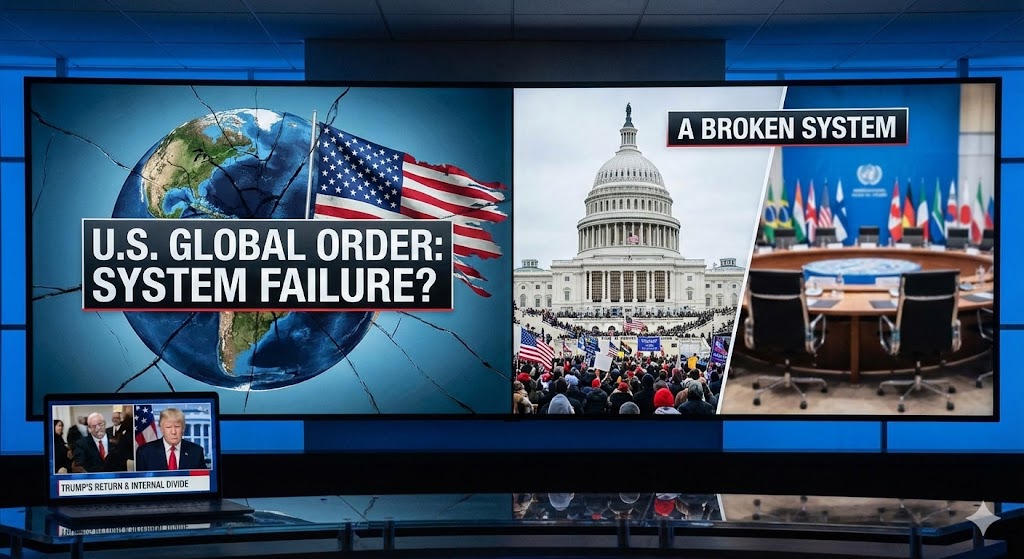
The instability dominating global politics today is often explained through individual events: wars, elections, sanctions, trade conflicts, or polarizing leaders. Yet none of these explanations fully account for the depth, persistence, and global nature of the crisis. What the world is experiencing is not a collection of disconnected problems, but the slow breakdown of a single overarching system—one that once provided structure, predictability, and hierarchy, but is now failing under conditions it was never designed to manage.
This system is commonly known as the post–Cold War U.S.-led international order, built around American military dominance, economic centrality, and institutional authority. For three decades, it shaped how power operated, how disputes were managed, and how states related to one another. Today, that same system has become a source of instability rather than order.
Crucially, this is not a crisis caused by one country, one ideology, or one leader. It is the consequence of structural limits—the point at which human-made systems stop matching the realities they govern.
The System: What It Was and Why It Worked
After the collapse of the Soviet Union, the United States emerged as the sole global superpower. This created what many scholars described as a unipolar moment. The international system that followed rested on four interlinked pillars.
First, there was military dominance. The U.S. possessed unmatched global force projection, allowing it to deter rivals, police key regions, and intervene almost anywhere. Second came financial dominance, anchored in the U.S. dollar as the world’s reserve currency. Global trade, debt, and energy markets revolved around dollar-based systems, giving Washington enormous leverage. Third were international institutions—the UN system, IMF, World Bank, WTO—built on rules that reflected U.S. preferences and values. Finally, there was a dense web of alliances, especially in Europe, East Asia, and the Middle East, tying other states’ security and prosperity to American leadership.
This system worked not because it was universally loved, but because it offered predictability. States knew the rules, the hierarchy, and the consequences of defiance. Alternatives existed, but they were costly and risky. Compliance was often the rational choice.
How the System Tightened Its Grip Without Direct Control
Importantly, this order did not rely primarily on occupation or direct rule. Its power came from dependency. Security depended on U.S. guarantees. Trade depended on dollar liquidity. Development depended on Western financial institutions. Legitimacy depended on alignment with “rules-based” norms largely written by the system’s architects.
This created a form of soft constraint. Countries were free in theory, but constrained in practice. The system did not need to enforce obedience constantly; it shaped incentives so that obedience made sense. This is why it appeared stable for so long.
Why the System Began to Fail
The breakdown did not begin with a single shock. It emerged gradually as reality changed faster than the system.
Technology redistributed power. Information, capital, and influence escaped state control. Corporations and platforms grew larger than many governments. Supply chains became global, complex, and fragile. Economic power shifted toward Asia, while political expectations rose among populations everywhere.
At the same time, new actors learned how to operate within the system without fully submitting to it. China expanded economically without adopting Western political norms. Regional powers learned to hedge rather than align. Financial tools once seen as neutral were increasingly used as weapons—sanctions, asset freezes, exclusion from payment systems.
Each of these moves made sense tactically. Together, they undermined trust in the system’s neutrality. What had once looked like rules began to look like instruments of control.
The American Internal Dimension: Fracture at the Core
As external pressures mounted, internal stresses within the United States intensified. Economic inequality, cultural polarization, institutional distrust, and information fragmentation eroded domestic consensus. A system that required coherence at its center now faced internal fracture.
American institutions remained powerful, but their legitimacy weakened. Elections were contested. Courts were politicized in perception. Federal authority was increasingly challenged by states. This did not produce civil war, but it produced something more corrosive: chronic internal conflict without resolution.
This internal struggle matters globally. The post–Cold War order depended on a confident, coherent American center. When that center weakens, the system loses its anchor.
Trump’s Role: Restoration or Acceleration?
The rise of Donald Trump must be understood in this context. Trump did not create the crisis; he reacted to it. His policies sought to restore the old order by force—using tariffs, pressure on allies, transactional diplomacy, and overt coercion.
In the short term, this approach produced visible leverage. Rivals hesitated. Partners complied. Domestically, it reassured a segment of the population that American power was being asserted again.
But structurally, these policies accelerated decay. Alliances weakened as trust eroded. Institutions lost credibility as rules appeared conditional. The dollar’s dominance was reinforced tactically but undermined strategically as states searched for alternatives. Trump’s approach treated symptoms with pressure, not causes with reform.
The paradox is clear: the harder the system is enforced, the faster its legitimacy drains.
Why Everyone Feels They Are Losing
One of the most revealing features of the current moment is that nearly all actors feel under threat.
The United States feels its dominance slipping. China feels time pressure and external containment. Europe feels strategically exposed. Middle powers feel trapped between blocs. Smaller states feel vulnerable to shocks they cannot control. Ordinary citizens everywhere feel economically insecure and politically unheard.
This is not because everyone is actually losing at the same time. It is because the old guarantees no longer hold. When a system loses credibility, fear replaces confidence. Actors become defensive, short-term, and risk-averse. This behavior further destabilizes the system, creating a self-reinforcing loop.
Who Is Actually Benefiting—for Now
While no one is fully winning, some actors are navigating the transition better than others.
Large technology and financial corporations benefit from regulatory gaps and cross-border influence. States that practice strategic patience—avoiding escalation while building alternatives—gain time and resilience. Countries that remain flexible and non-aligned extract value from multiple relationships.
Yet these advantages are temporary. In a fully fragmented system, even today’s beneficiaries face higher risks and lower predictability.
How the System Is Breaking—Not Collapsing
The key point is that the post–Cold War order is not collapsing suddenly. It is leaking. Rules still exist, but are selectively applied. Institutions still function, but command less trust. Power still concentrates, but cannot compel outcomes reliably.
This slow erosion is more dangerous than abrupt collapse. It creates a prolonged period of instability where coordination fails, crises multiply, and reform becomes harder with each delay.
Conclusion: The End of Automatic Order
The world is not facing chaos because one country has failed or one leader has acted irresponsibly. It is facing disorder because a system built for a different era has reached its limits.
The post–Cold War U.S.-led order succeeded because it aligned power, legitimacy, and reality. It is failing because those elements have drifted apart. Force can delay adjustment, but it cannot restore alignment. Denial can buy time, but it cannot rebuild trust.
The central challenge of the coming decades is not who replaces the United States, but whether a new framework can emerge that reflects how power, technology, and society actually function today. Until that happens, instability will remain the norm—not because the world lacks leadership, but because it is searching for a system that finally fits the world it governs.