
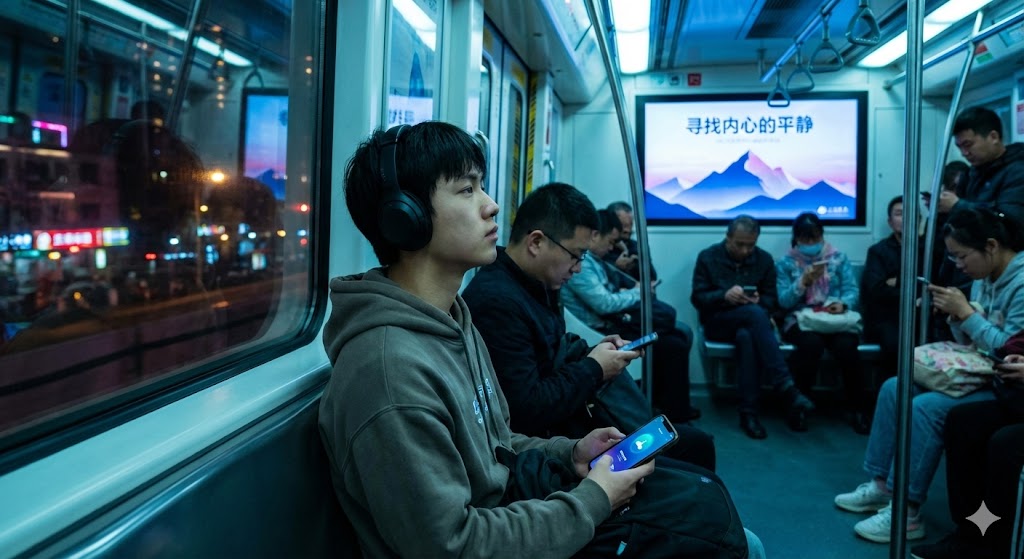






Introduction
China in the 21st century presents a paradox unlike any other civilization in modern history.
On the surface, it is a model of success:
economic growth, technological advancement, urban efficiency, global influence, and social order. Millions have been lifted out of poverty, infrastructure is world-class, and daily life is materially easier than at any point in Chinese history.
Yet beneath this visible success lies a quieter, less measurable reality: a growing emotional and existential unease — particularly among the younger generations.
This unease does not usually express itself through protest, religious revival, or ideological rebellion. Instead, it appears in what people search, what they watch, how they relax, and where they emotionally invest their time.
In China today, entertainment is not just entertainment.
Drama is not just drama.
Fantasy is not just fantasy.
They function as emotional escape mechanisms in a society where traditional sources of meaning have weakened, and new ones have not fully formed.
This article examines that phenomenon in depth.
Our Findings About Chinese Society and the Young Generation
Based on observable patterns in Chinese society — including search behavior, cultural consumption, youth discourse, work culture, and media trends — several consistent findings emerge:
- Meaning is no longer inherited through religion, metaphysics, or shared belief.
- Purpose is increasingly replaced by performance (productivity, success, optimization).
- Emotional expression is redirected from real life into fictional or digital spaces.
- Entertainment has become a psychological regulator, not merely leisure.
- Young people experience fatigue before fulfillment, despite achievement.
- Questions of “why” are suppressed, while questions of “how” dominate.
- Emotional escape is socially acceptable, while existential questioning is not.
These conditions form the background against which emotional escape becomes not only common — but necessary.
Key Questions Addressed in This Article
- What is emotional escape, and how does it function in modern China?
- Why has emotional escape become so dominant in Chinese society?
- How do Chinese dramas, fantasy genres, and digital entertainment serve this role?
- What does emotional escape reveal about the loss of meaning?
- When and why does emotional escape begin to fail?
- What psychological and social consequences emerge when it fails?
- What can realistically replace emotional escape without religious language?
- How do non-religious societies elsewhere address meaning crises?
- How can meaningful conversation begin in China without confrontation?
- What does the future trajectory look like if the current pattern continues?
Each question is addressed in full below.
1. What Is Emotional Escape in the Context of China?
Emotional escape in China is not a marginal psychological habit, nor a temporary cultural trend. It is a systemic social adaptation that has emerged in response to a profound transformation in how meaning, identity, and emotional expression are organized in modern Chinese life.
To understand emotional escape in China, it must be examined not as an individual coping mechanism, but as a collective behavioral pattern shaped by history, governance, economic structure, and cultural evolution.
1.1 Emotional Escape Is Not Mere Entertainment
In most societies, entertainment serves a secondary role:
it complements life, offering rest, pleasure, or artistic engagement.
In contemporary China, entertainment increasingly performs a primary emotional function. It does not sit beside life; it compensates for what life no longer provides.
Emotional escape refers to the process by which individuals redirect unmet emotional and existential needs—such as purpose, recognition, emotional release, and moral clarity—into symbolic or fictional environments, rather than confronting them in lived reality.
This includes:
- Prolonged immersion in television dramas
- Deep emotional investment in fictional characters
- Identification with idealized or tragic narratives
- Continuous consumption of short-form digital content
- Emotional dependency on virtual stimulation
These behaviors are not inherently problematic. What defines them as emotional escape is their function:
they regulate internal states that real social structures no longer stabilize.
1.2 Why Emotional Escape Becomes Collective in China
Emotional escape becomes socially dominant when multiple systems withdraw emotional responsibility at the same time.
In China, three key systems have gradually disengaged from providing meaning:
a) The Ideological System
Public ideology emphasizes:
- Stability
- Development
- Productivity
- Social order
While effective for governance, this framework does not address:
- Personal suffering
- Emotional loss
- Existential uncertainty
- Moral ambiguity
As a result, individuals learn how to function, but not how to feel or interpret life.
b) The Economic System
The modern Chinese economy rewards:
- Efficiency
- Output
- Endurance
- Adaptability
However, it often:
- Treats humans as replaceable units
- Measures worth through performance
- Compresses time for reflection
When economic participation becomes the dominant identity, emotional life is displaced, not nurtured.
c) The Social System
Rapid urbanization and competition have weakened:
- Community continuity
- Shared rituals
- Intergenerational emotional transmission
As traditional support structures erode, individuals are left to manage emotional burdens alone.
When all three systems retreat from meaning-making, emotional escape emerges as a socially acceptable substitute.
1.3 Emotional Escape as a Safe Emotional Outlet
In China, direct emotional confrontation carries risks:
- Vulnerability is often discouraged
- Public expression of existential doubt is limited
- Open discussion of despair or purposelessness is socially constrained
Emotional escape offers a safe alternative because it is:
- Non-political
- Non-confrontational
- Socially normalized
- Individually contained
A person can cry over a fictional character, feel moral outrage over a storyline, or experience catharsis through drama — without challenging real-world structures.
This makes emotional escape:
- Low-risk
- High-access
- Widely tolerated
It becomes the default channel for emotions that have nowhere else to go.
1.4 The Emotional Logic Behind Popular Chinese Narratives
The content dominating Chinese entertainment is not accidental. It reflects emotional needs.
Common narrative elements include:
- Characters who suffer meaningfully
- Sacrifice that is recognized, even if tragic
- Clear distinctions between loyalty and betrayal
- Destiny or fate that gives coherence to pain
- Emotional resolution, even in loss
These elements provide what daily life often lacks:
- A sense that suffering matters
- Moral clarity
- Narrative closure
In real life, effort does not always lead to dignity.
In fiction, it almost always does.
This contrast explains why emotional investment shifts toward fictional worlds.
1.5 Emotional Escape vs. Emotional Expression
It is important to distinguish emotional escape from healthy emotional expression.
Emotional expression:
- Processes feelings
- Integrates experience
- Leads to understanding
Emotional escape:
- Avoids resolution
- Suspends reality
- Requires repetition
In China, emotional expression is often:
- Private
- Internalized
- Discouraged in public settings
As a result, emotional escape replaces expression.
People do not articulate pain — they absorb stories that mirror it.
1.6 Digital Acceleration of Emotional Escape
Digital platforms intensify emotional escape by:
- Providing instant stimulation
- Eliminating downtime
- Fragmenting attention
- Creating endless emotional loops
Short-form content does not aim to resolve emotion; it aims to interrupt discomfort.
This creates a cycle:
- Emotional unease
- Digital immersion
- Temporary relief
- Emotional return
- Increased consumption
The faster the content, the less space there is for reflection.
1.7 Emotional Escape as a Signal, Not a Failure
Crucially, emotional escape should not be interpreted as weakness, decadence, or moral decline.
It is a signal.
It indicates that:
- Emotional needs remain unmet
- Meaning frameworks are insufficient
- Human questions persist despite modernization
People escape not because they reject meaning, but because they cannot find it where they live.
1.8 Why Emotional Escape Is Especially Intense in China
Emotional escape exists globally, but in China it is intensified because:
- Alternative meaning systems are limited
- Public existential dialogue is constrained
- Productivity is highly emphasized
- Collective endurance is normalized
When resilience is expected but meaning is not supplied, escape becomes the only release valve.
1.9 Summary of Emotional Escape in the Chinese Context
In the context of China, emotional escape is:
- A collective adaptation to meaning loss
- A substitute for emotional expression
- A response to structural silence
- A socially safe form of emotional survival
- A temporary solution to a permanent human need
It is not the cause of China’s emotional unease —
it is the symptom.
And like all symptoms, it persists until the underlying condition is addressed.
2. Why Has Emotional Escape Become Dominant in Chinese Society?
Emotional escape does not become dominant because people suddenly prefer fiction, entertainment, or distraction. It becomes dominant when real life systematically stops answering emotional and existential needs, while still demanding high performance, obedience, and endurance.
In China, emotional escape has grown not from excess freedom, but from structural pressure combined with emotional silence. This dominance is the result of multiple long-term processes converging at the same historical moment.
2.1 The Collapse of Inherited Meaning Without Replacement
For most of Chinese history, meaning was not an individual project. It was inherited.
Meaning came from:
- Family hierarchy and filial duty
- Moral cultivation traditions
- Social roles that defined value
- Cosmological or metaphysical assumptions
- Collective continuity across generations
Modern China dismantled many of these frameworks rapidly.
What replaced them was not a new meaning system, but functionality:
- Development
- Stability
- Growth
- Efficiency
These are effective goals for a state, but they do not answer personal questions such as:
- Why should I endure?
- What does my suffering mean?
- What remains if I fail?
- What gives my life dignity beyond success?
When inherited meaning collapses and no narrative replacement emerges, emotional escape becomes the default coping mechanism.
2.2 Performance Culture Without Emotional Infrastructure
Chinese society places extraordinary emphasis on performance:
- Academic ranking
- Workplace output
- Economic mobility
- Social comparison
Performance is measurable, rewarded, and visible.
However, performance culture alone cannot carry emotional weight.
In such a system:
- Failure is internalized
- Weakness is privatized
- Exhaustion is normalized
- Emotional processing is postponed indefinitely
There are few institutional spaces where people can:
- Admit confusion
- Express despair
- Question purpose
- Reframe failure meaningfully
Emotional escape steps in where emotional infrastructure is absent.
Entertainment becomes:
- The place where emotions are allowed
- The space where tears are acceptable
- The arena where injustice is acknowledged
- The narrative where suffering is seen
2.3 Silence Around Existential Questions
In many societies, existential questions are absorbed by:
- Religion
- Philosophy
- Public discourse
- Art with interpretive freedom
In China, existential questioning exists — but largely without a public language.
Questions such as:
- “Why does life feel empty despite success?”
- “What is the point of endless effort?”
- “What justifies sacrifice?”
are rarely addressed openly or structurally.
As a result:
- People do not stop asking these questions
- They simply stop asking them aloud
Emotional escape allows these questions to be felt without being spoken.
A drama can express despair, loss, injustice, or hope symbolically — without requiring real-world articulation.
2.4 The Weakening of Community as an Emotional Container
Traditional communities once absorbed emotional strain through:
- Shared rituals
- Intergenerational storytelling
- Collective hardship
- Moral reinforcement
Urbanization, migration, and competitive individualism have weakened these containers.
Modern Chinese life is often:
- Dense but lonely
- Connected but isolated
- Busy but emotionally fragmented
Without communal emotional processing:
- Pain becomes private
- Stress becomes internal
- Meaning becomes individualized
Emotional escape fills the gap by offering simulated emotional community:
- Shared fandoms
- Collective viewing experiences
- Online emotional synchronization
People feel together — even if they are alone.
2.5 Safety and Non-Confrontation
Another reason emotional escape dominates is that it is safe.
In a tightly managed social environment:
- Open confrontation carries risk
- Deep questioning draws attention
- Ideological alternatives are limited
Emotional escape, by contrast:
- Is politically neutral
- Requires no confrontation
- Attracts no scrutiny
- Is culturally normalized
Watching a drama, immersing in fantasy, or scrolling endlessly is not seen as resistance — but it quietly absorbs emotional pressure that might otherwise surface elsewhere.
From a systemic perspective, emotional escape is not disruptive.
From a human perspective, it is survival.
2.6 Entertainment as Emotional Regulation Technology
Modern entertainment in China functions less like art and more like emotional regulation technology.
It:
- Calms anxiety
- Distracts from despair
- Provides controlled emotional release
- Prevents emotional overload
This explains why:
- Content is emotionally intense
- Narratives are prolonged
- Consumption is repetitive
People are not chasing novelty — they are chasing emotional balance.
When reality destabilizes emotions, entertainment stabilizes them temporarily.
2.7 Why Young People Are Especially Affected
Younger generations are more vulnerable to emotional escape because:
- They inherit fewer stable narratives
- They face higher competition with lower mobility
- They experience delayed life milestones
- They are immersed in digital environments from childhood
Unlike older generations, they cannot anchor meaning in:
- Historical struggle
- Collective sacrifice
- Revolutionary identity
Their lives are optimized — but not interpreted.
Emotional escape becomes the place where:
- Identity is explored
- Emotions are rehearsed
- Meaning is simulated
2.8 Emotional Escape as a Rational Response, Not Irrational Behavior
It is critical to understand that emotional escape is not irrational.
Given the conditions:
- High pressure
- Low emotional articulation
- Limited existential discourse
- Performance-driven identity
Emotional escape is one of the most rational available responses.
It requires no permission.
It demands no explanation.
It provides immediate relief.
Societies do not drift into emotional escape accidentally.
They arrive there logically.
2.9 Summary: Why Emotional Escape Became Dominant
Emotional escape dominates Chinese society because:
- Meaning systems weakened faster than new ones formed
- Performance replaced purpose
- Silence replaced dialogue
- Community weakened
- Emotional expression lost public space
- Safe alternatives were limited
Entertainment stepped into a vacuum — not by design, but by necessity.
It did not create the crisis.
It adapted to it.
3. How Chinese Entertainment Becomes Emotional Refuge
In contemporary China, entertainment does not merely fill free time. It performs functions that were once carried by philosophy, religion, community, and shared moral narratives. To understand emotional escape in China, it is essential to understand how entertainment structurally replaces these functions, not accidentally but systematically.
Entertainment in China operates as a substitute emotional system — one that temporarily fulfills needs that daily life no longer addresses.
3.1 Entertainment as a Parallel Emotional World
Modern Chinese entertainment creates parallel emotional worlds that run alongside real life.
In real life:
- Effort does not guarantee dignity
- Sacrifice is often invisible
- Moral behavior is not always rewarded
- Endurance is expected without explanation
In fictional worlds:
- Effort is acknowledged
- Sacrifice has meaning
- Moral alignment is clear
- Suffering fits into a larger story
This contrast is crucial.
People do not turn to entertainment because it is unrealistic.
They turn to it because it is emotionally coherent, while real life often is not.
3.2 Chinese Dramas as Meaning Simulators
Chinese dramas function as meaning simulators rather than simple narratives.
Key recurring elements include:
a) Structured Suffering
Characters suffer for identifiable reasons:
- Loyalty
- Love
- Justice
- Honor
- Destiny
This gives pain a narrative logic, something daily life often lacks.
b) Moral Visibility
Right and wrong are usually distinguishable.
Even when endings are tragic, actions carry moral weight.
This restores a sense of ethical clarity that is often blurred in competitive social systems.
c) Emotional Recognition
Characters’ emotions are seen, named, and validated.
Viewers experience recognition through identification.
In real life, emotions are often suppressed.
In drama, they are amplified and legitimized.
3.3 Fantasy and Historical Genres: Escaping into Order
Fantasy and historical genres are especially dominant because they offer ordered universes.
These worlds contain:
- Clear hierarchies
- Moral codes
- Destiny or fate
- Transcendence beyond material success
Such elements restore what modern life fragments:
- Continuity
- Purpose
- Belonging
Importantly, these genres do not merely distract.
They re-enchant existence — temporarily restoring the feeling that life operates within a meaningful structure.
3.4 Emotional Catharsis Without Real-World Risk
Entertainment allows emotional release without real-world consequences.
Through fiction, individuals can:
- Cry without appearing weak
- Feel rage without confrontation
- Experience loss without personal risk
- Express longing without vulnerability
This makes entertainment a safe emotional outlet in a society where emotional exposure is often discouraged.
The emotional work is done symbolically, not socially.
3.5 Short-Form Content as Emotional Regulation
Short videos, clips, and micro-content serve a different but related function.
They:
- Interrupt anxiety
- Regulate mood
- Prevent rumination
- Fill emotional gaps instantly
Unlike long dramas, short-form content does not aim to create meaning.
It aims to suppress discomfort quickly.
This creates a rhythm:
- Discomfort → stimulation → relief → repetition
Over time, this rhythm replaces reflection with consumption.
3.6 Celebrity Culture as Emotional Projection
Celebrity culture functions as a projection mechanism.
Audiences project:
- Aspirations
- Longings
- Emotional intensity
- Idealized identities
Celebrities become:
- Emotional placeholders
- Symbols of imagined fulfillment
- Safe objects of attachment
This does not indicate immaturity.
It indicates displaced emotional investment in a society where deep personal bonds are increasingly strained by competition and mobility.
3.7 Entertainment as a Substitute for Narrative Identity
Human beings require a narrative answer to:
- Who am I?
- What does my struggle mean?
- Where am I going?
When personal life lacks narrative coherence, people borrow narratives.
Entertainment provides:
- Ready-made identities
- Emotional arcs
- Meaningful endings
Viewers temporarily inhabit these narratives to compensate for lives that feel episodic, repetitive, or directionless.
3.8 Why Entertainment Works Better Than Abstract Thought
Abstract reflection requires:
- Time
- Emotional safety
- Interpretive tools
Entertainment requires:
- Attention only
In high-pressure environments, people gravitate toward systems that:
- Demand less emotional labor
- Offer immediate emotional return
- Do not require articulation
This is why stories outperform philosophy, and images outperform arguments.
3.9 The Cost of Emotional Substitution
While entertainment fulfills emotional needs temporarily, it does not resolve them.
Over time:
- Emotional tolerance increases
- Satisfaction decreases
- Dependency grows
The system requires escalation:
- More intense plots
- Longer series
- Faster stimulation
This is not cultural decline — it is emotional compensation reaching its limits.
3.10 Summary: Entertainment as an Emotional Infrastructure
In China, entertainment functions as:
- A surrogate for meaning
- A container for suppressed emotions
- A simulator of moral order
- A regulator of psychological pressure
- A narrative substitute for identity
It does not solve the underlying problem.
It manages its symptoms.
Entertainment has become essential not because people love fantasy —
but because reality has stopped explaining itself.
4. What Emotional Escape Reveals About the Loss of Meaning
Emotional escape is not the root problem.
It is a diagnostic signal.
By examining what people escape into, how intensely they escape, and how long escape is sustained, we can infer what has disappeared from everyday life. In the case of China, emotional escape reveals a deep erosion of meaning structures that once gave coherence, dignity, and emotional stability to human existence.
4.1 Meaning Is Not an Abstract Idea — It Is a Social Function
Meaning is often misunderstood as a philosophical luxury. In reality, meaning performs essential social and psychological functions:
- It explains suffering
- It justifies sacrifice
- It anchors identity
- It connects effort to purpose
- It provides moral orientation
When meaning functions properly, people do not constantly ask about it — they live within it.
The prominence of emotional escape in China indicates that these functions are no longer being fulfilled by everyday social life.
4.2 The Absence of a Coherent Life Narrative
A meaningful society provides a story that answers three questions:
- Where do I come from?
- What am I doing here?
- What does my life contribute?
In contemporary China, the dominant narrative focuses on:
- Growth
- Stability
- National progress
- Personal competitiveness
While powerful at the macro level, this narrative offers limited guidance at the personal level. It explains what must be done, but not why it matters emotionally.
As a result, individuals experience their lives as:
- Episodic rather than continuous
- Functional rather than purposeful
- Measured rather than interpreted
Emotional escape compensates by offering complete narratives with beginnings, conflicts, and resolutions.
4.3 Suffering Without Interpretation
One of the clearest signs of meaning loss is uninterpreted suffering.
In a meaning-rich society:
- Pain fits into a story
- Endurance is respected
- Loss carries dignity
In China’s current structure:
- Suffering is expected
- Complaints are discouraged
- Endurance is normalized but unexplained
People are told to persist, but not why persistence matters.
Entertainment steps in to reinterpret suffering symbolically — transforming pain into tragedy, sacrifice, or heroism.
This reveals a gap:
real pain lacks symbolic recognition, so symbolic pain becomes emotionally necessary.
4.4 Moral Ambiguity in Daily Life
Meaning also depends on moral clarity.
In highly competitive systems:
- Ethical compromises are common
- Outcomes matter more than processes
- Success often overrides virtue
This creates a moral environment where:
- People behave pragmatically
- But feel ethically unsettled
Entertainment restores moral visibility:
- Good and evil are distinguishable
- Loyalty and betrayal have consequences
- Justice, even delayed, exists
The popularity of such narratives reveals a hunger for moral coherence absent in daily interactions.
4.5 Identity Reduced to Utility
Modern Chinese identity is increasingly shaped by:
- Educational achievement
- Economic productivity
- Social usefulness
While functional, this identity is fragile:
- Failure threatens self-worth
- Aging reduces value
- Non-performance feels meaningless
A society where worth is conditional creates existential anxiety.
Emotional escape reveals this condition by offering identities that:
- Matter beyond utility
- Are valued for loyalty, love, or courage
- Retain dignity even in failure
4.6 The Silence Around Ultimate Questions
Another indicator of meaning loss is the absence of shared language for ultimate questions.
Questions such as:
- What makes life worth living?
- What justifies sacrifice?
- What remains after loss?
exist internally but lack public expression.
Emotional escape allows these questions to be felt without being spoken.
Drama becomes the language that daily life lacks.
4.7 The Rise of Cynicism and Emotional Irony
Where meaning weakens, cynicism grows.
In China, this often appears as:
- Humor masking despair
- Irony replacing sincerity
- Emotional detachment presented as intelligence
These are defense mechanisms, not indifference.
They indicate:
- Disappointment with promised fulfillment
- Fear of vulnerability
- Loss of trust in narratives
Emotional escape provides sincerity without risk — allowing people to feel deeply without committing publicly.
4.8 Why Meaning Loss Produces Escape, Not Revolt
It is important to note what meaning loss does not produce.
In China, it does not typically produce:
- Mass rebellion
- Ideological movements
- Open confrontation
Instead, it produces:
- Withdrawal
- Emotional privatization
- Reduced aspiration
- Internal disengagement
Emotional escape thrives in such environments because it offers relief without resistance.
4.9 Emotional Escape as a Measurement Tool
By studying emotional escape, one can map where meaning has eroded:
- Heavy drama consumption → lack of emotional recognition
- Fantasy obsession → absence of moral order
- Short-form addiction → intolerance for silence
- Celebrity fixation → displaced aspiration
- Narrative immersion → identity fragmentation
Escape patterns function as cultural diagnostics.
4.10 Summary: What Emotional Escape Reveals
Emotional escape in China reveals that:
- Meaning is no longer embedded in daily life
- Suffering lacks interpretation
- Identity is performance-based
- Moral clarity is unstable
- Emotional expression lacks public space
- Life narratives are incomplete
People do not escape because they reject reality —
they escape because reality has stopped explaining itself.
5. When Does Emotional Escape Fail?
Emotional escape is effective only under specific conditions. It works when emotional pressure is moderate, when hope still exists somewhere in the background, and when symbolic substitutes can plausibly compensate for real-world absence of meaning.
In China, emotional escape is now reaching its structural limits. Its failure is not sudden or dramatic; it unfolds gradually, internally, and unevenly across society — particularly among younger generations.
5.1 Emotional Escape Is Designed for Short-Term Relief, Not Long-Term Meaning
Emotional escape is fundamentally a regulatory mechanism, not a meaning system.
It is effective at:
- Reducing emotional intensity
- Interrupting stress
- Offering temporary identification
- Creating symbolic resolution
It is ineffective at:
- Sustaining purpose
- Explaining prolonged suffering
- Anchoring identity
- Integrating life experiences
As long as emotional escape is used occasionally, it complements life.
When it becomes structural, it is forced to do work it was never designed to do.
This mismatch marks the beginning of failure.
5.2 Stage One Failure: Emotional Tolerance and Diminishing Returns
The first sign of failure is emotional tolerance.
What once produced:
- Strong emotional release
- Catharsis
- Identification
Now produces:
- Familiarity
- Predictability
- Weaker emotional impact
Observable outcomes include:
- Longer screen time
- Faster content switching
- Escalation toward more intense themes
- Increased multitasking during consumption
This is not boredom — it is desensitization.
The emotional system adapts, requiring more stimulation to achieve the same relief.
5.3 Stage Two Failure: The Return of Emptiness After Consumption
In earlier phases, emotional escape delays discomfort.
In later phases, discomfort returns immediately.
People report:
- A hollow feeling after finishing a series
- Emotional drop-offs following immersion
- A sense of wasted time despite enjoyment
This stage is critical because escape no longer masks emptiness — it reveals it.
The question shifts from:
“What should I watch next?”
to:
“Why does this still feel empty?”
5.4 Stage Three Failure: Intrusive Existential Questions
As emotional escape weakens, existential questions emerge inside the escape itself.
These questions include:
- “Why am I investing so much emotion here?”
- “What happens when this ends?”
- “Is this all my life consists of?”
These are not philosophical inquiries.
They are emotional signals that the substitute is no longer sufficient.
At this stage, emotional escape becomes self-defeating:
it creates the very awareness it was meant to avoid.
5.5 Stage Four Failure: Emotional Fatigue and Withdrawal
Sustained emotional stimulation without resolution leads to emotional exhaustion.
Common manifestations in China include:
- Detachment from content once loved
- Reduced emotional responsiveness
- Indifference replacing excitement
- Cynicism toward narratives
This fatigue often coincides with:
- Social withdrawal
- Reduced ambition
- Minimalist aspirations
- “Lying flat” attitudes
People do not rebel — they disengage.
5.6 What Happens Psychologically When Escape Fails
When emotional escape fails, individuals are left with:
- Unprocessed stress
- Unanswered questions
- Identity instability
- Reduced emotional resilience
At this point, three broad responses emerge:
Response 1: Deepened Escapism
Some intensify escape through:
- More extreme content
- Complete digital immersion
- Emotional numbing
This is a defensive reaction, but unstable.
Response 2: Emotional Shutdown
Others reduce emotional investment altogether:
- Lower expectations
- Avoidance of attachment
- Emotional minimalism
Life becomes manageable, but shallow.
Response 3: Meaning-Seeking Shift
A smaller but significant group begins searching for:
- Stable values
- Purposeful work
- Moral clarity
- Interpretive frameworks
This group marks the transition point from escape to inquiry.
5.7 Social Consequences of Widespread Escape Failure
When emotional escape fails collectively, societies experience:
- Declining motivation despite incentives
- Rising quiet dissatisfaction
- Weakening trust in success narratives
- Shrinking emotional bandwidth
In China, this manifests as:
- Reduced enthusiasm for traditional success paths
- Delayed life milestones
- Reluctance toward long-term commitments
- Emotional risk aversion
These are not signs of laziness.
They are signs of existential recalibration.
5.8 Why Failure Does Not Immediately Produce Alternatives
Even when escape fails, alternatives do not appear automatically.
This is because:
- Meaning systems require articulation
- Articulation requires language
- Language requires safety
Without these conditions, people remain in a liminal state:
- Escape no longer satisfies
- Meaning has not yet emerged
This is the most psychologically vulnerable phase.
5.9 Failure as a Necessary Transition, Not a Collapse
It is important to understand that failure is not purely negative.
The failure of emotional escape:
- Signals readiness for deeper engagement
- Exposes unmet needs
- Forces confrontation with unanswered questions
Historically, societies begin meaning reconstruction after substitutes collapse, not before.
Failure is not the end of escape —
it is the beginning of inquiry.
5.10 Summary: When Emotional Escape Fails
Emotional escape fails when:
- Stimulation outpaces satisfaction
- Emptiness returns faster than relief
- Questions arise within the escape itself
- Emotional fatigue sets in
- Withdrawal replaces immersion
What follows is not chaos —
it is a quiet turning point.
A society cannot escape forever.
Eventually, it must either rediscover meaning —
or adapt to permanent emptiness.
6. Consequences When Emotional Escape Collapses
When emotional escape begins to fail, a society does not automatically turn toward religion, ideology, or metaphysics. In fact, in environments where belief systems are weak, restricted, or culturally distant, replacement mechanisms emerge from within everyday life itself.
What replaces emotional escape is not belief — it is structure.
Specifically, structures that can perform the same functions that emotional escape temporarily provides, but in a sustainable and reality-based way.
These replacements are observable in non-religious or secular societies worldwide, and increasingly — though unevenly — in China.
6.1 The Core Functions That Must Be Replaced
Before identifying replacements, it is necessary to identify what emotional escape actually does.
Emotional escape temporarily provides:
- Emotional release
- Narrative coherence
- Moral recognition
- Identity beyond utility
- A sense that suffering “counts”
Any viable replacement must perform at least some of these functions, or emotional escape will return.
6.2 Meaningful Responsibility (Not Mere Busyness)
One of the strongest non-religious replacements for emotional escape is responsibility tied to value, not just obligation.
There is a critical difference between:
- Being busy
- Being responsible for something that matters
In China, much work is intensive but instrumental:
- Output-focused
- Metric-driven
- Replaceable
Meaningful responsibility emerges when:
- The outcome affects real people
- The contribution is visible
- The role cannot be easily substituted
- The effort aligns with a recognizable value
Examples include:
- Mentorship
- Teaching
- Craftsmanship
- Caregiving
- Research with social impact
- Building or maintaining something others rely on
This type of responsibility anchors identity and reduces the need for emotional escape because life itself begins to generate emotional feedback.
6.3 Narrative Identity Through Long-Term Commitment
Emotional escape thrives where life feels fragmented.
A powerful replacement is long-term commitment, which creates narrative continuity.
Commitment:
- Does not require belief
- Does not require ideology
- Does require time and endurance
Examples include:
- Mastery of a discipline
- Sustained creative practice
- Long-term collaboration
- Community projects
- Personal missions with delayed outcomes
In China, where life is often divided into short competitive cycles, long-term commitment restores:
- A sense of progression
- Personal authorship
- Meaningful memory
People stop escaping when they can say:
“This is what my life is building toward.”
6.4 Moral Coherence Without Moral Absolutism
Emotional escape compensates for moral ambiguity.
A replacement does not require absolute moral systems. It requires consistency.
Moral coherence exists when:
- Values are clear
- Actions align with those values
- Trade-offs are acknowledged honestly
- Integrity is socially recognizable
In environments where success is rewarded regardless of method, people experience internal conflict.
When moral coherence is restored — even locally — emotional tension decreases.
This is why:
- Ethical workplaces
- Transparent leadership
- Fair evaluation systems
have disproportionate emotional impact, even without ideological framing.
6.5 Legitimate Emotional Expression Spaces
One reason emotional escape dominates is the absence of socially legitimate emotional expression.
Replacement requires:
- Spaces where emotion is allowed
- Language for frustration and doubt
- Shared acknowledgment of difficulty
This can occur through:
- Peer discussion groups
- Mentorship relationships
- Honest creative expression
- Counseling structures
- Narrative-based communication (writing, storytelling)
These spaces do not resolve suffering — but they prevent emotional accumulation, reducing the need for escape.
6.6 Contribution Beyond the Self
Emotional escape is self-focused by nature.
A strong replacement is contribution that extends beyond personal benefit.
Contribution works because it:
- Relocates attention
- Creates moral relevance
- Makes effort visible
- Transforms sacrifice into impact
In non-religious societies, meaning often stabilizes when individuals:
- Serve others
- Improve shared systems
- Leave tangible benefits behind
In China, contribution-based identity remains underdeveloped but highly potent when present.
6.7 The Role of Truthful Language
Another replacement for emotional escape is truthful naming of experience.
When people can say:
- “This is exhausting”
- “This feels meaningless”
- “I am afraid of wasting my life”
without punishment or ridicule, emotional escape weakens.
Truthful language:
- Reduces isolation
- Prevents internalization
- Creates shared reality
This does not require philosophy or belief — only permission.
6.8 Why Replacements Must Be Gradual and Local
Meaning cannot be imposed systemically.
Effective replacements:
- Emerge locally
- Begin privately
- Spread horizontally
- Avoid grand narratives
Large-scale solutions often fail because they replicate the same abstraction that caused the crisis.
Small, durable meaning structures succeed because they are lived, not declared.
6.9 Why Emotional Escape Persists Alongside Replacements
Importantly, replacement does not eliminate emotional escape entirely.
Entertainment, fantasy, and leisure remain healthy when:
- They complement life
- They do not substitute for it
- They follow engagement, not replace it
The goal is not elimination — it is rebalancing.
6.10 Summary: What Replaces Emotional Escape
Without religious language, emotional escape is replaced by:
- Meaningful responsibility
- Long-term commitment
- Moral coherence
- Legitimate emotional expression
- Contribution beyond self
- Truthful language
- Narrative continuity
Where these exist, emotional escape recedes naturally.
Where they do not, escape returns — no matter how advanced the society appears.
7. What Can Replace Emotional Escape Without Religious Language?
Meaningful conversation does not begin where meaning is already strong.
It begins where meaning is weak but still desired.
In China, the challenge is not the absence of thought, intelligence, or reflection. The challenge is that meaning-related dialogue lacks safe entry points. As a result, conversations about purpose, value, and direction are displaced, delayed, or internalized.
Understanding how meaningful conversation begins requires understanding how it does not begin.
7.1 Meaning Does Not Enter Through Ideology or Instruction
In tightly structured societies, meaning-oriented dialogue rarely begins through:
- Doctrines
- Philosophical lectures
- Moral instruction
- Abstract reasoning
- Prescriptive frameworks
These approaches fail because they:
- Appear confrontational
- Trigger defensiveness
- Feel disconnected from lived experience
- Imply judgment or correction
In China, where social harmony and risk avoidance are deeply embedded, such approaches are perceived as unsafe or impractical, regardless of their content.
Meaningful conversation therefore enters sideways, not directly.
7.2 The First Entry Point: Shared Fatigue
The most reliable opening for meaningful conversation is shared exhaustion.
People may not openly discuss meaning, but they readily acknowledge:
- Burnout
- Pressure
- Emotional tiredness
- Sense of repetition
- Feeling “drained”
Statements such as:
- “This is exhausting”
- “It feels endless”
- “I don’t know what this is leading to”
are socially acceptable because they:
- Do not assign blame
- Do not challenge authority
- Reflect common experience
Shared fatigue creates emotional alignment, which precedes meaningful dialogue.
7.3 The Second Entry Point: Questions Without Demands
Meaningful conversation in China begins not with answers, but with open questions that do not require resolution.
These questions include:
- “When do you actually feel alive?”
- “What part of your day feels real?”
- “What would make this effort feel worth it?”
Such questions work because they:
- Are personal, not ideological
- Do not demand commitment
- Invite reflection without exposure
- Allow silence as a response
They shift attention from performance to experience.
7.4 The Role of Story Over Argument
In China, story consistently outperforms argument as a carrier of meaning.
Stories:
- Reduce abstraction
- Bypass defensiveness
- Humanize complexity
- Allow identification rather than agreement
This is why:
- Fiction resonates deeply
- Personal anecdotes circulate widely
- Narratives travel farther than principles
Meaningful conversation often begins when someone says:
“I once felt this way too…”
Rather than:
“This is what you should believe.”
Stories create emotional permission before intellectual engagement.
7.5 Indirect Language and Symbolic Expression
Direct language about meaning often feels too exposed.
As a result, symbolic language becomes essential:
- Metaphors
- Analogies
- Cultural references
- Fictional parallels
These forms allow people to:
- Explore ideas safely
- Maintain social distance
- Avoid definitive statements
- Protect emotional boundaries
Symbolic language functions as a protective layer for vulnerable questions.
7.6 Private Conversations Before Public Dialogue
Meaning-related dialogue in China almost always begins privately.
It emerges in:
- One-on-one conversations
- Late-night discussions
- Personal writing
- Quiet mentorship
- Anonymous online spaces
Public discourse follows only after private articulation becomes stable.
This sequence is critical:
- Private meaning precedes public meaning
- Personal clarity precedes collective language
Attempts to reverse this order typically fail.
7.7 Why Listening Matters More Than Framing
In societies marked by emotional restraint, being heard is transformative.
Meaningful conversation advances when:
- Listening replaces persuasion
- Presence replaces solutions
- Validation precedes interpretation
People are more willing to explore meaning when they feel:
- Understood without judgment
- Accepted without agreement
- Safe without exposure
Listening creates the emotional conditions under which deeper questions can surface.
7.8 The Slow Formation of Shared Vocabulary
Meaning cannot spread without language.
In China, a shared vocabulary for meaning is still emerging:
- Words for burnout
- Terms for emptiness
- Expressions for quiet despair
- Phrases for lost direction
As this vocabulary forms, conversation expands.
Language does not create meaning — but it allows meaning to be shared.
7.9 Why Meaningful Conversation Is Gradual, Not Viral
Meaning-related dialogue spreads slowly because:
- It involves vulnerability
- It resists simplification
- It cannot be commodified easily
- It does not produce immediate results
This slowness is not weakness.
It is stability.
Fast-spreading ideas often replace one abstraction with another.
Slow conversations build internal coherence.
7.10 Summary: How Meaningful Conversation Begins
In a society like China, meaningful conversation begins:
- With shared fatigue, not belief
- With questions, not answers
- With stories, not arguments
- With private reflection before public dialogue
- With listening before instruction
- With symbolic language before explicit frameworks
Meaning does not arrive as a declaration.
It emerges as a recognition.
People do not ask for meaning loudly —
they recognize it quietly when it finally has room to appear.
8. Lessons from Other Non-Religious Societies
Non-religious societies that stabilize meaning often rely on:
- Ethical humanism
- Service-based identity
- Strong cultural narratives
- Social trust
Where these fail, emotional escape rises globally — not just in China.
China’s challenge is not unique, but its scale is.
9. How Meaningful Conversation Begins in China
Meaningful conversation cannot begin with ideology.
It begins with:
- Shared fatigue
- Honest admission of emptiness
- Questions without immediate answers
Language that works:
- “This feels exhausting”
- “Why doesn’t success feel enough?”
- “What actually lasts?”
Language that fails:
- Moral preaching
- Political framing
- Abstract philosophy
Stories open doors where arguments close them.
10. Future Trajectory if Current Patterns Continue
If emotional escape remains the primary coping mechanism:
- Entertainment intensity will increase
- Emotional resilience will decline
- Social trust will weaken
- Youth disengagement will deepen
If meaning frameworks emerge:
- Escape becomes optional, not necessary
- Entertainment returns to leisure
- Emotional health stabilizes
The direction depends not on ideology — but on whether society can speak honestly about meaning again.
Conclusion
China is not facing a rebellion.
It is facing a silent emotional migration — from lived meaning into symbolic experience.
Emotional escape is not failure.
It is a signal.
A signal that a society built for efficiency now needs existence.
A signal that productivity alone cannot answer human questions.
A signal that stories, values, and purpose must return — in new forms.
Until then, millions will continue to search for life in drama, fantasy, and screens — not because they are weak, but because meaning has nowhere else to go.