






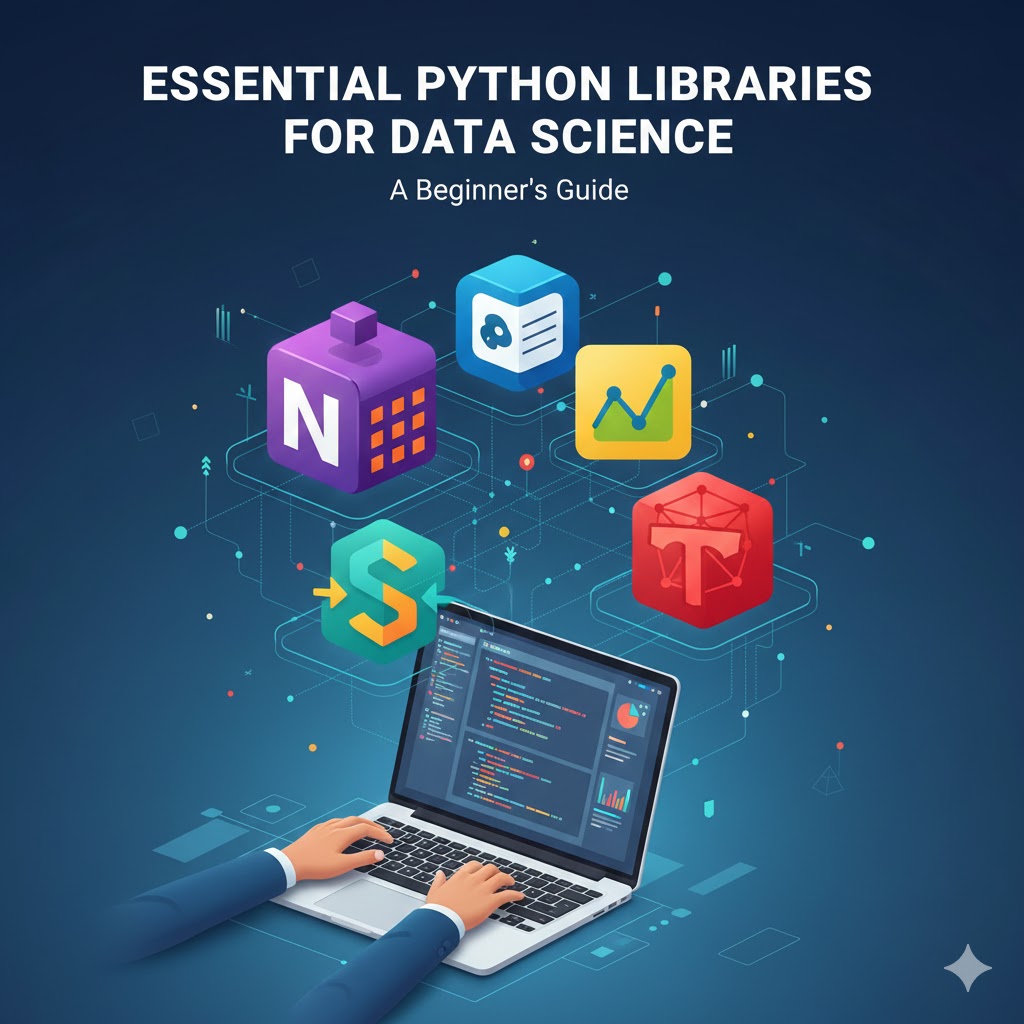
Python’s true power in Data Science comes from its rich ecosystem of specialized libraries. These libraries simplify complex tasks like numerical computation, data manipulation, visualization, and statistical analysis. In this lecture, we explore the four most important Python libraries every data science student must master: NumPy, Pandas, Matplotlib, and Seaborn.
This guide provides clear explanations, examples, and practical use cases—making it ideal for beginners entering the world of data analysis and machine learning.
Why Python Libraries Matter in Data Science
While Python provides a strong foundation, real-world data science tasks require efficient tools for:
- Handling large datasets
- Performing fast mathematical computations
- Cleaning and transforming data
- Creating visualizations
- Building machine learning models
Libraries like NumPy and Pandas drastically reduce complexity, while Matplotlib and Seaborn make it easy to create meaningful visual insights.
1. NumPy: The Foundation of Numerical Computing
NumPy (Numerical Python) is the most fundamental library in Data Science. It offers multi-dimensional arrays and efficient operations that are much faster than standard Python lists.
Key Features
- Fast numerical computations
- Support for vectors, matrices, and arrays
- Mathematical operations (linear algebra, statistics)
- Basis for other libraries (Pandas, Scikit-learn, etc.)
Example: Creating a NumPy Array
import numpy as np

arr = np.array([10, 20, 30])
print(arr)
Why NumPy Matters
Pandas, Scikit-learn, and even deep learning frameworks rely on NumPy’s array structure for speed and performance.
2. Pandas: The Most Popular Data Analysis Library
Pandas is the heart of data manipulation in Python. It provides intuitive structures for working with tabular data.
Key Structures
- Series → One-dimensional data
- DataFrame → Two-dimensional data (similar to Excel table)
Common Tasks with Pandas
- Importing data (CSV, Excel, SQL)
- Cleaning and transforming data
- Handling missing values
- Grouping and summarizing
- Merging and joining datasets
Example: Reading a CSV File
import pandas as pd

df = pd.read_csv("data.csv")
print(df.head())
Why Pandas Matters
It allows data scientists to prepare datasets quickly before performing modeling or visualization.
3. Matplotlib: The Core Data Visualization Library
Matplotlib is the most widely used plotting library in Python. It allows you to create simple or complex visualizations with full customization.
Popular Plot Types
- Line charts
- Bar charts
- Histograms
- Scatter plots
- Pie charts
Example: Creating a Simple Line Plot
import matplotlib.pyplot as plt

plt.plot([1, 2, 3], [10, 20, 30])
plt.title("Simple Line Plot")
plt.show()
Why Matplotlib Matters
It provides complete control over charts, making it ideal for scientific and analytical visuals.
4. Seaborn: Beautiful Statistical Visualizations
Seaborn is built on top of Matplotlib and focuses on creating attractive, statistical, and complex visualizations with minimal code.
Popular Seaborn Plots
- Heatmaps
- Box plots
- Violin plots
- Pair plots
- Distribution plots
Example: Creating a Seaborn Count Plot
import seaborn as sns
import matplotlib.pyplot as plt

sns.countplot(data=df, x="category")
plt.show()
Why Seaborn Matters
It delivers professional-looking graphics perfect for EDA and presentations.
How These Libraries Work Together
A typical workflow might look like this:
- Load data with Pandas
- Process and analyze using Pandas + NumPy
- Visualize patterns using Matplotlib & Seaborn
- Use insights for machine learning or reporting
These libraries form the backbone of every data science project.
Practical Example: Using All Four Libraries
import numpy as np
import pandas as pd
import matplotlib.pyplot as plt
import seaborn as sns

# Create a sample dataset
data = {
    "Age": [22, 25, 47, 52, 46, 28],
    "Salary": [30000, 45000, 90000, 110000, 95000, 40000]
}

df = pd.DataFrame(data)

# Calculate mean salary
mean_salary = np.mean(df["Salary"])
print("Mean Salary:", mean_salary)

# Visualize
sns.scatterplot(data=df, x="Age", y="Salary")
plt.title("Age vs Salary")
plt.show()
Mini Quiz
- What is NumPy primarily used for?
- Which Pandas structure is similar to an Excel sheet?
- Name two common Matplotlib plot types.
- How is Seaborn different from Matplotlib?
Conclusion
Mastering Python libraries is the key to performing efficient data analysis. NumPy provides the computational foundation, Pandas enables seamless data manipulation, and Matplotlib/Seaborn transform data into meaningful visuals. With these tools, you can confidently move toward advanced topics like EDA and machine learning.
In the next lecture, we will explore data collection techniques and important data sources for beginners.