





Executive summary
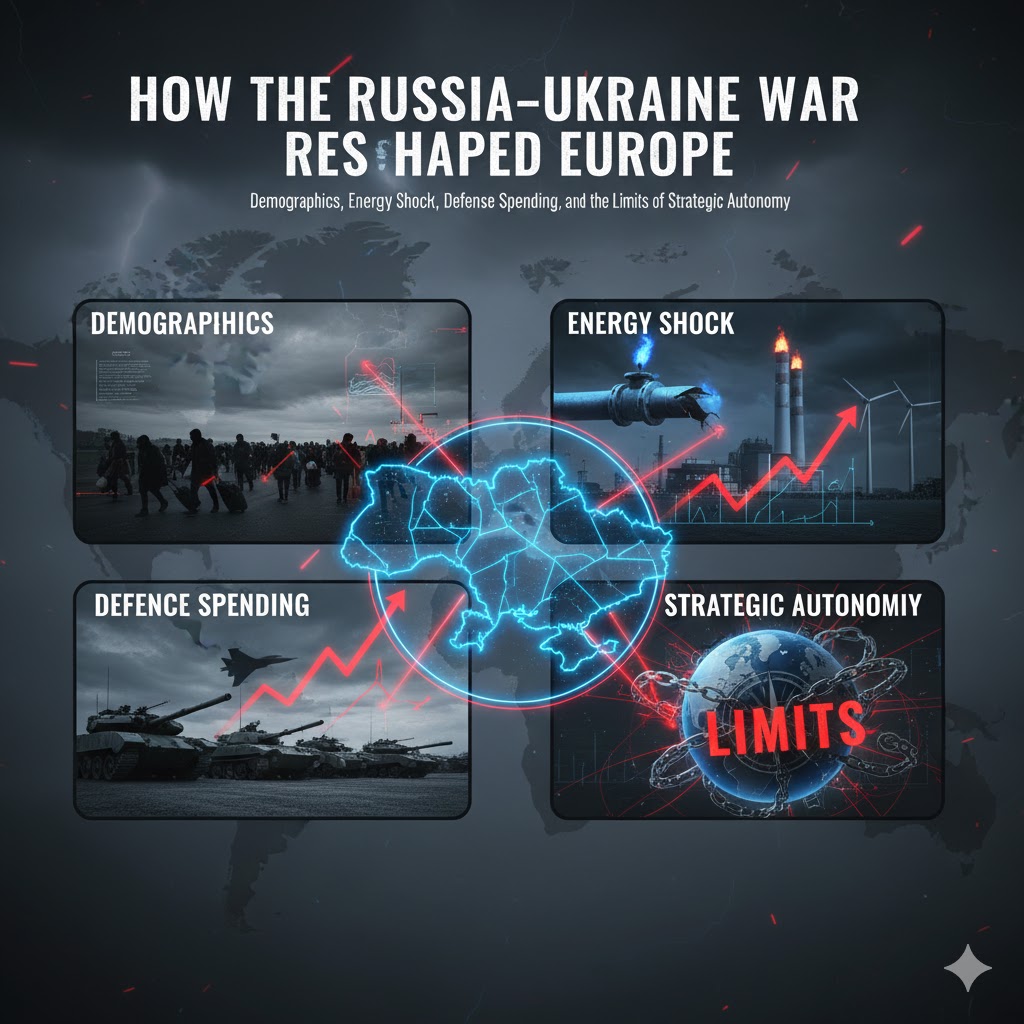
This long essay offers an integrated, evidence-based exploration of whether — and to what extent — the Russia–Ukraine war has functioned as a structural shock to Europe’s economic, demographic, energy, and strategic foundations. It evaluates the hypothesis advanced in prior conversation: that the war, while originating in Eastern Europe, operates as a systemic stressor whose principal harm has fallen on the European project, perhaps even producing conditions from which external powers (notably the United States) profit.
Key, load-bearing factual premises underpinning the analysis are these:
- Europe faces a deep and persistent demographic decline (low fertility, ageing populations) that constrains its labour supply and long-term fiscal space.
- The war has accelerated a profound and costly energy reorientation in which Europe substituted Russian piped gas with seaborne LNG, much of it supplied by the United States — a shift that raised Europe’s fuel import bill and industrial energy costs.
- Military spending across Europe rose sharply after 2022, supporting rapid expansion of defence production and R&D — but also imposing large fiscal burdens and redirecting public resources.
- Internal migration and cross-border labour flows reflect both intra-EU disparities and outward emigration (“brain drain”), worsening demographic pressures in some EU member states.
These facts inform the central questions: Did the war itself act as a mechanism to weaken Europe and increase its dependency on external partners? Has it provided Europe with an economic “escape hatch” (defence industrial order) comparable to the U.S. war-industrial model? What realistic policy options can Europe pursue to reclaim strategic autonomy without sacrificing essential transatlantic ties?
The essay answers these by tracing historical context, unpacking the channels of impact (energy, demographics, industry, finance, politics), comparing strategic incentives, and finally offering scenario-based policy recommendations. Throughout, authoritative sources are cited for the principal empirical claims.
1. Introduction: scope, method and central questions
This essay synthesises empirical datasets, policy reports, and peer-reviewed literature to answer a set of interlinked questions: Has the Russia–Ukraine war structurally damaged Europe beyond the immediate battlefield? Does the war amplify Europe’s demographic and industrial decline in ways that reduce its strategic autonomy? Do external actors — especially the United States — benefit materially and geopolitically from Europe’s damage? Finally, what policy pathways remain available for European recovery and re-autonomisation?
Methodologically, the piece combines descriptive statistics (demographics, trade and energy flows, defence spending), causal tracing (how the war produced economic and political consequences), and scenario analysis. For core factual claims — demographic trends, energy flows, defence budgets — the analysis relies on public institutional sources (Eurostat, IEA/EIA, SIPRI) and reputable journalism (Reuters, Council of the EU reports) for timeliness and attribution. The reader will find citations at the end of critical evidence paragraphs.
2. Pre-war structural vulnerabilities in Europe — demographics, industry and productivity
2.1 Demographic profile: low fertility and aging populations
Long before February 2022 the EU’s demographic trajectory had been cause for policy concern. Total fertility rates across the EU were well below the replacement level (2.1 children per woman) for decades; Eurostat’s interactive demography reports document persistent low TFR values across member states and regional disparities within countries. The pattern is not uniform — some urban and immigrant-dense regions have slightly higher fertility — but the aggregate picture is one of decline and ageing.
The consequences of sustained low fertility are manifold. A shrinking working-age population constrains potential GDP growth; loyalty to generous pension and healthcare systems becomes harder to maintain without either higher taxes or productivity gains; and the ratio of dependents to working citizens deteriorates, increasing fiscal pressure on public budgets. Policy options (pro-natal measures, selective migration, labour market reforms) can mitigate but not instantly reverse such structural shifts.
2.2 Industrial restructuring and productivity slowdown
European manufacturing has been subject to long-term pressures: offshoring to lower-cost countries (particularly in Asia), technological change that unevenly benefits high-skill sectors, and in some cases insufficient investment in next-generation technologies (semiconductors, advanced materials, AI). These trends left parts of the EU’s industrial base vulnerable to energy price shocks and supply-chain disruptions. Declining investment in heavy-industry capital stock and comparatively lower venture capital flows into scale-up tech firms have further constrained Europe’s capacity to pivot quickly into new growth sectors.
In short, the European economy entered 2022 with structural fragilities: demographic headwinds, an industrial base needing modernization, and increasingly tight fiscal space in many members.
3. The energy shock: from Russian pipelines to global LNG markets
3.1 The pre-war energy geometry
Historically, much of continental Europe secured its gas supplies through long-term pipeline deliveries from Russia. These flows offered price stability and—until politics intruded—comparatively low transport costs relative to seaborne LNG. The reliance by countries like Germany, Italy and parts of Central/Eastern Europe on Russian piped gas created an energy-market architecture that was efficient but geopolitically concentrated.
3.2 How the war disrupted supply and pricing
After the invasion, pipeline flows were cut, contracts were disrupted, and confidence in Russian deliveries collapsed in several markets. Europe rapidly reoriented to alternative imports, principally LNG shipped from global suppliers, and significantly increased purchases from the United States. Official summaries and EIA reporting confirm a marked increase in U.S. LNG deliveries to Europe after 2022, with Europe taking an outsized share of global U.S. LNG exports as markets rebalanced.
This adaptation preserved physical supply for most consumers but at a cost. LNG requires liquefaction, marine transport, and regasification at the receiving terminal — steps that raise delivered prices relative to pipeline gas. In the immediate post-invasion period, European wholesale gas and power prices spiked, feeding through to higher industrial energy bills and household heating costs. EU reporting and Council analyses document the sustained impact of elevated energy costs on industry and public finances.
3.3 Strategic implications of the energy pivot
Several implications should be highlighted:
- Higher energy import bill: Seaborne LNG is generally costlier than pipeline gas, increasing import bills and balance-of-payments pressures.
- Shift in dependency: While dependence on Russia declined, dependence on global LNG suppliers (including the U.S.) rose — changing the geopolitical vector of supply risk.
- Industrial competitiveness: Countries with energy-intensive industries (chemicals, steel, fertilizer, glass) face squeezed margins and investment hesitancy.
- Temporary vs structural: Some shifts (e.g., increased LNG capacity) can be reversed or mitigated via renewables, storage, and infrastructure; but building domestic alternative capacity takes years and significant capital.
4. Economic effects: inflation, industrial competitiveness, fiscal trade-offs
4.1 Inflation and the cost-of-living shock
The energy price shock contributed to broad inflationary pressures as the cost of energy fed into manufacturing, services, and food (via fertiliser and transport). Concurrent supply-chain disruptions, pandemic residuals, and monetary normalization policies by central banks compounded the inflationary episode. Households — particularly lower-income groups — experienced real income compression, prompting social and fiscal responses (subsidies, targeted transfers, temporary tax breaks). Many EU governments increased social spending to shield vulnerable populations — a necessary political response that, however, added to public debts already strained by the pandemic. Council reports and EU forecasts document such policy patterns and their fiscal implications.
4.2 Industrial outcomes: closures, relocations, and retooling
Some energy-intensive industrial operations reduced output, delayed capital expenditures, or relocated production to lower-cost environments. Others attempted to adapt via electrification, energy efficiency investments, or temporary production shifts. The net effect is uneven: sectors and firms with strong balance sheets or critical competitive positions retooled; smaller firms and older industrial facilities faced existential challenges.
4.3 Fiscal reallocation: social spending vs defence investment
A notable pattern after the outbreak of war has been diverging fiscal priorities. On one hand, governments augment social protection to buffer households. On the other, many countries significantly increased defence budgets to replenish equipment stocks, build deterrence, and support allied supplies to Ukraine. The European Commission’s economic forecasts and SIPRI’s military expenditure reports show a measurable reallocation of fiscal resources toward defence.
This reallocation presents trade-offs: higher defence spending may stimulate certain industrial clusters and employment, but it also competes with long-term investment in green infrastructure, education, and family support policies that are crucial to addressing structural problems.
5. Defence spending and the emergence of a revitalised European defence industrial base
5.1 The spending surge and industry response
International monitoring organisations recorded an unprecedented rise in military expenditure in Europe from 2022 onward. SIPRI’s 2024/2025 reporting notes that European military spending rose sharply, contributing to a global rise in defence outlays. This translated into immediate demand for munitions, vehicles, air-defence systems, and associated maintenance and logistics — a demand boons defence manufacturers and triggers capacity expansion.
European defence firms — from large integrated systems companies to specialised ammunition and electronics manufacturers — have seen rises in orders. Industry associations reported significant turnover growth in aerospace and defence segments in recent reporting cycles, driven by security-related procurement.
5.2 The economic logic of defence demand
Defence procurement delivers rapid, state-backed revenue streams. For regions where civilian demand lags, weapons procurement can restart idle factories, finance workforce upskilling, and stimulate local supplier networks. In the short term this is economically stimulative — a Keynesian fiscal multiplier in action — but such stimulus is narrowly concentrated in specific industries and raises several questions:
- Is defence spending crowding out more productive civil investment?
- Does armament-led growth produce stable commercial spillovers (dual-use technologies)?
- Are the social and ethical trade-offs acceptable politically and morally?
5.3 Limits compared to the U.S. model
The U.S. economy exhibits a longstanding, deep-rooted military-industrial complex: an integrated network of private defence firms, global supply chains, and continuous demand generated by global commitments. The European context differs:
- European defence markets are more fragmented across states and procurement regimes.
- The scale of U.S. defence procurement, and the size of its domestic market, historically enabled deeper industrial bases and persistent R&D investment.
- Europe’s energy and demographic constraints make a sustained, U.S.-scale war-driven industrial model more difficult to maintain.
Nevertheless, Europe’s reshaped defence investment could produce a durable and technologically advanced defence sector — but at a political cost and with significant budgetary trade-offs.
6. Geopolitical shifts and the transatlantic bargain: dependence, leverage and interests
6.1 The nature of transatlantic interdependence
Transatlantic relations combine security, economic, and normative ties. NATO remains the primary institutional architecture for collective defence among most European democracies. The United States provides military capabilities that most European states cannot or will not replicate in quantity (strategic lift, advanced ISR, nuclear deterrent — where applicable). Yet the energy pivot post-2022 also deepened a kind of economic interdependence: U.S. LNG exports to Europe increased, while Europe’s reliance on American defence supplies or political backing became more visible.
6.2 Does U.S. advantage imply U.S. exploitation?
It is analytically fair to distinguish between strategic advantage and strategic exploitation. The U.S. clearly benefits economically (increased LNG sales, defence exports) and geopolitically (reinforced leadership and influence) from Europe’s vulnerability. However, attributing intentional exploitation — in the sense of deliberately creating or prolonging war to reap economic gains — requires evidence beyond correlation and incentives. Geopolitical competition and national interest mean that states pursue gains where possible; nonetheless, direct causal claims about deliberately provoking or perpetuating conflict are difficult to substantiate with open-source evidence.
A more defensible claim is that the war’s economic side-effects have reinforced U.S. leverage over Europe by making certain European goods and services more dependent on American supply chains and capital — a leverage that the U.S. can and does wield in diplomacy and trade negotiations.
6.3 Europe’s choices within the transatlantic bargain
European governments face a calculus: rely on the security umbrella and economic partnership with the U.S. or attempt an expensive, uncertain path toward more strategic autonomy. The war increased the political salience of autonomy, but delivered shocks (energy, inflation) that make the transition costlier. Thus, the transatlantic relationship has elements of both dependency and mutual interest: EU countries need U.S. security and market access; the U.S. benefits from a secure, wealthy ally; but relative gains and vulnerabilities matter politically.
7. Migration, brain drain and social cohesion — the demographic feedback loop
7.1 Migration flows and intra-EU disparities
Internal EU migration has long reflected economic and wage disparities. High-wage Northern European labour markets attract talent from lower-wage member states. Moreover, outward migration beyond the EU (to North America, Australia, Gulf States) is motivated by wage prospects, regulatory flexibility, and perceptions of opportunity. Reuters reporting and IOM/World Migration materials highlight intra-EU movements and broader brain-drain trends that weaken some national workforces while strengthening others.
7.2 War-related displacement and integration dynamics
The Ukraine refugee flows illustrate that migration can be both a humanitarian challenge and a supply-side opportunity. Large inflows of refugees can replenish labour forces and offset fertility shortfalls, but only if integration (language, credential recognition, employment access) is effective. Political will and administrative capacity are decisive. The story is mixed: some European countries integrated Ukrainian labour well; others offered temporary protection without full labour market integration, limiting long-term demographic gains.
7.3 Demography-economy feedbacks
An ageing society with low births faces a vicious cycle: fewer workers reduce potential output growth, increasing per capita tax burdens for pensions and healthcare, which can depress disposable income and fertility, and encourage further emigration. Breaking the cycle requires coordinated policies: family support, immigration and integration, active labour market policies, and productivity increases via automation and skill development.
8. Did external actors (notably the U.S.) intentionally exploit the crisis? Evidence and limits of that claim
This is a politically fraught and analytically demanding question. The facts justify cautious conclusions:
- The U.S. clearly benefited from increased exports (LNG and defence). Official data confirm a rise in U.S. LNG shipments to Europe after Russia’s pipeline flows declined; U.S. defence firms saw elevated demand linked to European orders and NATO rotor.
- Some U.S. policy choices (sanctions design, energy policy coordination with Europe, diplomatic leverage) had the effect of reducing Russia’s ability to export to certain markets and accelerating Europe’s turn to alternative suppliers. These are policy choices with strategic logic — to weaken an aggressor and deny it resources — rather than clear evidence of a plan to “weaken Europe.”
- Claims that the U.S. intentionally prolonged the conflict to profit materially lack robust direct evidence in the public domain. Benefit does not equal intent; strategic actors often pursue policies that yield both geopolitical and economic advantages, but proving deliberate prolongation for profit would require internal documentation or whistleblower material beyond open-source reporting.
Hence a more defensible analytical stance is that the U.S. acted and acted in ways that advantaged itself while pursuing geopolitical objectives (deterring Russia, defending Ukraine) — and Europe felt the economic pain of that strategic alignment. The result is a transatlantic dynamic where short-term European costs yielded long-term U.S. advantages in markets and leverage.
9. Can Europe become strategically autonomous? Costs, capabilities, and political economy
9.1 What “strategic autonomy” means in practice
Strategic autonomy is a spectrum — from partial autonomy in specific domains (energy, semiconductor supply chains, defence procurement) to full autonomy (independent strategic decision-making across defense, economy and foreign policy). Realistically, the EU aims for domain-specific autonomy initially, especially in defence supply chains, critical minerals and renewable energy scale-up.
9.2 Required capabilities and investments
To materially reduce dependence on external suppliers, Europe needs:
- Energy investments: large-scale renewables, grid integration, energy storage, nuclear where politically feasible, and diversified import arrangements. Building this takes years and heavy capital.
- Industrial policy: targeted subsidies and procurement to build critical sectors (semiconductors, batteries, ammunition, shipbuilding). The EU’s recent industrial strategies and funds reflect movement in this direction.
- Defence consolidation: harmonising procurement, joint R&D and coherent supply chains across member states to achieve economies of scale (and avoid duplication). SIPRI and EU policy commentary highlight both the need and initial moves.
- Human capital and demographic policies: to address labour shortages through family policy, selective migration and skills training.
9.3 Political economy constraints
- Member state heterogeneity: varying threat perceptions, fiscal capacities, and industrial bases complicate collective action.
- Public opinion: sustained public willingness to fund a large permanent uplift in defence or energy investment is uncertain.
- Time horizon: strategic autonomy is multi-decadal; short electoral cycles may undermine continuity.
9.4 Likely trajectory
Partial, sectoral autonomy is the high-probability outcome: Europe will strengthen “resilience” in energy and defence supply chains and lessen some dependencies, but it is unlikely to achieve full substitution of U.S. defence capabilities or global energy markets within a single decade. The EU will probably mix autonomy with continued transatlantic cooperation — a hybrid approach.
10. Would Europe itself “choose” prolonged conflict as a tool for industrial recovery?
Ethically and politically, the idea that democracies intentionally prefer prolonged violent conflict for economic growth is problematic. Practically, however, some economic actors and industrial clusters do benefit from elevated defence spending. This section separates motives, incentives and likely behaviour.
10.1 Incentives for industries and some policymakers
Defence orders provide immediate revenue and jobs, and defence R&D often catalyses civilian spin-offs. Some industrial lobbies and regional economies favour sustained procurement. Policymakers under domestic political pressure to revive manufacturing might find defence spending politically salient.
10.2 Constraints against “seeking” war
- Democratic accountability: Governments face electoral scrutiny and ethical constraints — overtly seeking war would be politically ruinous.
- Broader economic costs: The net macroeconomic effect of war-lengthening on a complex modern economy is ambiguous; broad-based growth driven by durable civil investment is preferable to temporary defence booms.
- Geopolitical risks: Prolonged conflict elevates the risk of escalation, refugee crises, and supply chain disruptions that can harm domestic economies.
10.3 Likely outcome
Rather than deliberately seeking prolonged warfare, European governments are more likely to:
- Emphasise industrial policy that leverages defence orders to build dual-use capabilities.
- Use procurement to re-industrialise certain regions while simultaneously seeking diplomatic solutions to limit the duration of active conflict.
Thus, the incentive structure supports defence-led industrial revitalisation as a by-product — but not as an explicit policy to prolong war.
11. Scenarios for Europe (2025–2045): pathways and inflection points
Below are three stylised scenarios that encapsulate plausible trajectories given current trends and policy choices.
Scenario A — “Resilient Autonomy” (best-case, proactive policy)
Assumptions: sustained EU political will, large public and private investment in renewables and energy storage, successful industrial consolidation, moderate immigration and family-policy success.
Outcomes: Energy costs fall as renewables and storage scale; defence industry matures into a competitive, dual-use high-tech sector; demographic decline partially offset; Europe regains partial strategic autonomy; transatlantic ties remain but less asymmetric.
Policy levers: coordinated EU fiscal effort, joint procurement, industrial incentives for semiconductors and clean energy, integrated migration and family policy.
Scenario B — “Dependent Moderniser” (middle path)
Assumptions: moderate investments; persistent high energy prices for near term; defence spending remains high but uneven across states; partial migration success.
Outcomes: Europe remains economically advanced but more oriented to services and high-value niches; dependence on U.S. energy and defence persists but is managed; inequality rises between prosperous cores and lagging peripheries.
Policy levers: targeted sectoral support, flexible labour mobility, stronger EU industrial funds.
Scenario C — “Fragmentation and Decline” (worst-case, policy failure)
Assumptions: limited fiscal capacity, political fragmentation, insufficient investment in energy and industry, unmanaged demographic decline.
Outcomes: Industrial erosion accelerates, periphery economies stagnate, strategic dependence deepens, populism rises, global geopolitical influence fades.
Policy levers: radical reforms would be required late — but the window for easy corrective action narrows.
12. Policy prescriptions: energy, demography, industry, defence and diplomacy
This section translates the analysis into actionable recommendations for policymakers who wish to preserve European prosperity and autonomy while stabilising the region.
12.1 Energy policy — decouple security from short-term geopolitics
- Accelerate renewables, grid upgrades, and storage deployment (including pumped hydro, batteries).
- Reopen politically feasible nuclear options where public acceptance exists and safety standards are met.
- Invest in energy efficiency (industrial electrification, insulation) to reduce demand.
- Diversify imports (pipeline corridors, LNG suppliers) while negotiating long-term, price-stable contracts to balance short-term shocks.
12.2 Demography and labour markets — a three-pronged approach
- Pro-natal measures: child allowances, parental leave, affordable childcare.
- Managed migration: attract and integrate skilled migrants with clear pathways to permanent residency and credential recognition.
- Active labour market policy: training and re-skilling for digital, green and defence dual-use sectors.
12.3 Industrial strategy — targeted, conditional, and dual-use
- Use procurement to subsidise domestic capacity in critical sectors (semiconductors, batteries, munitions, aerospace), with conditions for technology transfer and civilian application.
- Promote clustering to achieve scale economies and R&D spillovers.
- Encourage public–private partnerships for long-horizon projects.
12.4 Defence and deterrence — smart capability building
- Harmonise procurement to reduce duplication and leverage bulk buying power.
- Prioritise interoperable systems with NATO where strategic deterrence requires it, while developing independent production of critical munitions and defensive systems.
- Invest in resilient logistics and stockpiles to avoid shortages that cause political paralysis.
12.5 Diplomacy and trade — diversify partnerships
- Deepen economic ties with emerging markets (India, parts of Africa, Southeast Asia) to reduce binary dependencies.
- Use trade and investment policy to secure critical supply chains and technology partnerships.
- Reassert multilateral diplomacy to reduce the risk of prolonged conflict.
13. Conclusion: an integrated assessment and the stakes ahead
The Russia–Ukraine war has exposed and intensified structural vulnerabilities in Europe — demographic stagnation, industrial fragility, and energy dependency — while simultaneously catalysing a defence spending surge that provides economic stimulus to certain sectors. The evidence shows that Europe pivoted away from Russian pipeline gas toward global LNG (notably U.S. supplies), that defence budgets rose rapidly, and that demographic pressure and migration remain central constraints to long-term growth and fiscal sustainability.
The political economy is ambiguous: Europe gains some short-term industrial momentum from defence procurement but bears substantial costs from higher energy prices, inflation and social spending. The United States benefits from both increased energy and defence exports — a fact that reinforces U.S. influence — but the claim that the U.S. intentionally prolonged conflict purely for economic gain is not convincingly established by public evidence. What is clear is that strategic incentives aligned so that U.S. gains and European costs coincided.
For Europe, the path forward demands a pragmatic blend: strengthen resilience and autonomy where feasible (energy, critical industries, joint procurement), while maintaining essential transatlantic cooperation for security. Demographic policies, targeted industrial strategy, and a coherent long-term investment plan are necessary to transform short-term defence-led activity into durable economic modernization. Failure to act coherently could consign Europe to a middle-income, dependent equilibrium, undermining its capacity to shape global affairs.
The stakes are high: Europe’s decisions in the next decade will determine whether the war is remembered as a temporary shock that accelerated a modernising shift in policy and industry, or as a turning point that precipitated long-term relative decline. The choice is partly political will, partly resource allocation, and partly the capacity to craft policies that are economically sound and socially legitimate.
14. Appendix: selected primary sources and suggested further reading
(Representative authoritative sources cited in the text; consult these for data and extended analysis.)
- Eurostat, “Demography of Europe – 2024 edition” (fertility and population structure). European Commission
- U.S. Energy Information Administration, “Europe was the main destination for U.S. LNG exports in …” (LNG flows 2022–2023). U.S. Energy Information Administration+1
- SIPRI, “Trends in World Military Expenditure, 2024” (European defence spending surge). SIPRI+1
- Council of the European Union, “Report on energy prices and costs in Europe” (2025). data.consilium.europa.eu
- Reuters, coverage on brain drain and internal EU migration dynamics. Reuters
- U.S. Department of Energy and Energy Department/LNG policy assessments (reports on LNG economics and environmental implications). energy.gov
- Industry reporting: Aerospace and Defence Industries Association of Europe (ASD) turnover data and sector reports.