




Hype and Fraud in India: How Aspiration, Insecurity, and Scale Created a Parallel Economy of Illusions

India is not merely experiencing isolated scams or occasional frauds. It is witnessing the rise of an entire ecosystem where hype replaces trust, speed replaces verification, and aspiration is routinely monetized through illusion. From startups and influencers to politics, spirituality, education, and finance, this article examines how hype and fraud function as a systemic pattern in Indian society — why they flourish, who enables them, and what this reveals about a nation under extreme aspirational pressure.


Read More
Emotional Escape in China: How a Meaning Crisis Is Reshaping Chinese Society and Its Youth

Emotional Escape in China: How a Meaning Crisis Is Reshaping Chinese Society and Its Youth

China’s extraordinary economic rise has created stability, efficiency, and global power — yet beneath this success lies a quiet crisis. As traditional belief systems fade and collective meaning weakens, millions turn to entertainment, drama, fantasy, and digital immersion as emotional escape. This in-depth article examines why emotional escape dominates Chinese society, when it fails, what can replace it without religious language, and how meaningful conversations can realistically begin in China today.

Read More
Why WhatsApp Business Sessions Fail to Auto-Delete After Multiple Logout Attempts: Technical Limitations, Agent-Based Architectures, and Practical Solutions for Developers

Why WhatsApp Business Sessions Fail to Auto-Delete After Multiple Logout Attempts: Technical Limitations, Agent-Based Architectures, and Practical Solutions for Developers

This article explains why WhatsApp Business sessions stop auto-unlinking after multiple deletion attempts, even when using libraries like Baileys. It provides a clear comparison between WhatsApp and WhatsApp Business behavior, explains backend limitations, and presents production-grade solutions for students and developers building WhatsApp automation systems.

Read More
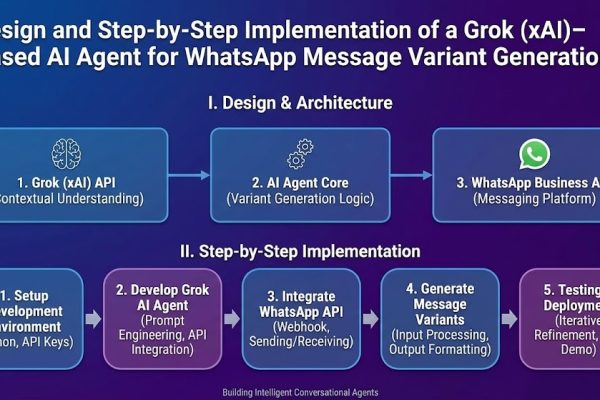
Design and Step-by-Step Implementation of a Grok (xAI)–Based AI Agent for WhatsApp Message Variant Generation

Design and Step-by-Step Implementation of a Grok (xAI)–Based AI Agent for WhatsApp Message Variant Generation

With the increasing use of conversational automation, generating human-like and non-repetitive messages has become a critical challenge, particularly in WhatsApp-based systems where repetitive content may lead to account restrictions. This article presents a step-by-step academic guide for integrating the Grok (xAI) large language model as an AI agent to generate message variants for WhatsApp automation using the Baileys library. The proposed system separates message intelligence from message delivery, ensuring scalability, safety, and maintainability. The guide is intended for students and developers seeking a practical yet conceptually sound approach to AI-driven messaging systems.

Read More